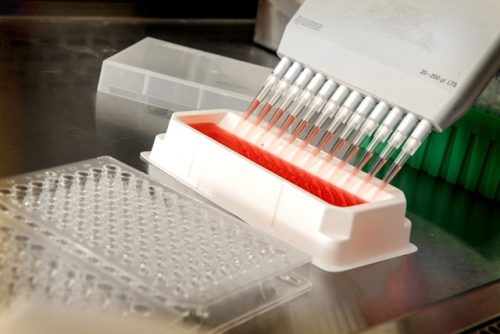
A stable cell line is a population of cells that carries a permanent and heritable genetic modification, such as gene insertion, disruption, or regulation. Unlike transient transfection, this gene modification is stably maintained through multiple cell division. The process of introducing the genetic modification and generating a new cell line or strain is named as stable cell line development or stable cell line generation.
With different gene modifications (insertion, disruption, regulation), different stable cell lines are classified into 5 types of stable cell lines, knockin stable cell line, knockout stable cell line, knockdown stable cell line, overexpression stable cell line, and reporter cell line. These stable cell lines are widely used in the biological research for application including gene localization, gene functional and expression analysis, signaling pathway studies, disease modeling, drug screening and development, drug validation and sensitivity testing, gene therapy development, and bioproduction. The following overview highlights which types of stable cell lines may support your research.
| Type | Gene Modification | Main Applications |
| Knockout | Gene deleted or disrupted (CRISPR/Cas9) | Gene function studies, disease modeling, target validation, pathway analysis |
| Knockdown | Gene expression reduced (stable shRNA) | Studying essential genes, dose-dependent effects, temporary silencing, drug screening |
| Knockin | Targeted insertion at specific locus | Gene tagging, reporter lines, gene replacement, conditional alleles |
| Overexpression | Extra gene copy inserted (random or targeted) | Protein production, gain-of-function studies, drug testing, pathway activation |
| Reporter | Gene fused with reporter (e.g. GFP, luciferase) | Tracking gene expression, live cell imaging, drug screening, promoter activity studies |
Knockin stable cell line is generated by the insertion of gene into a specific target site, usually a host gene. This process can be achieved by homology-directed repair (HDR) using tools like CRISPR/Cas9. The key features of knockin includes targeted insertion, the insertion controlled by endogenous promoter with a physiological expression levels. This type of stable cell lines is widely used as gene/protein tagging and gene replacement for gene/protein function, disease modeling and gene therapy studies.
A knockout stable cell line refers to a cell line in which specific gene has been completely disrupted or deleted to climate its function. Currently, the typical strategy to generate a knockout cell line relies on the introducing small indels by CRISPR-NHEJ, which cause a frameshift mutation. Knockout stable cell lines are widely used in various studies, including:
Knockdown is similar to knockout that both aim to reduce the function of a specific gene; however, unlike knockout, knockdown dose not completely eliminate gene expression but instead reduce it, typically by RNA interference, such as shRNA or siRNA. Knockdown is useful when studying essential genes required for cell survival, or when only a partial loss of function is desired, such as simulating haploinsufficiency or partial gene dysfunction in neurodegenerative or developmental disorders.
An overexpression stable cell line is engineered to introduce and express a specific gene at a higher-than-normal level. The primary purpose of establishing such a cell line is to produce or overexpress a target protein. To achieve this, the gene of interest is typically delivered via a plasmid or integrated cassette driven by a strong exogenous promoter, such as CMV or EF1α. Overexpression is similar to knock-in strategies, but they differ in key aspects. In a knock-in cell line, the gene is inserted at a specific, targeted locus and regulated by an endogenous promoter, resulting in a physiological expression. In contrast, gene insertion in an overexpression cell line is random or episomal, and the expression is driven by a strong exogenous promoter, leading to a high-level expression. Overexpression stable cell lines are widely used in protein production, gain-of-function studies, and disease modeling (such as simulating oncogene activation or the accumulation of toxic proteins).
Reporter cell lines are similar knockin or overexpression stable cell lines; the inserted or overexpressed genes/proteins are reporter genes/proteins, typically fluorescent proteins (FPs), luciferase or their variants. When the reporter gene is inserted at a specific locus, following (downstream of) or within a target gene, it is expressed with the target gene and controlled by native promoter. This enables tagging of the target protein or tracking the endogenous expression of the target gene. For instance, GFP is inserted into OCT4 gene locus in iPSCs to monitor pluripotency status. In contrast, if the reporter gene is inserted randomly with a strong exogenous promoter (such as CMV), the reporter proteins are highly expressed, allowing for sensitive detection in drug screening, cytotoxicity assay, etc. Lentiviral vector or electroporation are usually used to deliver reporter genes to establish reporter cell lines. The development of GFP reporter cell line and luciferase reporter cell line is widely used for biological research.
The reporter cell lines expressing fluorescence proteins are used with techniques such as fluorescence microscopy (e.g. confocal microscopy, live-cell imaging, super-resolution microscopy) and flow cytometry at the single cell level. Fluorescence imaging allows for observation of reporter protein expression and localization of FP-tagged proteins while flow cytometry can detect the populations of cells expressing the reporter, which is useful in drug screening, etc., and the population can also be sorted to establish an enriched pool of fluorescent proteins for the further assays.
The expression of luciferase in the luciferase reporter cell lines can be detected and quantified using bioluminescence assay, that luciferase catalyzes the oxidization process of luciferin with the presence of ATP and emit light. Basically, these cell lines are used in the drug screening and the tracking of gene expression that light intensity are affected by cell viability, gene activity, and pathway modulation. Luciferase activity (light intensity) decreases as cells die in cytotoxicity assay; while it is enhanced or reduced in the pathway assays, depending on the regulation. Moreover, protein-protein interactions are also studied in luciferase reporters cell lines, relying on the assays like bioluminescence resonance energy transfer (BRET). More advanced, luciferase reporter cell lines (cancer cell model) are used with animal models, called in vivo imaging, to monitor tumorigenicity and metastasis. The luciferase expression allows for non-invasive, longitudinal tracking of tumor cells in live animals.
When researchers decide to establish a stable cell line, one of the key questions is how to choose the appropriate host cells/cell lines. The first main factor to consider can be the intended purpose of the stable cell line. For disease modeling, a disease-related cell model is chosen first, such as A549 for respiratory disease studies. For the production of recombinant proteins, HEK293 and CHO cell lines are suitable choices, due to their fast growth, high transfection efficiency, and ability to express proteins with correct post-translational modification. The next consideration is the growth mode of the host cells/cell lines. For commercial use, HEK293 and CHO cell lines may not be the best choice to produce recombinant proteins due to their adherent growth mode, but their variants, HEK293F, HEK293T/17 SF, and CHO-K1 are adapted to suspension growth, which is more suitable for scale-up.
What are the types of stable cell lines?
The main types include knockin, knockout, knockdown, overexpression, and reporter cell lines. Knockin, knockout, knockdown, and overexpression stable cell lines are distinct due to various types of gene modification. Reporter cell lines are classified based on their functions, and they can be generated by knockin or overexpression.
How do I choose an appropriate host cell line for my stable cell line project?
You may follow the instructions in “host cell chosen” section to use the disease-related cell model as host cell line, or HEK293F, HEK293T/17 SF, and CHO-K1 for commercial research and development. For more requirements, you can connect us for inquiry and discussion with our expert team.
What is the difference between knockin and overexpression stable cell lines?
Knockin inserts a sequence at a specific genomic locus, allowing for a natural regulation of inserted elements. Overexpression introduces a gene with a strong promotor; the insertion is random, and the expression level is high regardless of endogenous control.


PCR assay ensures contamination-free research

Swift and dependable shipping to get your orders on time

Affordable solutions without compromising quality

Professional 24/7 support from experienced specialists