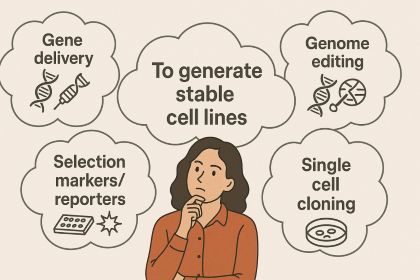
The stable cell line generation involves the process to transfer the exogenous vector into host cell and introduce a genetic modification which is inheritable and consistent across cell generations. This exogenous vector may carry genome editing tools to insert, delete, replace or regulate a target gene, or RNA interference (RNAi) components to silence gene expression. The stable cell line generation process begins with gene delivery using exogenous vector, followed by selection of modified cells, and finally obtains a cell clone. This article introduces four critical points to consider before and during stable cell line generation.
To form an inheritable genetic modification, the integration of the exogenous sequence into host cell genome is required. The gene delivery of stable cell line is not only passing through cell membrane to cytoplasma, but also traveling to nucleus. Typically, gene delivery methods include chemical and viral methods, as well as physical approaches, but not all of them has the ability to delivery deeply into nucleus, and some of them may need help of additional elements.
Chemical methods have long development history, and contains three main systems, lipid, calcium phophates, and cationic polymer. These materials, working as nanocarriers, interact with plasmids to form a complex passing through the cell membrane. Chemical method is typically used for transient transfection as a fast and non-viral method. When generating stable cell lines, the integration efficiency of introduced DNA into the host genome is much lower than viral method. To improve integration efficiency, additional strategies such as linearized plasmids or transposon systems are applied.
Viral methods show high efficiency for gene delivery based on their native invasion mechanisms. The viral vectors, such as retrovirus, HIV (lentivirus), adenovirus, herpes simplex virus (HSV), and poxvirus, are able to enter cells to express both their own viral elements and the introduced transgene in their modified genome using the host’s biosynthetic machinery. Retroviral and lentiviral (HIV-based) vectors are the two typical methods used for stable cell line generation due to their ability to integrate into host genome. In contrast, adenovirus, HSV, and poxvirus vectors used alone have only capacity of transient transfection, and typically used in other fields. Between retroviral and lentiviral vectors, lentiviral vectors are generally preferred, as they are able to transduce both dividing and non-dividing cells, and traditional retroviruses only infect dividing cells. However, the use of lentiviral vector system raises biosafety concerns, as their handing is restricted and requires BSL-2 or higher containment. To address these concerns, researches continually modify the HIV-based lentiviral vector system to improve its safety. A safer lentiviral system (third generation) is developed with several safety features, including separation of viral components into a 4-plasmid packaging system, deletion of accessory and pathogenic genes, a self-inactivating design, and replacement of native envelope protein with VSV-G envelope. Among viral methods, lentiviral vectors are widely used for stable cell line generation due to high efficiency and ability for genome integration.
Physical methods deliver genes into cells by directly penetrating genetic material into cells, including electroporation, microinjection, sonoporation, photopration and biolistics. Electroporation, sonoporation and photoporation induce transient membrane pores by electric impulses, low-frequency ultrasound waves, or a laser beam. Microinjection directly injects genetic materials into cytoplasm or nucleus of single cells by a fine needle puncture. In biolistics delivery (gene gun), nucleotide molecules (DNA or RNA) are firstly coated onto microscopic gold or tungsten particles, and then shot into cells by high-pressure gas or an electric discharge. Most of these physical approaches are effective to deliver genes into single or multiple target cells, reducing the risk of dispersion of transfection/transduction reagents. However, genes in most situation have little chance to pass through nucleus membrane and naked DNA or RNA have risks to be digested by enzymes, resulting in low efficiency into nucleus. Moreover, these methods physically disrupt cell membrane and cause significant cell damage, which may require careful protocol optimization and costly instruments (such as nucleofector). Among physical approaches, microinjection, sonoporation, photoporation, and biolistics are ralely used for stable cell line generation due to low efficiency, low throughout, or technical complexity. In contrast, electroporation is one of most widely used non-viral methods for stable transfection and stable cell line generation, though it requires transposon systems to facilitate genome integration.
Transposon system is used in gene delivery via a “cut-to-paste” mechanism. Transposon is a DNA sequence that can move from one genomic location to another with the help of a transposase enzyme. The transposase can recognize inverted terminal repeats flanking a gene of interest and facilitates the integration into the host genome. Three transposon system are used in mammalian cells, PiggyBac, Sleeping Beauty, and Tol2. Among them, PiggyBac and Sleeping Beauty systems are widely used for stable cell line generation, while Tol2 system is more commonly used in zebrafish and other model organisms. The PiggyBac system has the ability to carry large DNA sequences for integration into active gene regions of host genome, which enables a strong and stable expression. However, this bias may raise biosafety concerns, as integration near oncogenes could increase the risk of insertional mutagenesis. Sleeping beauty is safer due to a more neutral integration profile with less preference for active gene regions. Therefore, PiggyBac system is more preferred for research only projects requiring high expression and large cargo capacity; Sleeping Beauty should be chosen for clinical translation or preclinical gene therapy models due to its safer integration profile.
In stable cell line generation, genome editing is to insert, delete, disrupt, or silence a gene and generated knockin, knockout, knockdown, overexpression stable cell lines.
The insertion of gene could be precise (targeted insertion) and random (transgenic insertion). Precise targeted insertion is avoiding the disruption of the important or target gene and activation of oncogenes and control the inserted gene under natural expression patterns. It enables the applications such as gene tagging to localize and track the target gene, introduction of specific mutations or SNPs for disease modeling, insertion of correct version of a gene for therapeutic research. Transgenic insertion is often used when a fast, simple, and strong expression of a gene is required. The expression is typically driven by a strong exogenous promoter and the integration site is not important. It may cause problems, such as disrupting a gene accidentally or activating oncogenes but this is a less expensive and technically simpler method than targeted insertion. Therefore, it is preferred to be used when the main goal needs high levels of a protein. The gene insertion can generate knockin and overexpression stable cell lines, as well as reporter cell lines.
Both deletion and disruption result in loss of gene function and are used to generate knockout stable cell lines. Gene deletion means completely removing gene regions (such as coding sequence or regulatory elements), leading to the full loss of gene. Gene disruption relies on frameshift mutation or nonsense point mutation to abolish the gene function, which is fast and simple achieved by CRISPR system. CRISPR-based methods are widely used in gene deletion and disruption to generate knockout stable cell lines. It can cut at the two ends of the gene to delete the gene, insert or delete bases to shift the reading frame, or convert one base to another to form a stop codon. Although both approaches are used for knockout stable cell line generation, they are applied in different situations: disrupting a gene when a fast and simple knockout is required; deleting a gene when requiring completing loss, including isoforms or regulatory sequences.
Gene silence is used to generate knockdown stable cell line whenlong-term repression of a gene of interest is required. Knockdown is typically achieved by overexpressing short hairpin RNA (shRNA) or small interfering RNA (siRNA). To generate a knockdown stable cell line, a DNA sequence encoding shRNA is integrated into the host genome, usually via lentiviral vectors or transposon systems like PiggyBac. The sequence is transcribed and processed by the cell’s RNA interference machinery (Dicer enzyme) into siRNA. This siRNA is a part of RNA-induced silencing complex (RISC), which guides the selective degradation or repression of target gene RNA, leading reduced expression. In knockdown stable cell line, the expression of the target gene is not completely eliminated, and some residual expression remains. However, shRNA-mediated knockdown generates highly uniform silencing of treated cells, whereas knockout strategy may face the challenge that not all gene copies are deleted, requiring additional screening and identifying.
Typically, the sequences encoding antibiotic resistance and reporter markers are co-introduce with the gene of interests (GOI), (even for knockout, for example, the Cas gene is delivered,) for the further selection and identification of modified cells.
The antibiotic resistance gene is located near the GOI and typically co-expressed with it. Based on this, to ensure the expression of GOI in modified cells, cells are cultured in medium containing corresponding antibiotic after transfection or transduction. Only the cells with successful integration of the construct can survive and proliferate. Commonly used resistance genes include neomycin phosphotransferase (neo) for G418 (Geneticin), puromycin-N-acetyl-transferase (pac) for Puromycin, and blasticidin S deaminase (bsd) for Blasticidin. This antibiotic selection process enriches for a pure population of stably modified cells.
Reporter genes provide a visual or quatififiable readout of successfully modified cells. These reporter genes include fluorescent proteins (such as GFP, RFP, YFP, etc.) and luciferase. Lucifease is used to measure the transfection efficiency; while fluorescent proteins direct visualization of gene expression under a microscope and enable cell sorting via flow cytometry.
In the construction for stable cell line generation, a vector is used to deliver not only gene of interest, but also a resistance gene and a reporter gene. The combination of antibiotic selection and reporter-based identification ensures efficient and accurate generation of stable cell lines.
When generating stable cell lines, the goal is to obtain a homogenous population of cells carrying the consistent and reproducible genetic modification. It means this homogenous population is growing from a single progenitor cells. The involved process to form single-cell-derived colonies is called sing cell cloning. Transfected/transduced cells are selected to removed unmodified cells and enrich modified cells for single cell isolation and low density plating, enabling the growths of single-cell-derived colonies.
There are mainly four methods to enrich modified cells: antibiotic selection, fluorescence-activated cell sorting (FACS), magnetic-activated cell sorting (MACS), metabolic selection. Antibiotic selection enriches cells rely on the killing of unmodified cells and allowing stably modified cells integrated with antibiotic resistance genes to survive. A killing curve using corresponding antibiotic is recommended to establish before killing to ensure a high selection efficacy with apposite dose and time. FACS enrichment typically works with fluorescent markers to select modified cells. It can not only separate positive and negative cells, but also pick up based on the expression level (fluorescence intensity). In MACS, cells expressing specific surface marker link to corresponding antibodies conjugated to magnetic beads and are enriched under magnetic field. Metabolic selection is similar to antibiotic selections, that chemicals select modified cells relying on metabolic selection genes. Among the above methods, antibiotic selection is simplest, FACS are most precise, MACS has less precise but high throughout than FACS, while metabolic selection is suitable for some specific cell lines.
To derive single cell colonies from enriched populations, two strategies are mainly used, direct single-cell isolation and low-density plating. Direct single-cell isolation, such as limited dilution and FACS, picks up single cells and seed them at 96- or 384 –well plates, at a density of 0.5-1 cell per well, ensuring the growing of homogeneous colonies in each well. In contrast, low-density plating culture several cells in one dish either in semi-solid medium or adherent cell culture that allowing for spatially separated colonies to form, typically derived from a single cell.
After colony formation, the genetic modification and reporters in each colony are detected for identifying the modification. Methods, such as FACS, PCR. qPCR, Sanger sequencing, functional assay, etc. are common methods to analyze expression level of reporters and GOI, and identify the uniformity of cell population. These may be the final points to be considered, how to validate the generated stable cell lines.
What is the difference between transient transfection and stable transfection?
Transient transfection allows cells to temporarily express the introduced gene, but this expression is lost over time or with cell division. In contrast, stable transfection allows for integration of the transgene into the host genome, resulting in long-term and heritable expression across cell generations.
Can non-viral transfection methods be used to generate stable cell lines?
Yes. Although non-viral methods alone typically do not support genomic integration, they can be used with transposon systems (e.g., PiggyBac, Sleeping Beauty) to enable genomic integration for dividing cells, resulting in stable expression to generate stable cell lines.
Is single cell cloning necessary for stable cell line development and why?
Yes, single cell cloning is significant for stable cell line development. While cells are transfected or transduced together, the characteristics, such as integration site, gene copy number, expression level, etc. can vary. A homogenous colony derived from a single cell is the base of consistent and reproducible results.
What are common markers for selection and identification of successfully modified cells?
The common selection markers and reporters include antibiotic resistance genes (Neo, Puro, Bsd, etc.) and reporters like GFP or luciferase.


PCR assay ensures contamination-free research

Swift and dependable shipping to get your orders on time

Affordable solutions without compromising quality

Professional 24/7 support from experienced specialists