The following workflow presents the overview of cell line development using the lentiviral system:
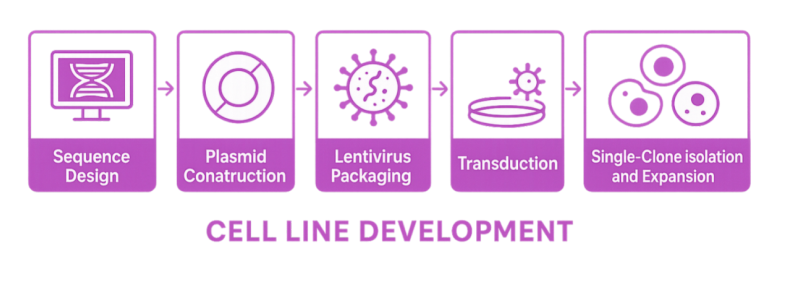
Sequence Design
Careful sequence design is critical for successful cell engineering. This process starts with obtaining the cDNA sequence of the target gene or protein from reliable sources such as BLAST (NCBI) and UniProt. Next, codon optimization is performed to enhance translation efficiency in the chosen cell line. This is followed by the selection of an appropriate plasmid backbone, taking into account factors like promoter strength, selection markers, and host compatibility. Restriction sites, linkers, or tags are also considered as elements incorporated into the design to facilitate cloning and downstream applications. Together, these steps form a comprehensive strategy for gene synthesis and vector construction.
Plasmid Construction
After sequence design, the next crucial phase is plasmid construction, which brings the designed sequence into a workable form for cell engineering. This process begins with obtaining the insert fragment(s), either through gene synthesis or PCR amplification from genomic cDNA. Meanwhile, the chosen plasmid backbone is linearized to prepare for insertion. Using seamless cloning or restriction enzyme cloning, the insert is integrated into the plasmid vector. Successful assembly is then verified by gel electrophoresis to confirm fragment sizes, followed by Sanger sequencing to validate the accuracy and integrity of the construct. This workflow ensures that the designed gene is precisely incorporated into a vector ready for downstream applications.
Viral Packaging
The lentiviral system is widely used for gene delivery into cells, especially when long-term and stable gene expression is needed. In the third generation lentiviral packaging system, the transfer plasmid carrying the gene of interest (GOI) is co-transfected with packaging plasmids and envelope plasmids into HEK293T cells. After 48 hours of incubation, the supernatant is collected, centrifuged to remove cell debris, and then filtered to ensure sterility. To increase viral concentration, polyethylene glycol (PEG) precipitation is employed. The titer of lentiviral particles is determined by qPCR. If further purification is required, sucrose gradient ultracentrifugation can be used to obtain ultra-purified lentiviral particles for downstream applications such as transduction of primary cells or in vivo delivery. Our lentiviral system is suitable for packaging gene overexpression vectors, chimeric antigen receptor (CAR) expression constructs, guide RNA expression vectors, and short hairpin RNA expression vectors with reporter genes.
Transduction
Transduction (or viral-mediated gene delivery) is the critical step following lentiviral packaging. Engineered viral particles infect target cells and deliver GOI into the host genome. Unlike transient transfection, transduction leverages the natural ability of viruses to efficiently introduce genetic material into various cells, including both dividing and non-dividing cells. This process ensures stable genomic integration of the transgene and long-term expression or modification.
Antibiotic Resistance Selection
Following transduction, antibiotic resistance selection is the next step, used to eliminate untransduced cells. This process relies on the inclusion of a selection marker (e.g., puromycin resistance, neomycin resistance), encoded within the viral vector. A killing curve is first established by treating parental cells with varying antibiotic concentrations to determine the minimum dose that kills >95% of cells within 3–7 days. This optimized dose is then applied to transduced cells, ensuring that only cells harboring integrated resistance genes survive, forming a pooled population of stably engineered cells.
Single-Clone Isolation and Expansion
Single-clone isolation is achieved through limiting dilution, typically plating cells at 0.5 cell/well or lower in a 96-well plate to statistically ensure clonality. After plating, wells are carefully monitored to confirm the presence of a single cell. Once single clones begin to expand, they are gradually transferred to larger culture vessels for further growth.






