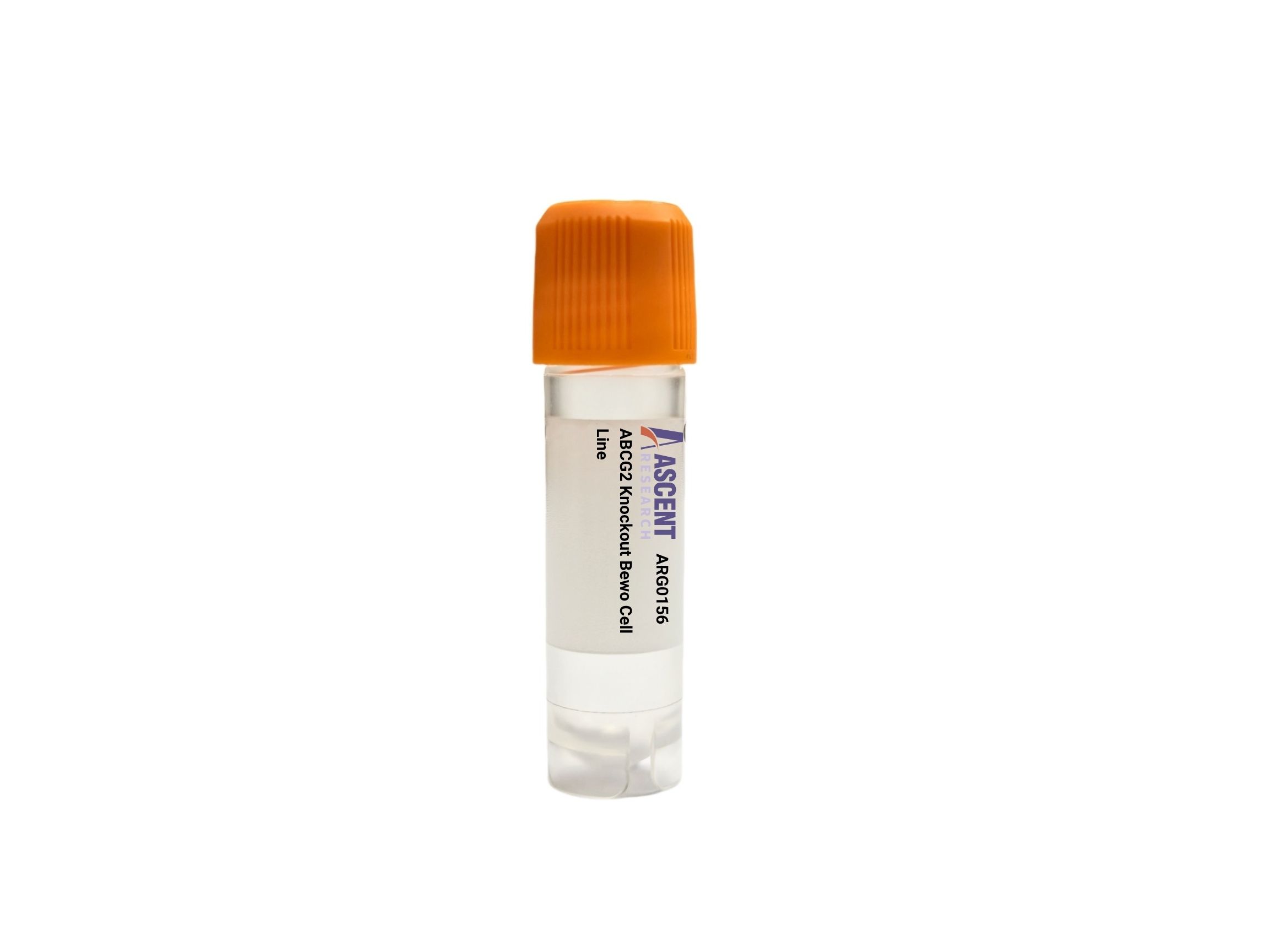
The ABCG2 Knockout Bewo Cell Line is a human CRISPR/Cas9-engineered gene knockout model in which ABCG2 has been disrupted in the BeWo host background, resulting in loss of functional ABCG2/BCRP expression. This stable in vitro cell line is generated in a placental choriocarcinoma-derived trophoblast-like cell context that is widely used for mechanistic studies of epithelial barrier transport and xenobiotic handling. The model is intended for investigators examining ATP-dependent efflux systems, placental transport processes, and cellular responses to transporter loss in a human trophoblast-relevant setting.
BeWo cells are a well-established human placental trophoblast-like model derived from choriocarcinoma and are broadly used to study placental barrier biology, trophoblast differentiation, syncytialization, and transplacental drug movement. Their experimental utility lies in their ability to recapitulate key features of trophoblast transport physiology while remaining amenable to routine molecular and pharmacological manipulation. As a result, BeWo cells are frequently used in studies of maternal-fetal exchange, fetal exposure risk assessment, and mechanisms controlling movement of endogenous metabolites and xenobiotics across the placental interface.
ABCG2 encodes the breast cancer resistance protein, an apically localized ATP-binding cassette transporter that mediates efflux of structurally diverse substrates, including topotecan, mitoxantrone, doxorubicin, SN-38, methotrexate, and pheophorbide A, and also contributes to urate transport. ABCG2 functions within ABC transporter-mediated transmembrane transport and multidrug resistance networks, alongside related transporters such as ABCB1/P-gp and ABCC1/MRP1. Its expression is transcriptionally regulated by factors including HIF1A, AHR-ARNT, ESR1, PPARG, NFE2L2, and SP1, and is responsive to hypoxia, estrogen, progesterone, and xenobiotic exposure. At the protein level, ABCG2 interacts with membrane lipid microdomains, PDZ domain-associated scaffold proteins, HSP90, and ubiquitin-proteasome machinery that influence transporter localization, stability, and turnover. Through these mechanisms, ABCG2 limits intracellular substrate accumulation and modulates cytotoxic drug sensitivity, processes relevant to altered drug disposition, placental drug transfer, fetal exposure toxicology, gout and hyperuricemia, and porphyrin-related disorders.
In the BeWo background, loss of ABCG2 provides a tractable model for defining the specific contribution of BCRP to trophoblast barrier function. Because BeWo cells are used to model transplacental transport, disruption of this apical efflux transporter enables direct interrogation of how ABCG2 constrains intracellular xenobiotic levels and influences transcellular transfer of substrate compounds. The model is also useful for studying compensatory relationships with ABCB1 or ABCC family transporters and for assessing how upstream regulators such as hypoxia-responsive HIF1A or xenobiotic-responsive AHR signaling affect transporter network behavior in the absence of ABCG2.
This knockout cell line supports experimental workflows including western blotting, RT-qPCR, RNA-seq, immunofluorescence, and flow cytometry for evaluation of transporter expression and broader transcriptional adaptation. Functional applications include drug accumulation assays, efflux studies using pheophorbide A or Hoechst 33342, LC-MS-based substrate transport analysis, transwell transport experiments for placental transfer modeling, and drug sensitivity studies with canonical ABCG2 substrates such as topotecan or mitoxantrone. It is suitable for transporter-substrate identification, mechanistic analysis of multidrug resistance, evaluation of xenobiotic detoxification pathways, and comparative studies of trophoblast barrier biology under hormonal, hypoxic, or xenobiotic stimulation conditions. Researchers may contact Ascent Research for additional technical information, product details, or related gene-edited cell models.