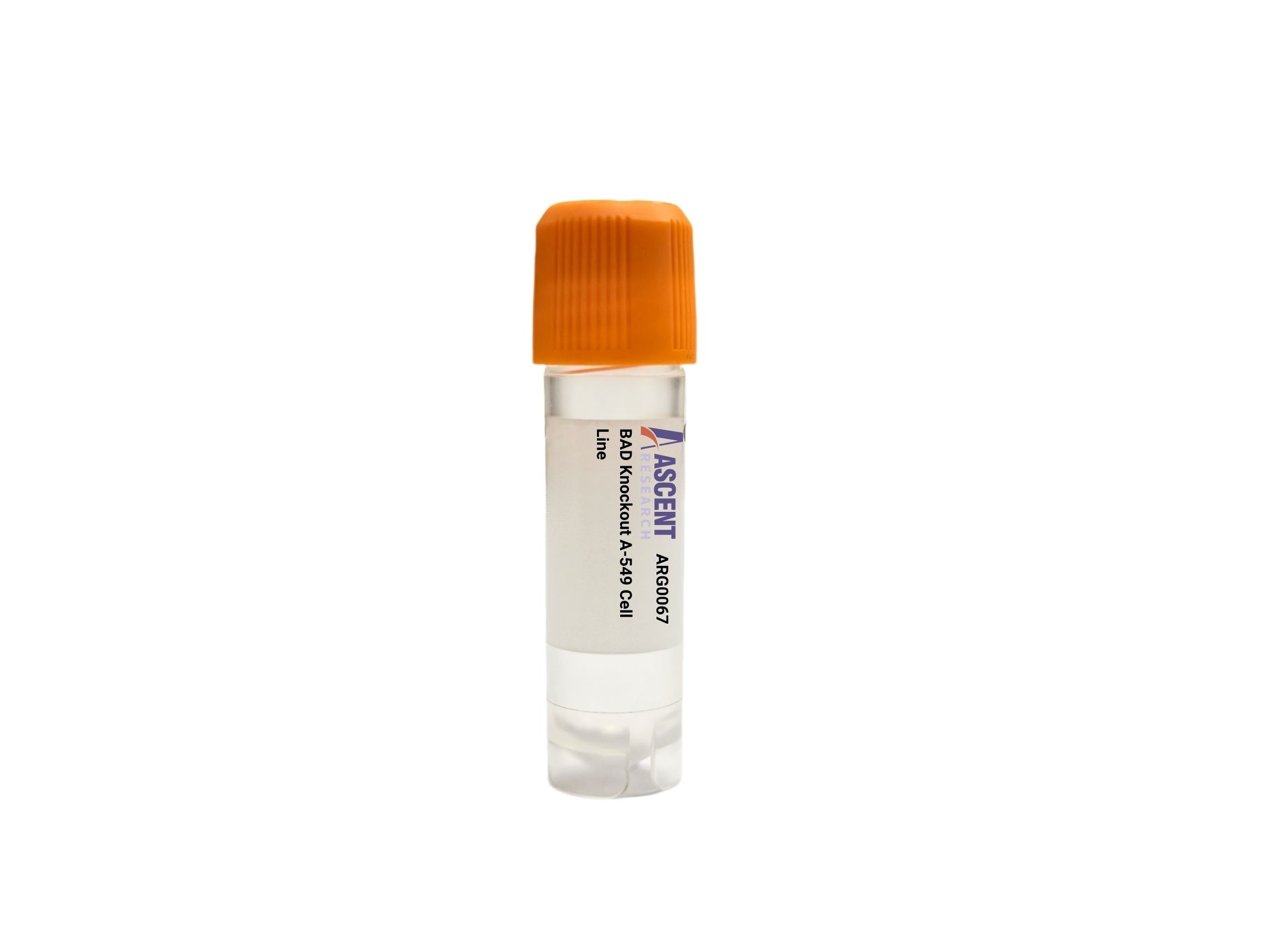
BAD Knockout A-549 Cell Line is a CRISPR/Cas9-engineered human cell model in which the BAD gene has been disrupted to eliminate functional BAD expression in the A-549 background. This stable knockout line is generated in a human lung adenocarcinoma epithelial cell line and provides a defined in vitro system for studying loss of a pro-apoptotic BH3-only BCL-2 family regulator in cancer cells. The model is suited for mechanistic investigation of mitochondrial apoptosis, survival signaling, and treatment response in a lung tumor cell context.
A-549 is a well-established human non-small cell lung adenocarcinoma cell line with epithelial and alveolar epithelial-like features. It is widely used to study lung cancer cell survival, apoptosis regulation, stress adaptation, and pharmacologic response because it recapitulates important aspects of epithelial tumor biology in a tractable in vitro format. In biomedical research, A-549 cells are commonly applied to examine oncogenic signaling, cell death control, and therapeutic sensitivity, making this host background relevant for studies of apoptosis resistance and tumor cell persistence.
BAD functions within the intrinsic apoptosis pathway as a BH3-only protein that promotes mitochondrial cell death by binding and antagonizing anti-apoptotic factors including BCL2 and BCL2L1/BCL-xL. Through this activity, BAD acts upstream of BAX and BAK1 activation, mitochondrial outer membrane permeabilization, cytochrome c release, APAF1-dependent apoptosome signaling, and subsequent CASP9 and CASP3 activation. Its pro-apoptotic function is negatively regulated by phosphorylation mediated by survival kinases such as AKT1, PRKACA/PKA, and RPS6KA1/RSK1, which promotes association with 14-3-3 proteins including YWHAB and YWHAZ and suppresses mitochondrial death signaling. Accordingly, BAD integrates signals downstream of growth factors, EGFR signaling, insulin/IGF pathways, and survival cytokines, linking PI3K-AKT, MAPK/ERK-RSK, and PKA-mediated signaling to BCL-2 family network control.
In the A-549 context, BAD knockout enables interrogation of how loss of a mitochondrial apoptosis sensitizer alters survival signaling dependencies in lung adenocarcinoma cells. This is particularly relevant for studying apoptosis resistance, stress-response signaling, and the balance among BAD, BCL2L1, MCL1, BAX, BAK1, BID, and BIM/BCL2L11 under basal conditions or after pharmacologic perturbation. The model can support analyses of pathway compensation, altered phospho-signaling states, and gene-expression changes associated with reduced apoptotic priming in NSCLC-related systems.
This cell line is suitable for apoptosis and survival pathway studies using annexin V/propidium iodide staining, flow cytometry-based cell death assays, caspase-3/7 activity measurements, mitochondrial membrane potential assays, and cytochrome c release experiments. It can also be used in western blotting, RT-qPCR, RNA-seq, immunofluorescence, and co-immunoprecipitation workflows to examine BCL-2 family interactions, phospho-BAD pathway regulation, and downstream caspase signaling. In drug response studies, the model is applicable to cell viability assays and combination treatment designs aimed at evaluating sensitivity to targeted agents, stress-inducing compounds, or apoptosis-modulating therapeutics in lung cancer cells. Researchers may contact Ascent Research for additional technical information, product details, or related gene-edited cell models.