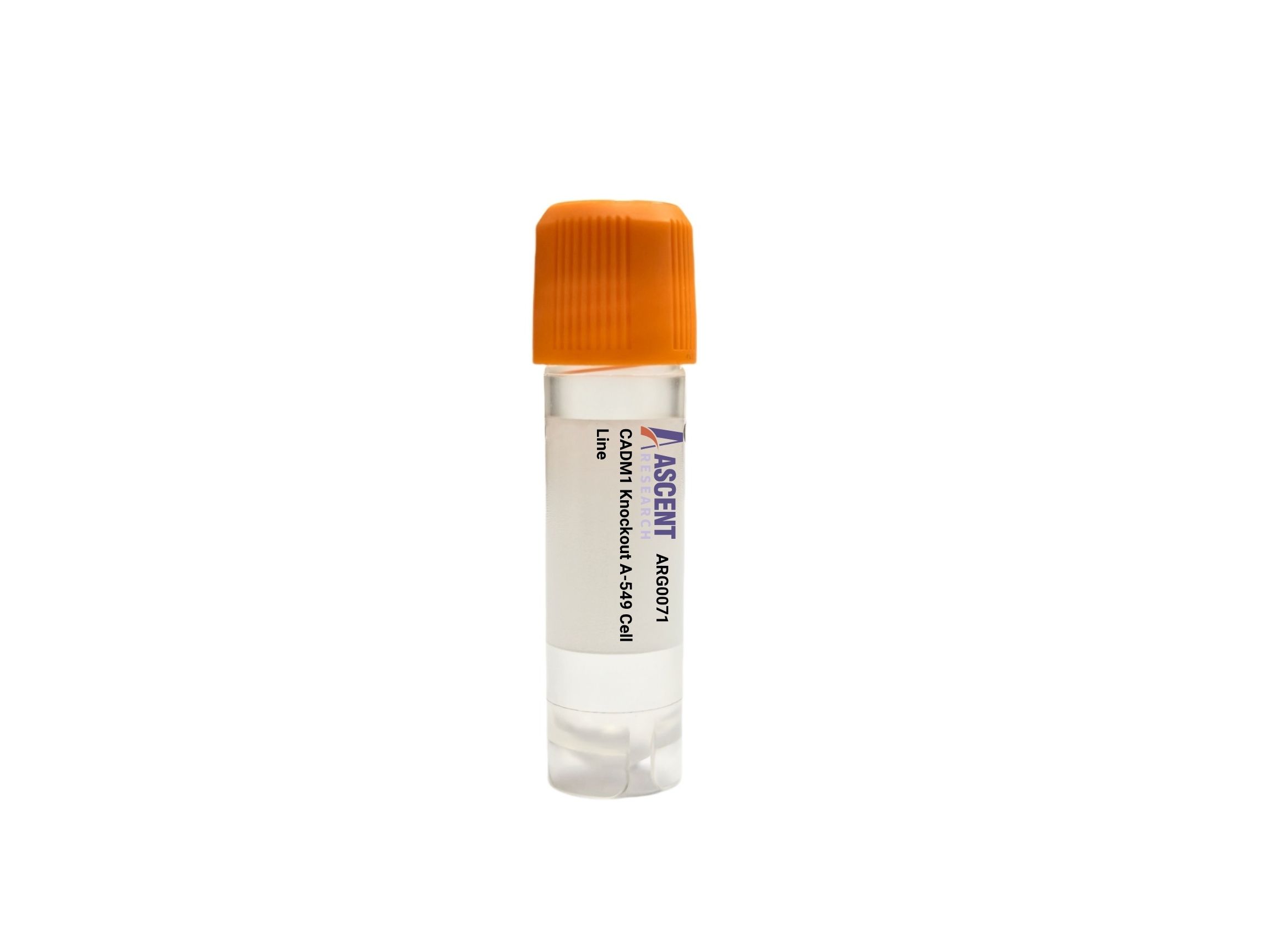
The CADM1 Knockout A-549 Cell Line is a human CRISPR/Cas9-engineered cell model in which the CADM1 gene has been disrupted to eliminate functional CADM1 expression. This stable knockout line is generated in A-549 cells, a human alveolar basal epithelial adenocarcinoma cell line, and provides an in vitro system for investigating the consequences of CADM1 loss in a lung epithelial tumor context. Because CADM1 encodes a membrane-associated immunoglobulin superfamily adhesion molecule, this model is particularly relevant for studies examining cell-cell contact regulation, epithelial organization, and signaling responses linked to junction integrity.
A-549 cells are derived from human lung adenocarcinoma and display alveolar type II-like epithelial features, making them a widely used model for lung cancer biology, epithelial differentiation, and responses to growth factors, infection, and anticancer agents. In experimental settings, A-549 cells are commonly used to study carcinoma-associated changes in adhesion, proliferative signaling, barrier-related properties, and therapeutic sensitivity. Their utility as a barrier-forming epithelial model makes them well suited for evaluating how perturbation of adhesion molecules influences epithelial behavior, contact inhibition, and disease-relevant phenotypes in non-small cell lung cancer and lung adenocarcinoma research.
CADM1 mediates homophilic and heterophilic cell-cell adhesion and contributes to epithelial polarity, adherens junction organization, and growth-suppressive signaling. Its expression is regulated by epithelial differentiation state, promoter DNA methylation, TGF-beta signaling, and EMT-associated transcription factors including SNAI1, SNAI2, and ZEB1, which repress epithelial gene programs during transition toward invasive states. At the membrane cortex, CADM1 interacts with DAL-1/EPB41L3, PALS2/MPP6, TIAM1, CRTAM, MAGUK-associated scaffold proteins, and actin-associated cortical proteins, linking adhesion complexes to cytoskeletal architecture. Through these interactions, CADM1 acts upstream of cell-cell adhesion strength, contact inhibition, YAP1 and TAZ/WWTR1 subcellular localization within the Hippo pathway, and signaling outputs involving AKT1 and ERK1/MAPK3-ERK2/MAPK1. Functional loss of CADM1 can therefore alter LATS1/LATS2-dependent growth control, perturb CDH1 and CTNNB1-associated junctional organization, and promote cytoskeletal remodeling, migration, and invasion phenotypes relevant to cancer progression.
In the A-549 background, CADM1 knockout provides a useful system for defining how epithelial adhesion loss reshapes oncogenic signaling and carcinoma cell behavior. This context is valuable for mechanistic studies of tumor invasion, epithelial-mesenchymal transition, and contact-dependent growth suppression, as well as for examining how altered junctional organization influences sensitivity to extracellular cues and therapeutic perturbation.
This cell line can be applied in western blotting and phospho-signaling analyses to quantify changes in AKT and ERK1/2 activation, in immunofluorescence assays to assess YAP1 localization, CDH1 distribution, and actin cytoskeleton architecture, and in RT-qPCR or RNA-seq workflows to profile EMT-associated transcriptional changes. It is also suitable for co-immunoprecipitation studies of CADM1-associated junctional complexes, flow cytometry-based phenotyping, cell proliferation and apoptosis assays, migration and invasion assays, spheroid formation experiments, and drug sensitivity studies designed to test pathway dependencies created by adhesion loss. Researchers may contact Ascent Research for additional technical information, product details, or related gene-edited cell models.