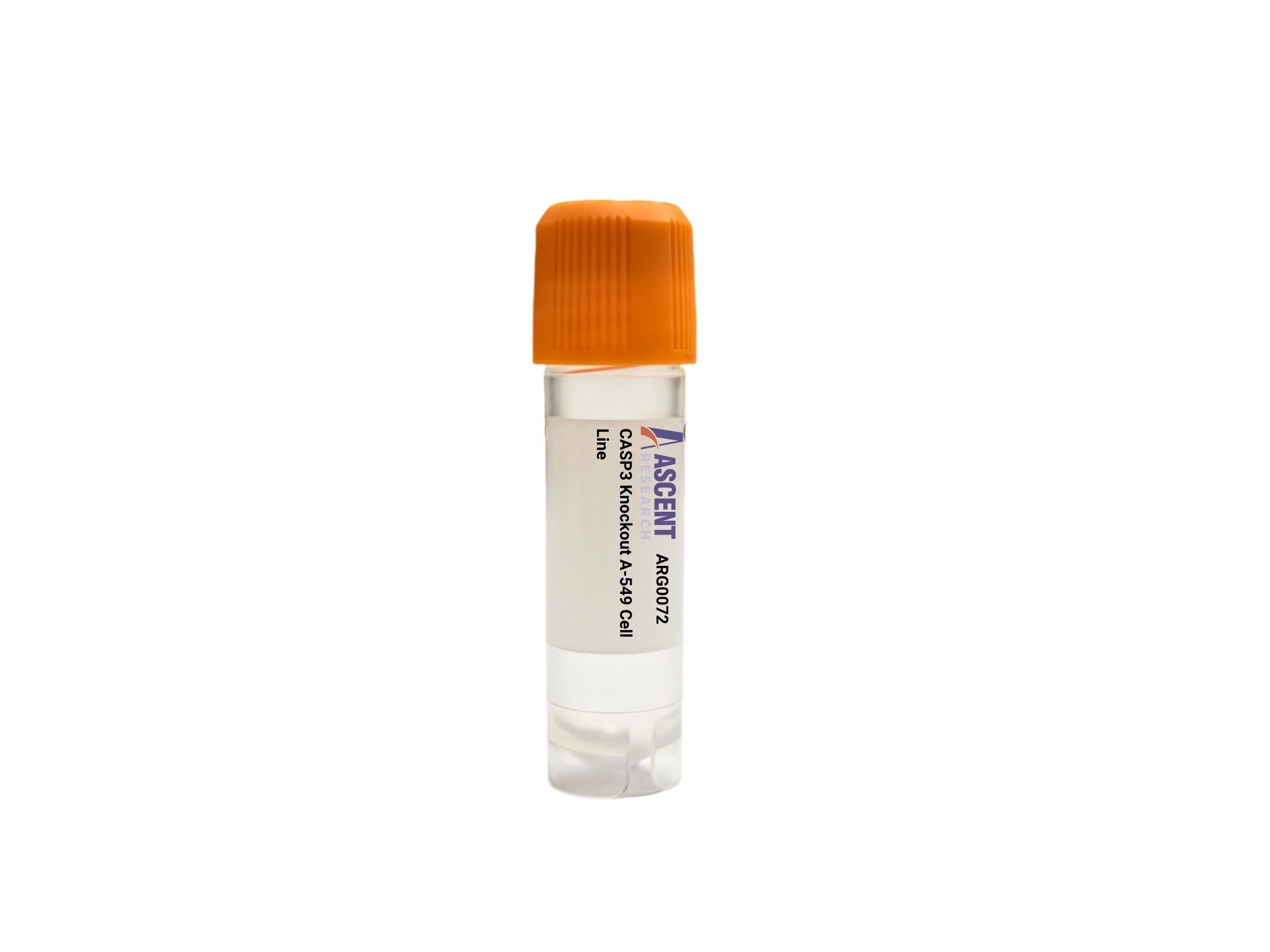
The CASP3 Knockout A-549 Cell Line is a CRISPR/Cas9-engineered human cell model in which the CASP3 gene has been disrupted to eliminate functional caspase-3 expression. This stable knockout line is generated in the A-549 background, a human alveolar epithelial adenocarcinoma cell line, and provides an in vitro system for studying execution-phase apoptosis, stress-induced cytotoxicity, and therapeutic response in a lung cancer-relevant epithelial context. The model is suited for mechanistic interrogation of apoptosis signaling and for comparative studies against parental or matched control A-549 cells under defined perturbation conditions.
A-549 cells are derived from human lung adenocarcinoma and are widely used as an alveolar type II-like airway epithelial model. Their utility spans pulmonary carcinoma biology, epithelial barrier-associated processes, oxidative stress responses, and anticancer drug testing. Because A-549 cells retain broad relevance to lung epithelial tumor biology while remaining experimentally tractable in standard molecular and cell biology workflows, they are frequently used to study signaling responses to chemotherapy, radiation, and pro-apoptotic stimuli. In this setting, gene-edited derivatives can be used to isolate the contribution of individual pathway nodes to epithelial tumor cell survival and death phenotypes.
CASP3 encodes caspase-3, a terminal effector cysteine protease activated downstream of initiator caspases in both extrinsic and intrinsic apoptosis pathways. Caspase-3 functions downstream of FAS/FASLG- and TNFRSF10A/DR4- or TNFRSF10B/DR5-mediated death receptor signaling through FADD and CASP8, and downstream of mitochondrial outer membrane permeabilization regulated by BAX, BAK1, BCL2 family proteins, cytochrome c, APAF1, and CASP9. Once activated, caspase-3 cleaves canonical substrates including PARP1, ICAD to release DFFB/CAD, ROCK1, gelsolin, and lamins, thereby promoting chromatin condensation, DNA fragmentation, cytoskeletal remodeling, and apoptotic body formation. CASP3 also interacts functionally with CASP7, CASP8, CASP9, XIAP, survivin/BIRC5, cIAP1/BIRC2, cIAP2/BIRC3, and SMAC/DIABLO, placing it within a tightly regulated proteolytic network relevant to apoptosis resistance and treatment sensitivity.
Loss of CASP3 in A-549 cells provides a relevant model for examining how executioner caspase deficiency modifies lung adenocarcinoma cell responses to genotoxic stress, TP53-linked damage signaling, death receptor agonism, and chemotherapy-induced cell death. In an epithelial cancer background commonly used for drug-response studies, CASP3 disruption enables investigation of reduced substrate cleavage, altered terminal apoptotic morphology, pathway compensation by CASP7 or inhibitor of apoptosis proteins, and shifts in cell fate decisions following cytotoxic challenge.
This knockout line can be applied in western blot analysis of PARP1 cleavage and apoptosis-associated substrate processing, annexin V and flow cytometry-based death profiling, caspase-3/7 activity measurements, TUNEL assays, immunofluorescence of nuclear and cytoskeletal changes, and mitochondrial membrane potential assays to distinguish upstream mitochondrial signaling from downstream execution defects. It is also useful for RT-qPCR and RNA-seq studies of stress-response transcriptional programs, cell viability and clonogenic survival assays following chemotherapy or irradiation, co-immunoprecipitation studies of apoptosis regulators, and combination treatment experiments designed to define dependencies on death receptor signaling, mitochondrial apoptosis, or IAP-mediated restraint of caspase activation. Researchers may contact Ascent Research for additional technical information, product details, or related gene-edited cell models.