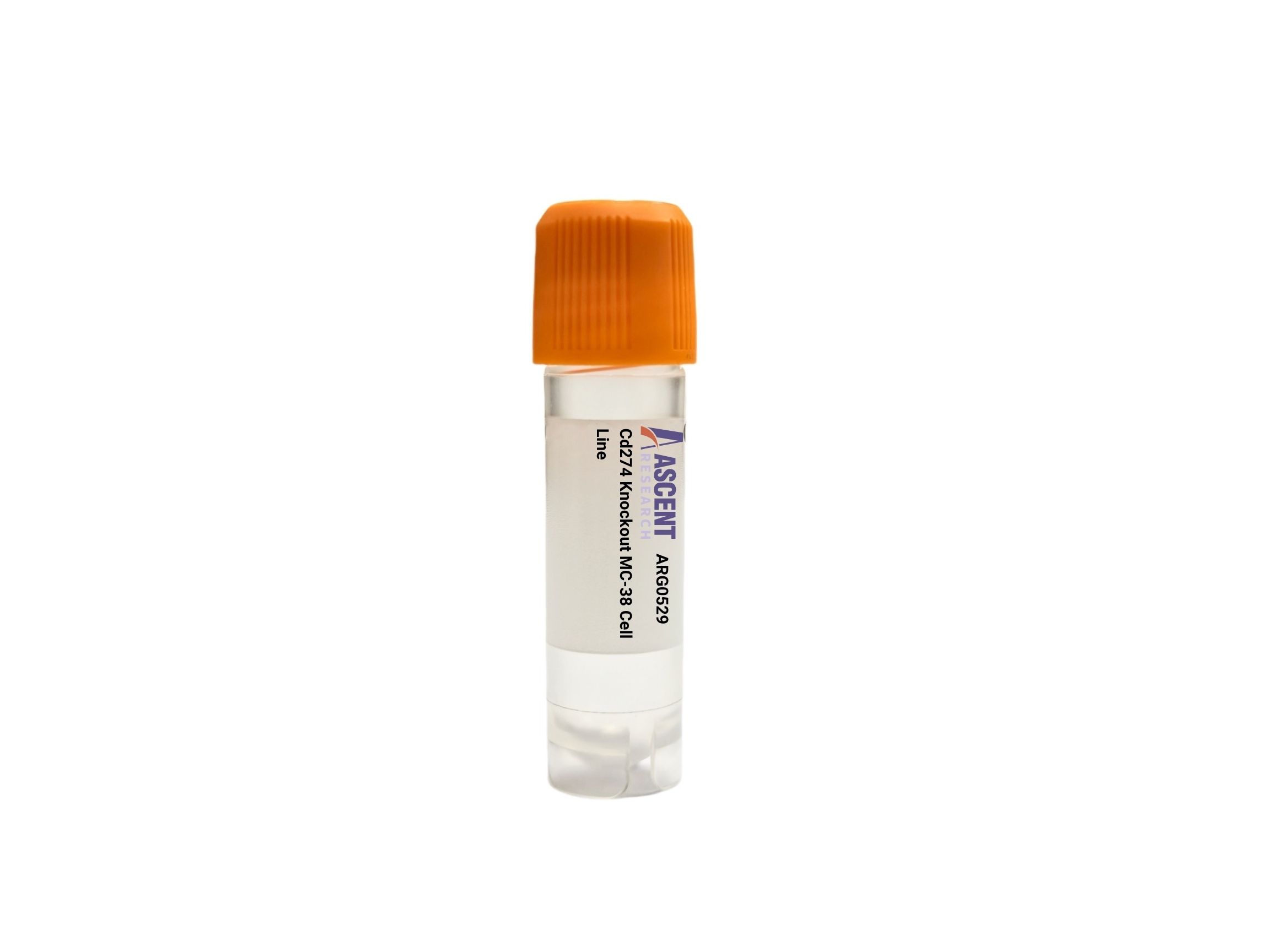
The Cd274 Knockout MC-38 Cell Line is a CRISPR/Cas9-edited knockout cell line derived from the MC-38 murine colorectal adenocarcinoma cell line, featuring targeted disruption of the Cd274 gene. This loss-of-function model provides researchers with a genetically defined tool to investigate the roles of programmed death-ligand 1 (PD-L1) in immune checkpoint regulation, tumor-immune interactions, and associated signaling networks. The cell line is generated through CRISPR/Cas9-mediated gene disruption, eliminating PD-L1 protein expression and enabling precise dissection of its functions in a syngeneic tumor microenvironment without introducing exogenous reporters or selection markers.
The parental MC-38 cell line originates from a C57BL/6 mouse colon adenocarcinoma and is widely recognized as an immunogenic, transplantable model for colorectal cancer research. Its susceptibility to immune-mediated rejection and responsiveness to checkpoint blockade therapies, particularly those targeting the PD-1/PD-L1 axis, make it an ideal host for engineering disruptions of immunomodulatory genes. The cell line retains its epithelial adenocarcinoma characteristics, grows subcutaneously or orthotopically in syngeneic C57BL/6 hosts, and recapitulates key aspects of human colorectal cancer biology, including immune cell infiltration and cytokine signaling within the tumor stroma.
The Cd274 gene encodes PD-L1, a transmembrane immune checkpoint ligand that binds to PD-1 (PDCD1) on activated T cells, recruiting the tyrosine phosphatase SHP2 (PTPN11) to the T cell receptor (TCR) signaling complex. SHP2 dephosphorylates components of the TCR and co-stimulatory pathways, thereby inhibiting PI3K/AKT signaling, reducing NFAT-mediated transcription, and suppressing IL-2 production, ultimately promoting T cell anergy and exhaustion. In addition to PD-1, PD-L1 also interacts with B7-1 (CD80) to deliver inhibitory signals. Expression of Cd274 is transcriptionally activated by interferons, particularly IFNG through the JAK-STAT pathway, and is also upregulated by oncogenic drivers such as MYC, HIF1A, and PI3K/AKT signaling, linking tumor metabolism and growth to immune escape.
By disrupting Cd274 in the MC-38 context, researchers can eliminate the dominant PD-1 ligand expressed by tumor cells, potentially abrogating the PD-L1/PD-1 immune checkpoint and restoring T cell effector functions. This model is particularly valuable for dissecting tumor-intrinsic versus host-derived PD-L1 contributions, as MC-38 cells express PD-L1 constitutively and upon cytokine stimulation. Syngeneic implantation of the knockout cells into immunocompetent C57BL/6 mice enables evaluation of tumor growth kinetics, immune cell infiltration, and therapeutic responses under conditions where PD-L1-mediated suppression is genetically removed, offering a controlled system for testing immune checkpoint inhibitors, combination therapies, and novel biologics.
Researchers can employ this cell line in a variety of experimental workflows. In vivo, subcutaneous or orthotopic tumor models facilitate assessment of tumor progression, metastasis, and immune cell infiltration via flow cytometry or immunohistochemistry. In vitro, co-culture with activated T cells allows measurement of T cell proliferation, cytokine secretion (e.g., IL-2, IFNG) by ELISA, and expression of activation markers. Key assays include flow cytometry to confirm PD-L1 ablation, western blotting and RT-qPCR for Cd274 mRNA and protein levels, and functional studies using immune checkpoint inhibitors. Applications span tumor immunology, syngeneic mouse modeling, drug combination studies, autoimmune disease research, and mechanistic studies of immune evasion. For further information or to discuss custom applications, please contact Ascent Research.