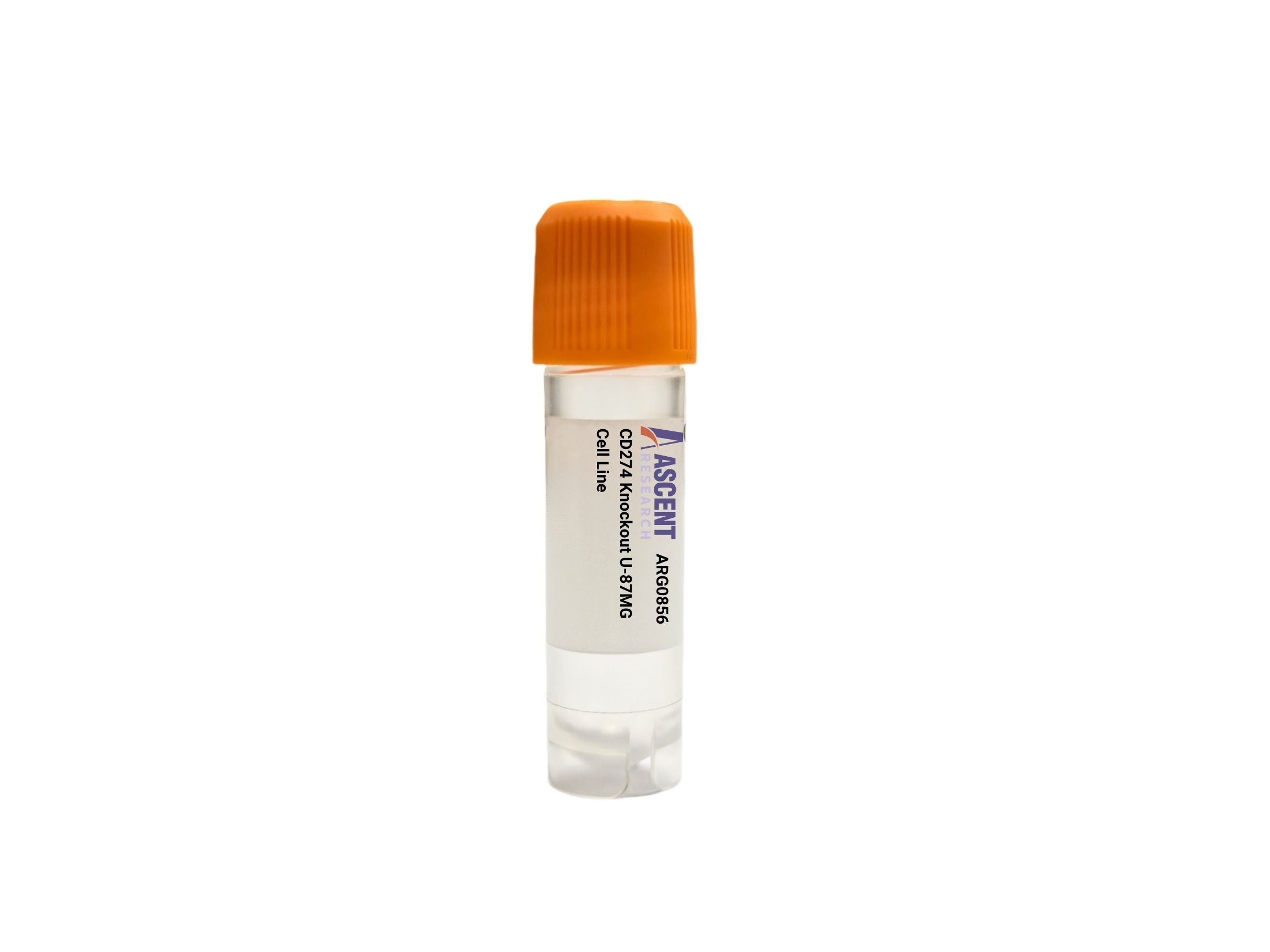
The CD274 Knockout U-87MG Cell Line is a CRISPR/Cas9-edited knockout cell line derived from the human U-87MG glioblastoma cell line. This cell line features targeted disruption of the CD274 gene, which encodes the PD-L1 (B7-H1) immune checkpoint ligand, and serves as a validated loss-of-function model for interrogating PD-L1-mediated immune evasion mechanisms.
The parental U-87MG cell line is a well-characterized human glioblastoma model derived from a malignant glioma. It harbors a PTEN mutation, wild-type p53, and amplifies EGFR, making it a relevant system for studying signaling networks that drive glioblastoma multiforme. U-87MG cells are commonly employed to investigate tumor proliferation, invasion, and immune escape mechanisms.
The CD274 gene encodes programmed death-ligand 1 (PD-L1, B7-H1), a transmembrane immune checkpoint protein. PD-L1 interacts with its receptor PD-1 (PDCD1) on activated T cells, recruiting the tyrosine phosphatases SHP-1 (PTPN6) and SHP-2 (PTPN11) to the intracellular domain. This initiates an inhibitory cascade that dephosphorylates key TCR-proximal kinases such as ZAP70 and LCK, impairing downstream PI3K/AKT and RAS/MEK/ERK signaling, ultimately reducing IL-2 and IFN?? production and promoting T cell exhaustion. PD-L1 expression is transcriptionally regulated by IFN-?? through STAT1 and NF-??B, and by oncogenic signals including EGFR, PI3K/AKT/mTOR, and HIF-1??.
In U-87MG glioblastoma cells, PD-L1 is often upregulated as a mechanism of immune evasion, dampening anti-tumor T cell responses within the tumor microenvironment. Disruption of CD274 in this cell line abrogates PD-L1 expression, removing the inhibitory signal and potentially restoring T cell effector functions. This isogenic knockout model therefore provides a powerful tool to dissect the contribution of PD-L1 to glioblastoma immune escape and to assess the efficacy of PD-1/PD-L1 blockade strategies in a defined genetic background.
Researchers can employ this CD274 knockout cell line for a variety of immune-oncology applications, including co-culture assays with primary T cells or PBMCs to measure restoration of cytotoxicity and cytokine secretion (e.g., IFN??, IL-2 via ELISA), screening of novel anti-PD-L1 small molecules or biologics, and dissecting PD-L1-driven signaling crosstalk with EGFR, PI3K/AKT, and MAPK pathways. The loss-of-function model is particularly suited for comparative studies with the parental U-87MG line using techniques such as flow cytometry (to confirm PD-L1 ablation), western blotting, RT-qPCR, and immunofluorescence. It also enables investigation of tumor-intrinsic roles of PD-L1 in proliferation, migration, and drug sensitivity. For more information, please contact Ascent Research.