Quick Order Cart

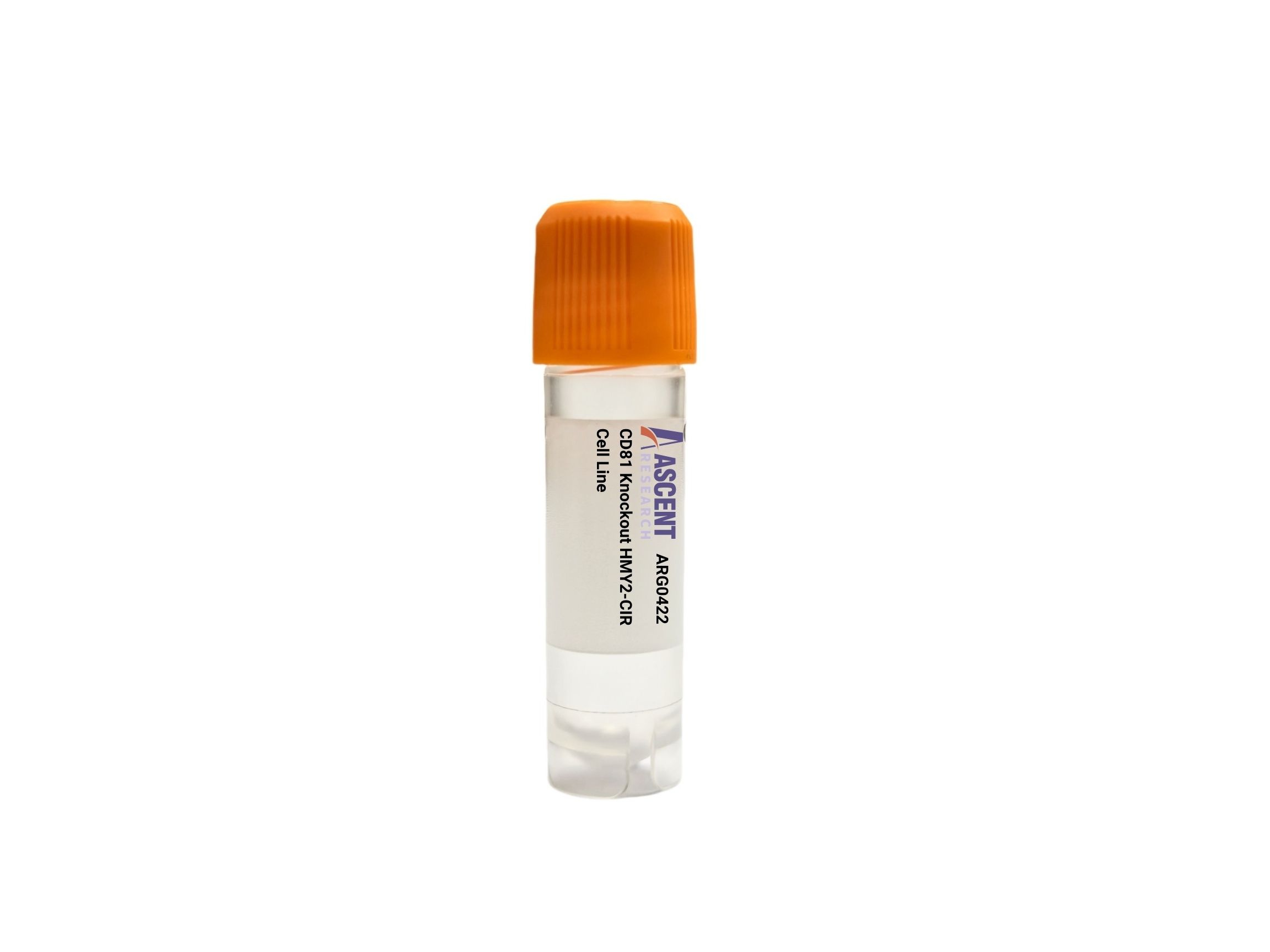
Cat. No. ARG0422

CD81 Knockout HMY2-CIR Cell Line

  • Product Type:

    Genome-edited Cells

  • Tissue Source:

    Blood (peripheral blood)

  • Gene Species:

    Homo sapiens (Human)

CRISPR/Cas9-edited knockout cell line targeting human CD81 in the MHC class II-deficient HMY2-CIR B-lymphoblastoid line. CD81 is a tetraspanin that organizes membrane microdomains, interacts with integrins and other tetraspanins such as CD9 and CD63, and co-modulates BCR signaling via CD19/CD21 complexes. It also serves as the hepatitis C virus entry receptor. This knockout model enables studies of B-cell adhesion, migration, immune synapse formation, and HCV entry without MHC II confounding effects. Applications include viral pseudoparticle assays, co-immunoprecipitation, flow cytometry, and phospho-signaling analysis, supporting research in virology, immunology, and cancer.

Inquire Now

In stock

Ships next business day


Ask a Question

Shipping Info:

Cryopreserved in vials and shipped on dry ice


Disclaimer:

For Research Use Only

  • Characteristics

    Host Cell

    HMY2-CIR

    Morphology

    Lymphoblast-like

    Age

    33 years

    Gene Name

    CD81

    Gene Species

    Homo sapiens (Human)

    Gene Identifier

    NCBI Gene ID 975

  • Culture Conditions

    Temperature

    37°C

    Atmosphere

    5% CO₂

  • Quality Control

    Sterility testing

    Daily monitoring confirms that the cells are free from bacterial, yeast, and fungal contamination.

    Mycoplasma testing

    Negative for mycoplasma through PCR analysis

    Pathogens

    Cells tested negative for HIV-1, HBV, and HCV.

  • Disclaimer

    Intended Use

    This product is intended for laboratory in vitro use only. lt is not intended for diagnostic, therapeutic, or clinical applications.

    Disclaimer

    Ascent Research endeavors to provide accurate and up-to-date product information. However, no warranties or representations are made regarding its completeness or reliability. References to scientific literature and patents are for informational purposes only, and the customer assumes sole responsibility for verifying their accuracy.

    By accepting this product, the customer acknowledges and agrees to assume all risks associated with its receipt, handling, storage, disposal, and use, including compliance with all applicable safety and environmental regulations and precautions. Relevant laws, regulations, and ethical guidelines must be followed in conducting any research, modifications, or derivatives derived from this product.

    This product is provided "AS IS", and except as expressly stated herein, Ascent Research disclaims all other warranties, express or implied. Under no circumstances shall Ascent Research, its affiliates, or representatives be liable for indirect, incidental, consequential, or punitive damages arising from the use of this material. While Ascent Research employs rigorous quality control measures, we shall not be held responsible for damages resulting from misidentification or misinterpretation of the provided materials.

Description

The CD81 Knockout HMY2-CIR Cell Line is a CRISPR/Cas9-edited knockout cell line in which human CD81 has been disrupted. This model provides a defined loss-of-function system to study CD81 functions in tetraspanin-enriched microdomain organization, cellular adhesion, signal transduction, and hepatitis C virus entry. The knockout is generated in the HMY2-CIR B-lymphoblastoid background, enabling mechanistic studies without the pleiotropic effects of pharmacological inhibitors or RNA interference.

The parental HMY2-CIR is an EBV-transformed B-lymphoblastoid cell line deficient in MHC class II expression and antigen processing. These cells retain humoral immune features including antibody secretion but cannot present exogenous antigens via MHC class II. The background is widely used to study alternative antigen-presentation pathways and B-cell signaling independently of classical MHC restriction. EBV transformation confers continuous proliferation and latent gene expression, including the viral protein LMP1, which influences host signaling.

CD81 encodes a tetraspanin that scaffolds membrane microdomains and interacts with integrins ??4??1 and ??6??1, and tetraspanins CD9, CD63, and CD82. In B cells, CD81 associates with CD19 and CD21 to co-modulate BCR signaling, activating downstream Akt, ERK1/2, NF-??B, and Rac1. Upstream regulators include IL-4, STAT6, TGF-??, and EBV LMP1. CD81 signaling proceeds through FAK, PI3K, and Src kinases. As the HCV entry receptor, CD81 binds viral E2 glycoprotein and cooperates with claudin-1 for internalization.

In HMY2-CIR, CD81 knockout abrogates contributions to membrane organization and signal integration. The MHC class II deficiency emphasizes tetraspanin-mediated co-stimulation and adhesion, making this line valuable for studying CD81-dependent immune synapse formation and integrin signaling without MHC II interference. Loss of CD81 likely alters CD19/CD21 clustering, impairing BCR-mediated PI3K/Akt and MAPK/ERK activation. Additionally, these cells resist HCV pseudoparticle entry, serving as a negative control for viral assays.

Applications include HCV pseudoparticle entry assays, co-immunoprecipitation of tetraspanin-enriched microdomains, and cell adhesion/migration assays. The knockout line is suitable for flow cytometry and western blotting to confirm CD81 loss and assess changes in CD9 and CD63. Phospho-signaling analysis can dissect CD81-dependent kinase activation downstream of BCR or integrins. These tools support research in virology, cancer metastasis, immunodeficiency, and autoimmunity. For further details, contact Ascent Research.


Reset Password

    Reach Us Questions? Click Me Here!

    Fill out the form below and a member of our team will contact you shortly!

    *Required field


      Reach Us

      Fill out the form below and a member of our team will contact you shortly!

      *Required field

      Product Inquiry (Optional)