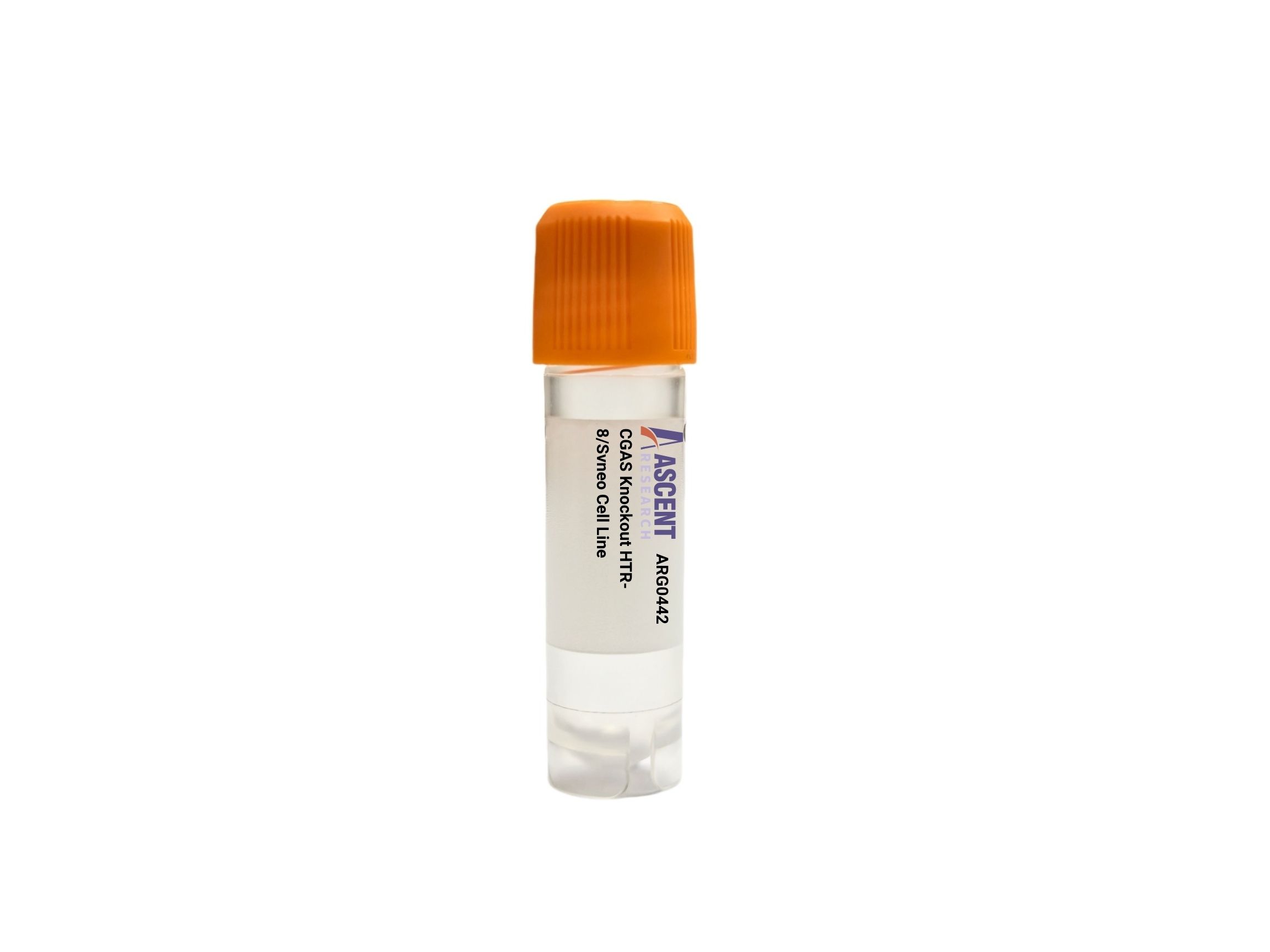
The CGAS Knockout HTR-8/Svneo Cell Line is a CRISPR/Cas9-edited knockout cell line derived from the immortalized first-trimester human extravillous trophoblast line HTR-8/Svneo. CRISPR/Cas9-mediated gene disruption abrogates CGAS expression, preventing cGAMP synthesis and subsequent innate immune signaling. This stable loss-of-function model provides a clean genetic background to dissect cGAS-dependent pathways in a trophoblast context, enabling reproducible studies of DNA sensing mechanisms without interference from endogenous cGAS activity.
HTR-8/Svneo cells were established from first-trimester human placental tissue and immortalized to retain extravillous trophoblast characteristics such as HLA-G expression, cytokeratin-7 positivity, and invasive capacity. These cells invade the maternal decidua and remodel uterine spiral arteries during early pregnancy, processes essential for establishing adequate blood flow to the fetus. HTR-8/Svneo cells respond to growth factors like EGF and TGF-??, making them a physiologically relevant model for studying trophoblast function, implantation, and pregnancy complications. They are widely used to explore mechanisms of placentation and immune tolerance at the maternal-fetal interface.
CGAS functions as a cytosolic DNA sensor that detects double-stranded DNA from sources including mitochondrial stress, viral genomes, or damaged cellular DNA. Upon binding DNA, CGAS catalyzes the synthesis of cGAMP, a second messenger that binds and activates STING1 (TMEM173) on the endoplasmic reticulum. STING activation leads to TBK1 recruitment and phosphorylation of IRF3, while also triggering NF-??B signaling through the IKK complex. Phosphorylated IRF3 translocates to the nucleus and cooperates with NF-??B to induce type I interferons (IFN-??/??) and pro-inflammatory cytokines such as IL-6 and TNF. This cascade is tightly regulated by the exonuclease TREX1, which degrades cytosolic DNA, and by interacting factors like PCBP1, ZCCHC3, and BAF that modulate CGAS or STING activity.
In extravillous trophoblasts, cGAS-STING signaling is positioned to respond to microbial or self-DNA, influencing immune surveillance and inflammation at the maternal-fetal interface. Aberrant activation of this pathway is linked to pregnancy disorders like preeclampsia and intrauterine growth restriction, where excessive type I interferon responses disrupt placental function. Additionally, gain-of-function mutations in TREX1 or other pathway components cause Aicardi-Gouti??res syndrome, while cGAS overactivation contributes to systemic lupus erythematosus. This knockout cell line enables precise dissection of CGAS-dependent mechanisms in trophoblasts, providing a platform to study how DNA sensing impacts invasion, immune tolerance, and antiviral responses.
Common experimental protocols include stimulation with dsDNA mimics or cGAMP to activate STING signaling, followed by Western blotting for phospho-TBK1 and phospho-IRF3. RT-qPCR quantifies interferon-stimulated genes like IFNB1 and CXCL10, while ELISA measures cGAMP production. Immunofluorescence assays can monitor IRF3 nuclear translocation and STING trafficking. Functional studies using transwell invasion tests evaluate the role of CGAS in trophoblast motility, and viral replication assays with herpes simplex virus or cytomegalovirus model placental infections. Co-culture systems with decidual NK cells or endothelial cells enable investigation of paracrine immune signaling. For technical inquiries, please contact Ascent Research.