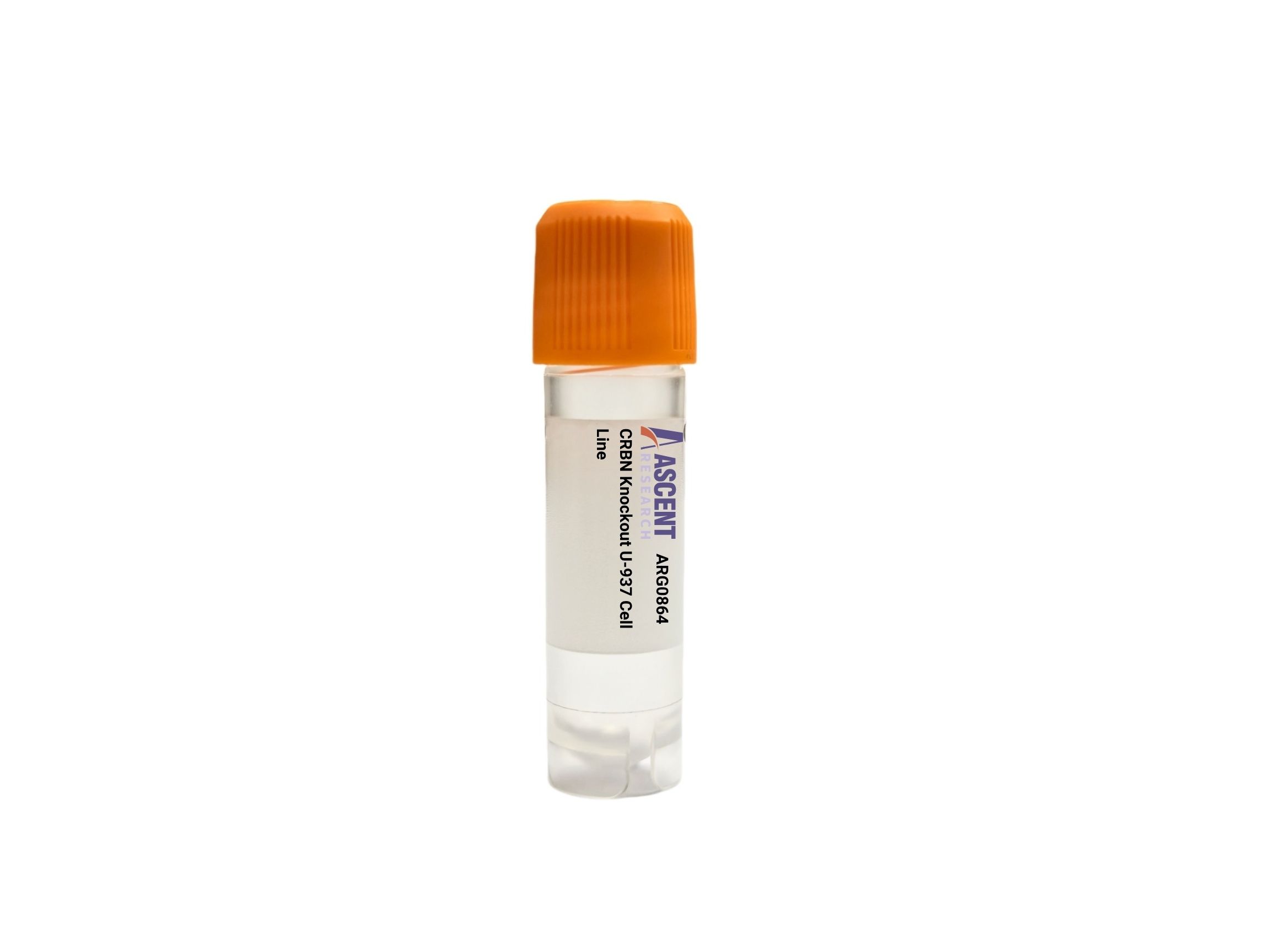
The CRBN Knockout U-937 Cell Line is a CRISPR/Cas9-edited human knockout cell line designed for loss?of?function studies of cereblon (CRBN) in a histiocytic lymphoma background. This engineered product provides a defined genetic background to interrogate CRBN?dependent ubiquitination processes and drug responses, without asserting clonality or specific editing outcomes. By disrupting the CRBN gene, the model serves as a powerful tool for dissecting the substrate?receptor function of the CRL4 E3 ligase complex in a hematologic cellular context.
The parental U?937 cell line was originally established from the pleural effusion of a patient with diffuse histiocytic lymphoma and displays monocytic characteristics, making it a widely used model for monocyte/macrophage biology and lymphoid malignancies. U?937 cells are amenable to a variety of transfection, drug treatment, and functional assay protocols, enabling robust investigation of signaling pathways and cellular responses relevant to both innate immunity and cancer.
CRBN functions as a substrate receptor for the CUL4A?CDDB1?CRBX1 (CRL4) E3 ubiquitin ligase complex. Under homeostatic conditions, it mediates the ubiquitination and proteasomal degradation of target proteins such as MEIS2 and GLI2, thereby regulating limb morphogenesis and other developmental pathways. Immunomodulatory imide drugs (IMiDs), including thalidomide, lenalidomide, and pomalidomide, bind to CRBN and re?direct its substrate specificity toward neo?substrates, most notably the transcription factors IKZF1 (Ikaros), IKZF3 (Aiolos), and casein kinase 1?? (CK1??/CSNK1A1). This drug?induced degradation underlies the therapeutic and teratogenic effects of IMiDs. Upstream regulators such as the SP1 transcription factor and interferon?gamma also modulate CRBN expression, further integrating CRBN into growth and immune signaling networks.
In the U?937 histiocytic lymphoma model, CRBN knockout enables specific investigation of IMiD?mediated signaling and resistance mechanisms. Because U?937 cells are naturally sensitive to IMiD?induced apoptosis and growth inhibition, ablation of CRBN provides a clean genetic control for confirming on?target drug effects and for distinguishing CRBN?dependent from CRBN?independent pathways. The knockout also facilitates studies of CRBN??s endogenous role in protein homeostasis and its interaction with the HSP90 chaperone network. These features make the cell line highly relevant for multiple myeloma and myelodysplastic syndrome research, where IMiDs are standard?of?care agents.
Typical applications of this knockout cell line include mechanistic dissection of CRL4 E3 ligase signaling, validation of small?molecule modulators of CRBN, analysis of protein degradation dynamics using ubiquitination assays and co?immunoprecipitation, and profiling of drug sensitivity via MTT?based viability assays. The model is also suited for genome?wide CRISPR screens, flow?cytometric assessment of apoptosis and cell?cycle changes, and transcriptomic studies by RT?qPCR or RNA sequencing. Researchers can employ the line to model teratogenicity or to engineer novel CRBN?based degrader molecules, thereby advancing targeted protein degradation strategies. For technical inquiries or custom cell?line generation, please contact Ascent Research.