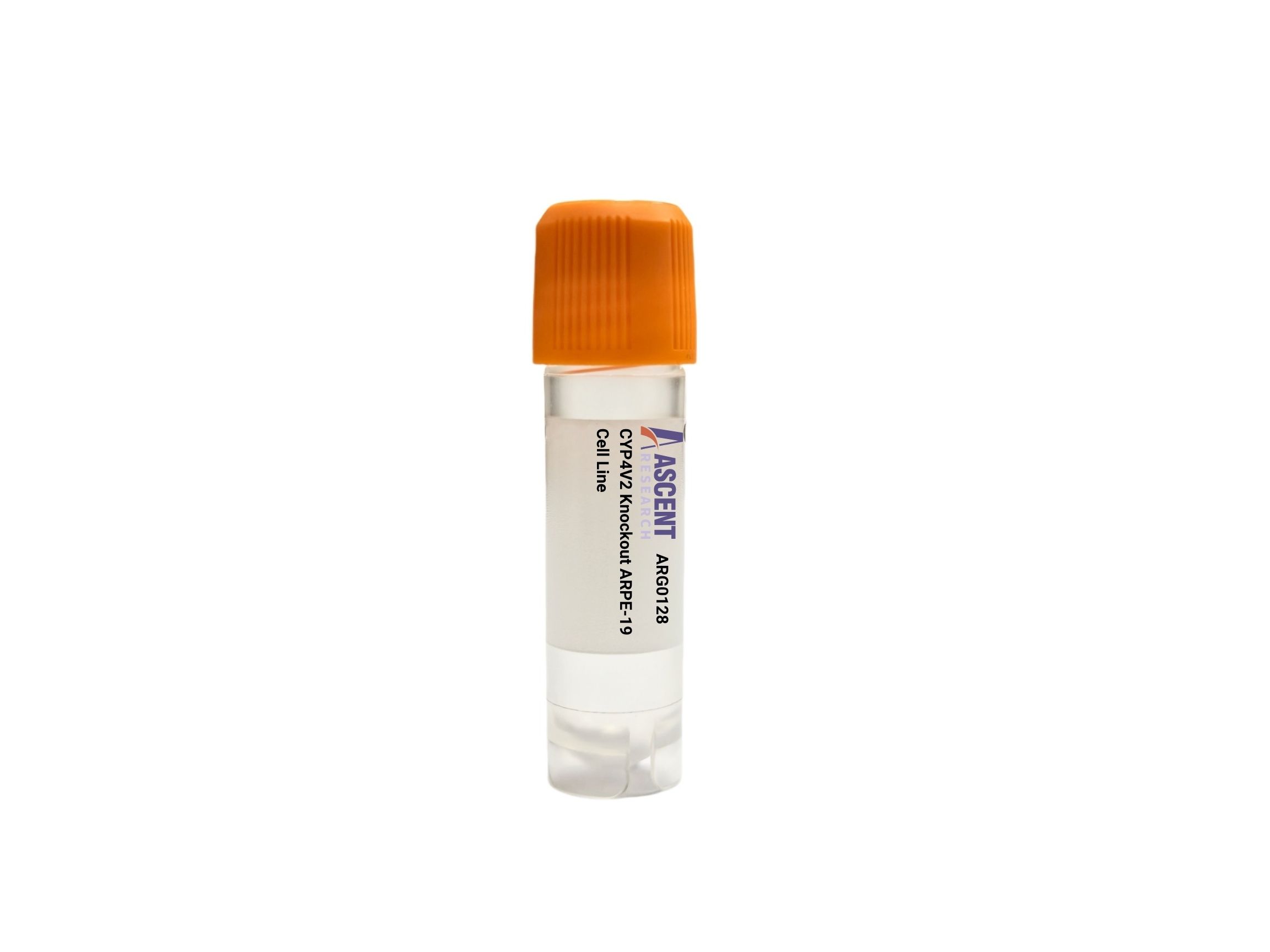
The CYP4V2 Knockout ARPE-19 Cell Line is a CRISPR/Cas9-engineered human retinal pigment epithelial model in which the CYP4V2 gene has been disrupted to eliminate functional gene expression. This stable in vitro system enables direct investigation of CYP4V2 loss in a biologically relevant retinal pigment epithelium background. ARPE-19 cells provide an epithelial context for studying lipid handling, retinoid-associated physiology, barrier-associated functions, and stress responses that are central to outer blood-retina barrier maintenance and photoreceptor support.
ARPE-19 is a human RPE-derived cell line widely used for retinal biology and disease research because it captures key aspects of epithelial transport, phagocytic activity, oxidative stress susceptibility, and barrier-related behavior. As a model of retinal pigment epithelium dysfunction, ARPE-19 is particularly useful for examining mechanisms linked to lipid accumulation, metabolic adaptation, and degeneration-associated cellular stress. Its experimental tractability supports multimodal analyses of gene function in retinal disease settings, including inherited degeneration and RPE-centered pathology.
CYP4V2 encodes an endoplasmic reticulum-associated microsomal cytochrome P450 enzyme that catalyzes omega-hydroxylation of fatty acids and contributes to long-chain and polyunsaturated lipid processing. Its activity is integrated with fatty acid omega-oxidation, arachidonic acid metabolism, and broader retinal lipid homeostasis. CYP4V2 is regulated by cellular lipid status and by nuclear receptor pathways involving PPARA, PPARG, and RXRA, and it functions with key redox and electron transfer partners including NADPH-cytochrome P450 reductase (POR) and cytochrome b5 (CYB5A). In the ER membrane lipid environment, loss of CYP4V2 is expected to alter generation of omega-hydroxylated fatty acid metabolites and influence downstream phenotypes such as lipid droplet accumulation, reactive oxygen species homeostasis, mitochondrial function, and epithelial stress-response gene regulation. These relationships are directly relevant to Bietti crystalline dystrophy, chorioretinal degeneration, and lipid storage abnormalities.
In the ARPE-19 background, CYP4V2 disruption provides a mechanistically relevant platform for testing how impaired fatty acid metabolism intersects with RPE-specific functions. Because RPE cells depend on tightly regulated lipid processing and redox balance, this model is suitable for dissecting how CYP4V2 deficiency modifies oxidative stress responses, epithelial integrity, metabolic state, and degeneration-associated phenotypes. The system is also useful for examining pathway dependencies downstream of PPAR/RXR signaling and for evaluating how altered lipid substrate handling affects mitochondrial performance and stress adaptation.
This knockout cell line supports a broad range of experimental applications, including Bietti crystalline dystrophy modeling, retinal lipid metabolism studies, and RPE dysfunction research. Researchers can confirm gene disruption by genotyping, RT-qPCR, and western blotting, then characterize downstream consequences using RNA-seq, lipidomics, and LC-MS metabolite profiling. Lipid storage phenotypes can be quantified by Oil Red O or BODIPY staining, while ROS assays, mitochondrial membrane potential measurements, and Seahorse metabolic analysis can define redox and bioenergetic changes. Additional use cases include immunofluorescence-based phenotyping, apoptosis assays, barrier integrity measurements, phagocytosis assays, drug sensitivity testing, and gene restoration experiments designed to evaluate functional rescue in a retinal epithelial context. Researchers may contact Ascent Research for additional technical information, product details, or related gene-edited cell models.