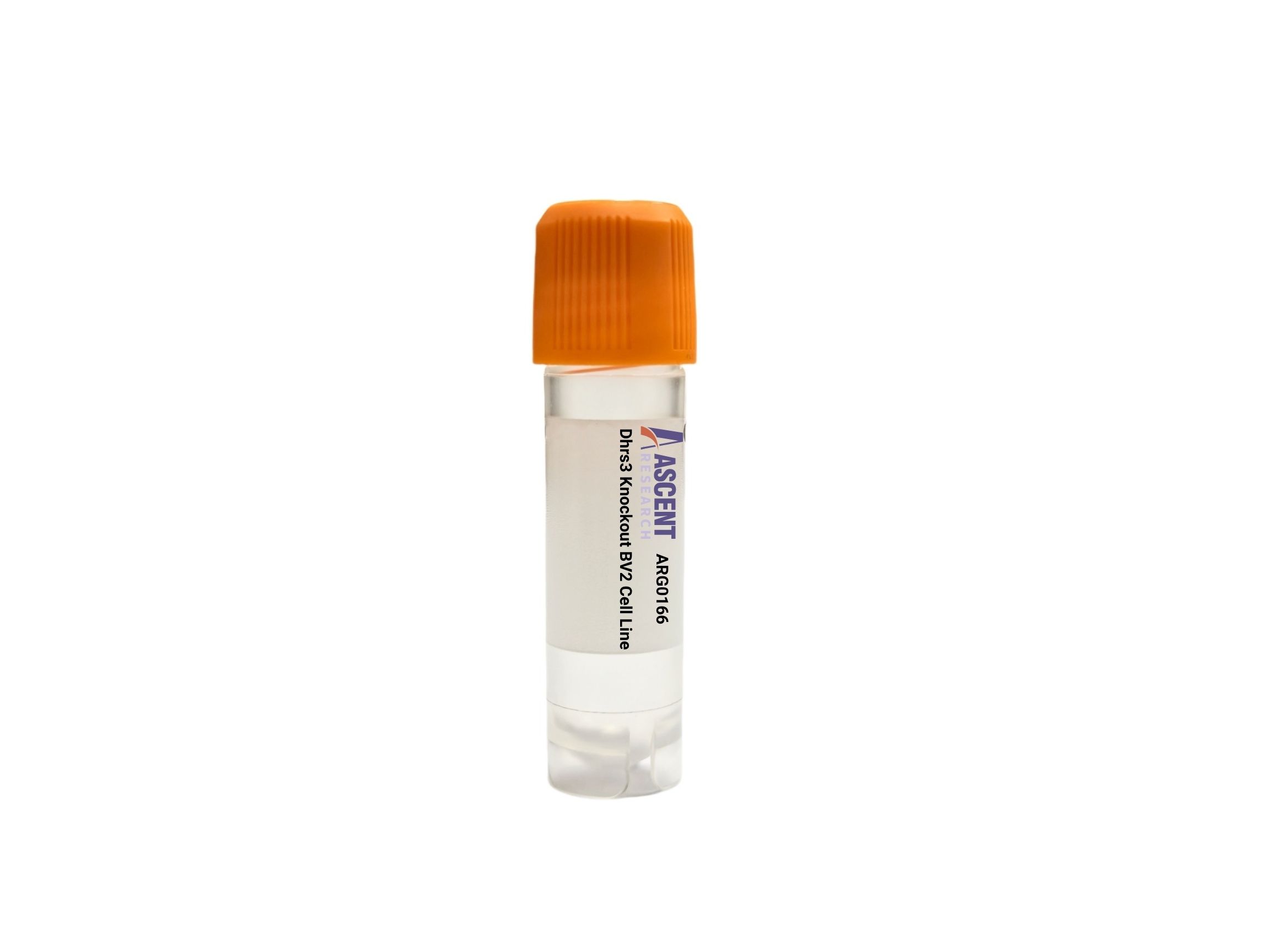
The Dhrs3 Knockout BV2 Cell Line is a CRISPR/Cas9-engineered mouse microglial cell model in which the Dhrs3 gene has been disrupted to eliminate functional DHRS3 expression. This stable in vitro system enables direct investigation of DHRS3-dependent biology in an immortalized microglia-like background. BV2 cells provide a tractable platform for studying gene function in CNS-resident innate immune cells, and targeted knockout of Dhrs3 is particularly relevant for examining retinoid handling, metabolic regulation, and transcriptional responses linked to retinaldehyde and retinoic acid homeostasis.
BV2 is a murine immortalized microglial cell line widely used as an experimental surrogate for resident CNS macrophage-like cells involved in immune surveillance and inflammatory signaling. The line is commonly applied to studies of neuroinflammation, phagocytosis, innate immune activation, and microglial state transitions. Because BV2 cells retain many features useful for modeling inflammatory and metabolic responses, they are well suited for analyzing how perturbation of a retinoid-metabolizing enzyme influences microglial behavior in contexts relevant to neurodegeneration, inflammatory challenge, and CNS immune regulation.
DHRS3 is a short-chain dehydrogenase/reductase that catalyzes the reduction of all-trans-retinaldehyde to all-trans-retinol, thereby acting upstream of retinoic acid biosynthesis and buffering intracellular retinoid flux. Its expression and activity are regulated by cellular retinoid status, differentiation stimuli, and all-trans-retinoic acid signaling through RAR/RXR pathways. Within the retinoid network, DHRS3 functionally interacts with RDH10 in retinaldehyde-retinol interconversion and is linked to LRAT, RBP1/CRBP1, RARs, and RXRs in pathways controlling retinol storage, retinyl ester formation, and retinoid-responsive transcription. Representative pathway components include retinol, all-trans-retinaldehyde, all-trans-retinoic acid, ALDH1A1, ALDH1A2, ALDH1A3, RAR??, and RXR??. Loss of Dhrs3 is therefore expected to alter retinaldehyde availability, retinol levels, retinyl ester formation, retinoic acid production, and downstream RAR target gene expression.
In the BV2 background, disruption of Dhrs3 provides a useful model for studying how retinoid metabolism influences microglial activation state and inflammatory responsiveness. Since microglia integrate metabolic and transcriptional cues during CNS surveillance and stress responses, altered retinaldehyde/retinoic acid balance in Dhrs3-deficient cells may help define pathway dependencies linking retinoid homeostasis to immune signaling, redox biology, and lipid droplet-associated retinoid regulation. This is relevant to research on neuroinflammation, neurodegeneration, vitamin A deficiency biology, and macrophage-like cell activation.
This knockout cell line can be applied to mechanistic studies using RT-qPCR and western blotting to profile retinoid-regulated genes and pathway proteins, LC-MS-based assays to quantify retinol, retinaldehyde, and retinoic acid, and reporter assays to monitor RAR activity. RNA-seq can be used to define transcriptional programs altered by Dhrs3 loss in resting or stimulated microglia-like cells. Additional applications include cytokine measurement assays for inflammatory output, flow cytometry and immunofluorescence for activation markers, phagocytosis assays to assess microglial function, lipid droplet staining to examine retinoid storage-related phenotypes, and metabolic assays to evaluate consequences for cellular redox and lipid metabolism. Researchers may contact Ascent Research for additional technical information, product details, or related gene-edited cell models.