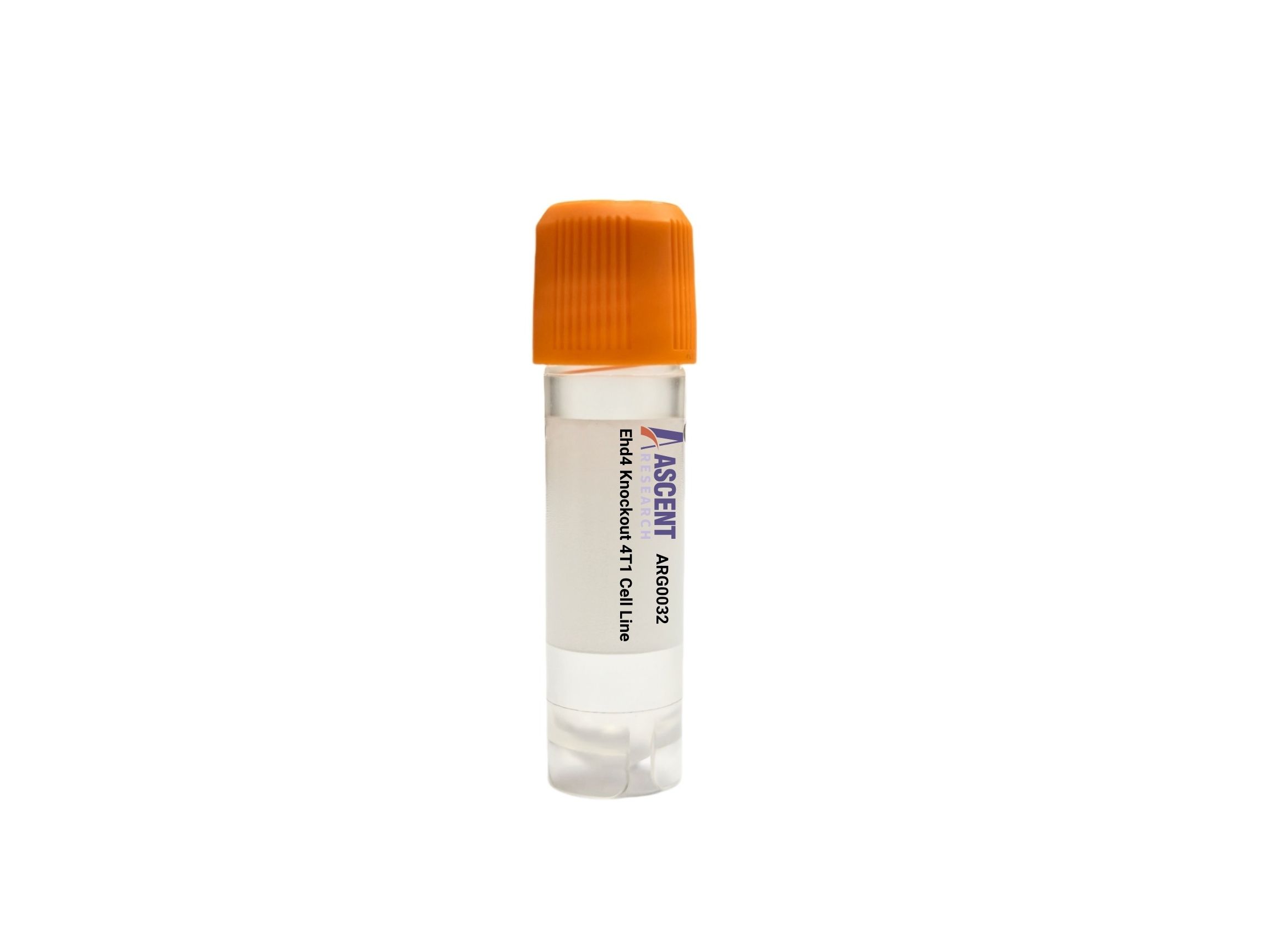
The Ehd4 Knockout 4T1 Cell Line is a CRISPR/Cas9-engineered mouse mammary carcinoma cell model in which the Ehd4 gene has been disrupted to eliminate functional EHD4 expression. This stable in vitro knockout line is generated in the 4T1 background, an epithelial-like tumor cell system frequently used to study aggressive breast cancer biology. The model is intended for investigation of EHD4-dependent membrane trafficking processes and their contribution to cancer-associated cellular phenotypes in a metastatic mammary tumor context.
4T1 is a murine triple-negative mammary carcinoma cell line derived from a BALB/c mouse breast tumor and is widely used as a syngeneic model of metastatic breast cancer. Because 4T1 cells display rapid growth, invasive behavior, and metastatic competence, they are highly relevant for studies of tumor progression, dissemination, and microenvironment-dependent signaling. As a tumor epithelial-like model, 4T1 is particularly useful for examining how membrane receptor dynamics, adhesion turnover, and endocytic trafficking influence motility, invasion, and responses to perturbation in breast cancer cells.
EHD4 is an EH domain-containing ATPase within the EHD family that associates with endosomal membranes and mediates endocytic recycling, membrane tubulation, and cargo transport through the endosomal system. Its activity is regulated by receptor internalization cues, growth factor stimulation, Rab5-positive early endosome dynamics, Rab11-dependent recycling activity, and membrane phosphoinositides. EHD4 interacts with trafficking and membrane remodeling factors including RABEP1, MICAL-L1, PACSIN1, PACSIN2, Rab5, Rab11 family proteins, sorting nexins, clathrin, dynamin, and related EHD family members such as EHD1, EHD2, and EHD3. Through these networks, EHD4 acts downstream of endocytic uptake and upstream of endosome-to-plasma-membrane trafficking, influencing receptor surface abundance, integrin trafficking, growth factor receptor localization, and cell migration behavior.
In the 4T1 background, Ehd4 loss provides a mechanistically relevant system for studying how altered endosomal recycling affects metastatic breast cancer phenotypes. Disruption of EHD4 is expected to modify trafficking of surface receptors and adhesion molecules that shape signaling output, migratory capacity, and invasive behavior. This makes the model valuable for evaluating pathway dependence between endocytic membrane remodeling and tumor cell phenotypes linked to breast cancer progression, receptor trafficking defects, and metastasis-associated cell plasticity.
Researchers can apply this cell line to endocytic trafficking studies using immunofluorescence microscopy, live-cell trafficking imaging, receptor internalization and recycling assays, and cell-surface biotinylation to quantify changes in membrane protein localization and recycling kinetics. Western blotting, RT-qPCR, and RNA-seq can be used to define molecular consequences of Ehd4 disruption, while co-immunoprecipitation and flow cytometry support analysis of trafficking complexes and receptor surface abundance. Invasion assays, migration assays, and drug sensitivity studies are appropriate for linking altered integrin or growth factor receptor localization to functional changes in motility and treatment response in a metastatic breast cancer model. Researchers may contact Ascent Research for additional technical information, product details, or related gene-edited cell models.