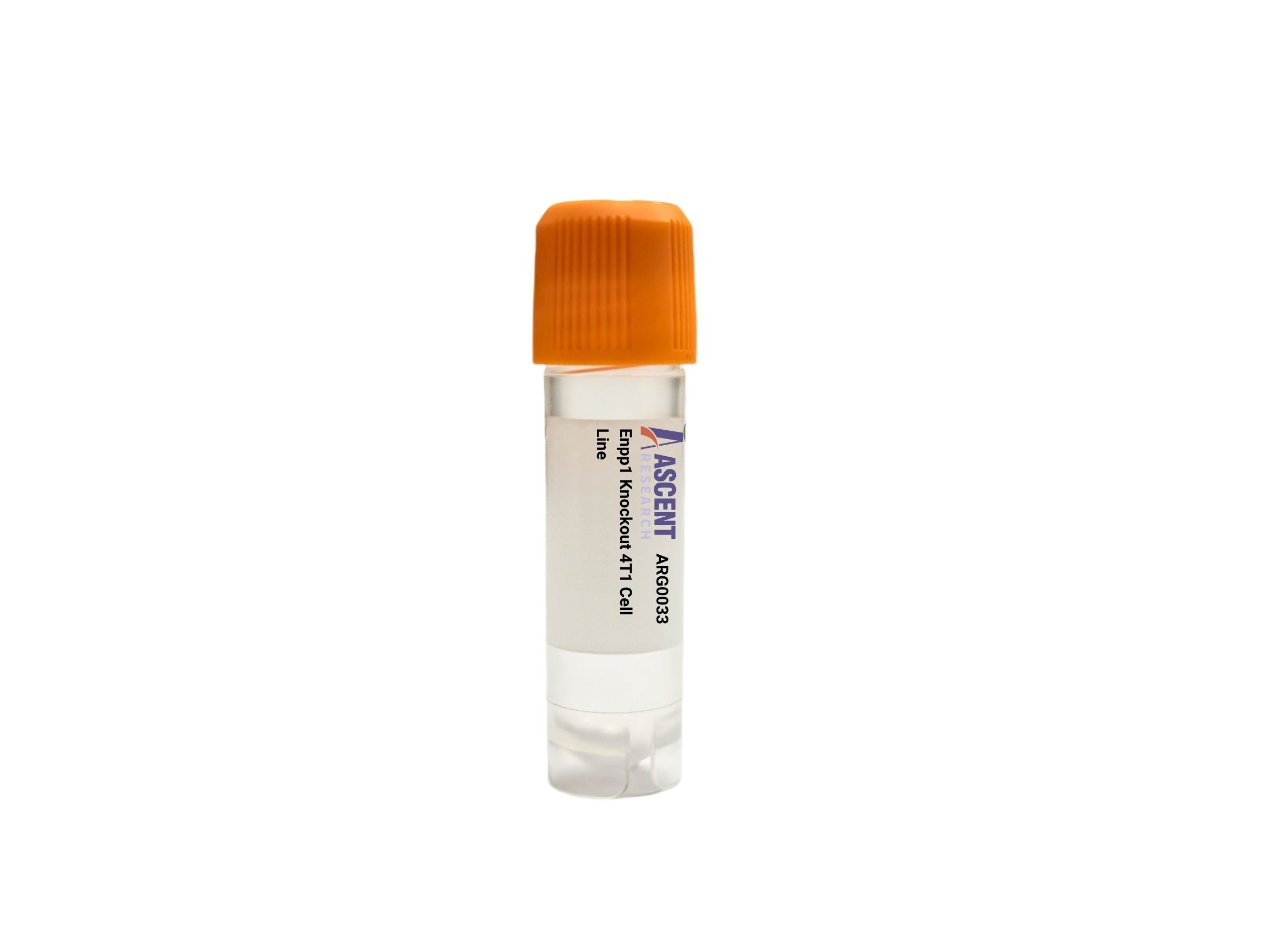
The Enpp1 Knockout 4T1 Cell Line is a CRISPR/Cas9-engineered mouse mammary carcinoma model in which the Enpp1 gene has been disrupted to eliminate functional ENPP1 expression. This gene-edited derivative of 4T1 provides a stable in vitro system for investigating ENPP1-dependent extracellular nucleotide metabolism and innate immune regulatory mechanisms in tumor cells. As a knockout model generated in a well-established breast cancer background, it is suited for mechanistic studies requiring defined loss of ENPP1 activity in a syngeneic murine context.
4T1 is a BALB/c-derived mammary carcinoma cell line widely used as a model of triple-negative breast cancer with aggressive growth and high metastatic potential. The line is extensively applied in studies of tumor expansion, invasion, dissemination, and tumor-immune interactions, particularly in immunocompetent mouse systems. Because 4T1 recapitulates key features of advanced metastatic breast cancer, including strong relevance to inflammatory and immune-associated tumor biology, it is a useful host for examining how specific gene loss alters cancer cell behavior and communication with the microenvironment.
ENPP1 is a cell-surface ectonucleotide pyrophosphatase/phosphodiesterase that hydrolyzes extracellular ATP and cyclic dinucleotides such as extracellular cGAMP, generating metabolites that reshape signaling in the tumor milieu. Through these activities, ENPP1 acts upstream of AMP and pyrophosphate (PPi) production and indirectly contributes to adenosine generation via CD73/NT5E. ENPP1 function is regulated by extracellular ATP, extracellular cGAMP, inflammatory cytokines, type I interferon-associated inflammatory cues, oncogenic stress, and broader tumor microenvironmental stimuli. It interacts functionally with ATP, ADP, AMP, cGAMP, CD39/ENTPD1, CD73/NT5E, purinergic receptors, and the cGAS/MB21D1-STING/TMEM173 axis. By limiting extracellular cGAMP availability, ENPP1 can modulate STING activation state, TBK1 phosphorylation, IRF3 activation, type I interferon gene expression, and inflammatory cytokine output.
In the 4T1 background, ENPP1 loss is particularly relevant for studying tumor immune evasion, extracellular cGAMP biology, and ATP-adenosine axis remodeling in metastatic breast cancer. Disruption of Enpp1 may help define how altered nucleotide turnover influences cancer cell-intrinsic signaling, inflammatory transcriptional programs, and crosstalk with immune cells within a highly metastatic triple-negative breast cancer model. This system is therefore useful for interrogating pathway dependence linking extracellular nucleotide metabolism to innate immune activation and tumor-associated phenotypes.
Applications include western blot analysis of ENPP1-associated pathway markers, phospho-TBK1 and phospho-IRF3 signaling assays, RT-qPCR or RNA-seq profiling of type I interferon genes and inflammatory cytokines, ELISA-based measurement of IFN-beta and related secreted factors, and extracellular nucleotide metabolism or cGAMP quantification assays. The model can also support flow cytometry and immunofluorescence studies of pathway activation, proliferation, apoptosis, migration, and invasion analyses, as well as co-culture experiments with immune cells to assess tumor-immune communication. In vivo syngeneic tumor studies may further enable evaluation of Enpp1-dependent effects on tumor growth, metastatic behavior, and therapeutic combination strategies targeting purinergic signaling or cGAS-STING-associated mechanisms. Researchers may contact Ascent Research for additional technical information, product details, or related gene-edited cell models.