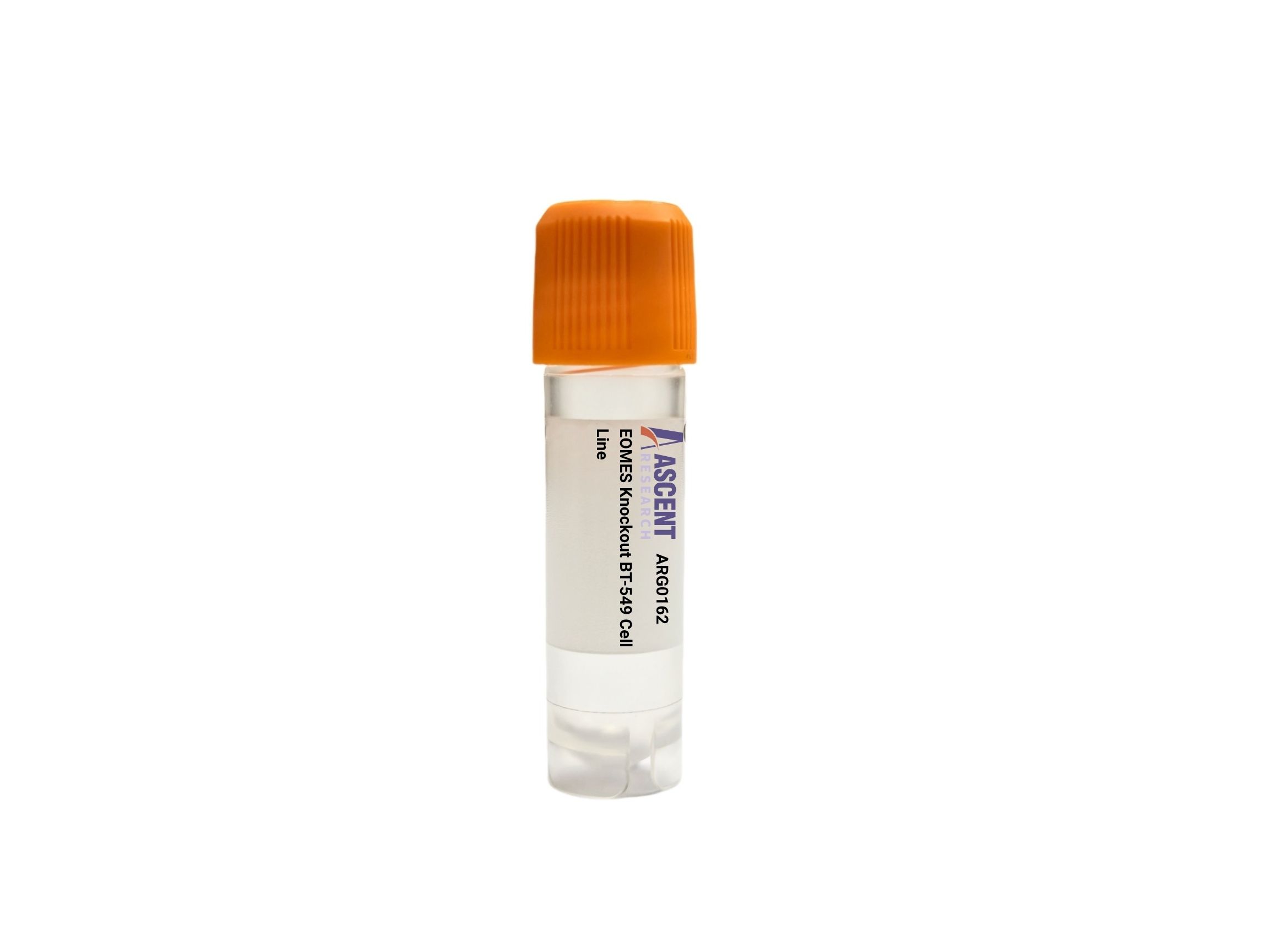
The EOMES Knockout BT-549 Cell Line is a human CRISPR/Cas9-engineered breast carcinoma model in which the EOMES gene has been disrupted to abolish functional eomesodermin expression. This stable knockout cell line is generated in BT-549 cells, a widely used in vitro system for investigating aggressive basal-like/triple-negative breast cancer biology. By removing a T-box transcription factor that controls lineage-associated gene expression programs, this model enables direct analysis of EOMES-dependent transcriptional regulation, cell-state transitions, and signaling responses in a cancer-relevant context.
BT-549 is derived from invasive ductal carcinoma and is commonly used as a model of mesenchymal-like triple-negative breast cancer. The line is valued for studies of migratory and invasive phenotypes, tumor progression, and mechanisms associated with aggressive breast cancer behavior. Because BT-549 cells capture features relevant to basal-like disease states and epithelial-mesenchymal transition-associated programs, they provide a useful background for interrogating regulators of differentiation, motility, and pathway crosstalk in breast cancer cells.
EOMES encodes a T-box DNA-binding transcription factor that mediates lineage-specific transcriptional programs linked to developmental specification, differentiation, migration, and immune cell function. EOMES is regulated by signaling inputs that include WNT3A, CTNNB1/beta-catenin, TGFB1-TGFBR1 signaling through SMAD2 and SMAD3, and FGF-ERK1/2 pathways involving MAPK1 and MAPK3. At the chromatin level, EOMES interacts with cofactors and transcriptional regulators including TBR1, beta-catenin, EP300, and CREBBP, consistent with context-dependent assembly of transcriptional complexes. Downstream, EOMES can influence expression of genes associated with epithelial-mesenchymal and migratory programs, including CDH1, CDH2, VIM, SNAI1, ZEB1, MMP2, and MMP9, and is also linked to differentiation-associated transcriptional outputs such as IFNG in immune contexts. These signaling relationships position EOMES within T-box regulatory networks and at the interface of WNT/beta-catenin, TGF-beta, and MAPK/ERK signaling.
Within BT-549 cells, EOMES loss provides a relevant system for studying how transcription factor disruption alters cancer cell-state control in a mesenchymal-like triple-negative background. The model is suited to investigating whether EOMES contributes to transcriptional programs associated with migration, invasion, and differentiation status, and how these programs are coordinated with CTNNB1, SMAD2/3, or ERK-dependent signaling inputs. It is also useful for examining pathway dependency and context-specific transcriptional rewiring in tumor progression models.
Applications include loss-of-function studies using western blotting and RT-qPCR to assess EOMES-regulated markers; RNA-seq to define transcriptome-level changes; ChIP-qPCR or ChIP-seq to interrogate altered chromatin occupancy and cofactor-dependent regulatory circuits; and reporter assays to examine WNT/beta-catenin or TGF-beta-responsive transcription. Researchers can further apply immunofluorescence, flow cytometry, co-immunoprecipitation, migration assays, invasion assays, proliferation assays, apoptosis assays, and drug sensitivity studies to characterize phenotypic consequences of EOMES disruption and to evaluate signaling-targeted perturbations in triple-negative breast cancer models. Researchers may contact Ascent Research for additional technical information, product details, or related gene-edited cell models.