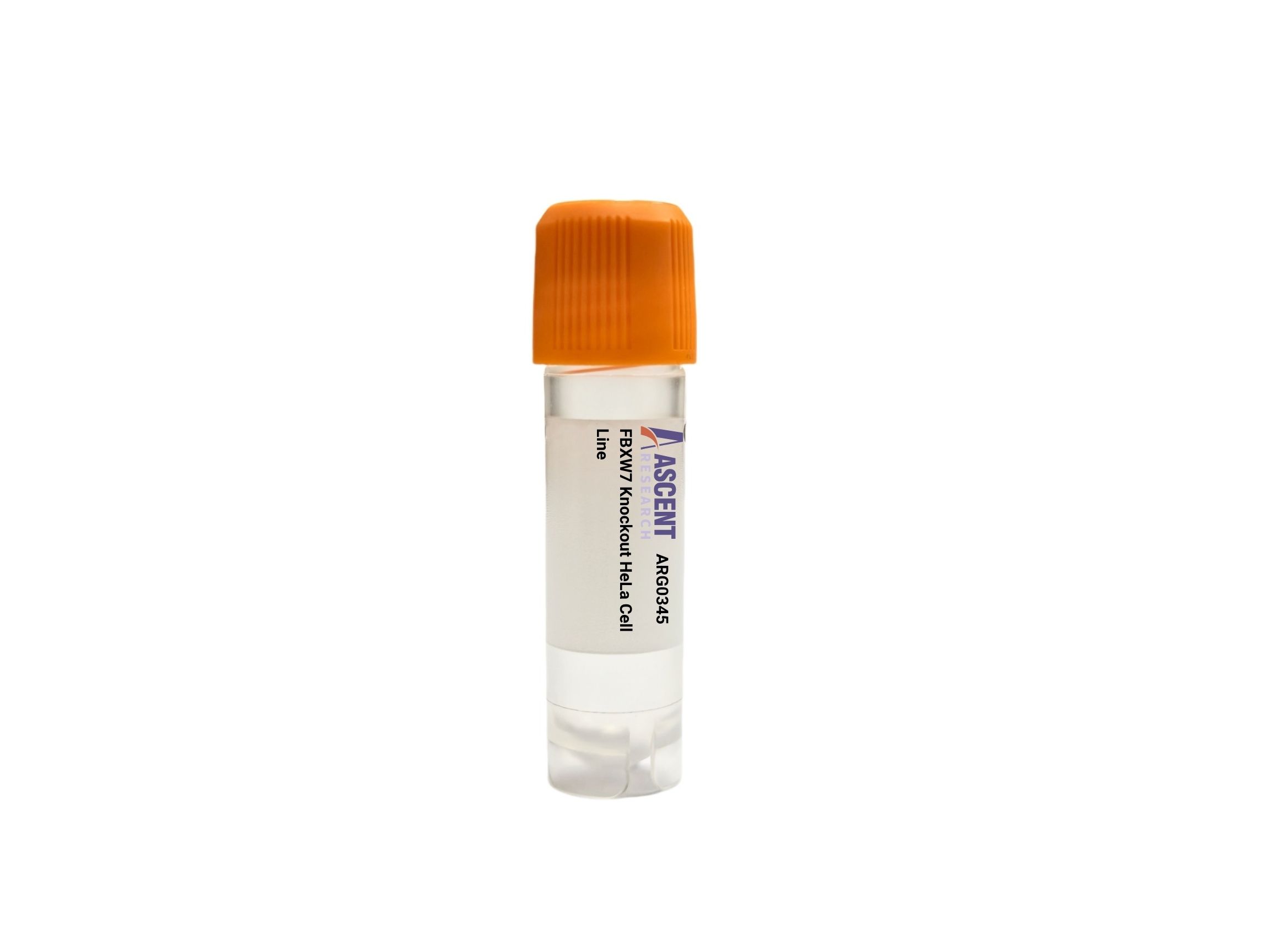
The FBXW7 Knockout HeLa Cell Line is a genetically modified human cell product generated through CRISPR/Cas9-mediated disruption of the FBXW7 gene in the HeLa epithelial carcinoma cell line. This loss-of-function model enables precise investigation of FBXW7-dependent tumor suppression mechanisms. By eliminating expression of the substrate recognition component of the SCF E3 ubiquitin ligase complex, the cell line provides a defined experimental system for dissecting ubiquitin-proteasome pathway dynamics and oncogenic substrate stability. Researchers can utilize this knockout cell line to explore signaling alterations that arise in the absence of FBXW7, including changes in cell cycle progression, apoptotic sensitivity, and drug response phenotypes.
HeLa cells, derived from a human cervical adenocarcinoma, represent one of the most extensively characterized immortalized cell lines in biomedical research. These HPV18-positive epithelial cells retain key oncogenic signaling networks relevant to cervical cancer and broader epithelial tumor biology. The HeLa background provides a robust platform for studying tumor suppressor functions, given its well-documented growth properties, responsiveness to pharmacologic agents, and compatibility with a wide range of molecular and cellular biology techniques. The integration of FBXW7 knockout into this established model facilitates direct interrogation of substrate turnover pathways within a malignancy-relevant context.
FBXW7 functions as the substrate recognition subunit of the SCF (SKP1-CUL1-FBXW7-RBX1) E3 ubiquitin ligase complex, directing critical oncoproteins such as cyclin E (CCNE1), c-Myc (MYC), Notch1 intracellular domain, and c-Jun (JUN) for ubiquitin-dependent degradation by the 26S proteasome. This targeted proteolysis is tightly regulated by upstream signals including p53-mediated transcription, C/EBP?? activation, and microRNAs such as miR-223, miR-27a, and miR-25, as well as DNA damage response pathways. Loss of FBXW7 disrupts this regulatory axis, leading to accumulation of substrates that drive unchecked cell cycle entry, enhanced proliferation, and apoptosis resistance. Additional downstream effectors influenced by FBXW7 status include MCL1, mTOR, and AURKA, expanding its role beyond simple substrate recognition to broader signaling coordination.
In the HeLa cervical carcinoma context, FBXW7 knockout recapitulates a common oncogenic lesion observed in a spectrum of human malignancies, including colorectal, endometrial, and lung cancers. The model enables systematic evaluation of how loss of this tumor suppressor alters cellular behavior, such as resistance to genotoxic stress, dysregulation of G1/S checkpoint control, and modulation of Notch-dependent transcriptional programs. Because HeLa cells already harbor TP53 inactivation via HPV E6, introduction of FBXW7 knockout creates a compound genetic setting that mimics aggressive tumor subtypes, facilitating synthetic lethality screens and investigation of cooperative oncogenic events. This is particularly valuable for dissecting molecular dependencies that arise when multiple tumor suppressor pathways are concurrently disabled.
Typical research applications of the FBXW7 Knockout HeLa Cell Line encompass ubiquitination assays, cycloheximide chase experiments to measure substrate half-life, and co-immunoprecipitation to assess residual SCF complex integrity. The cell line is suited for cell cycle analysis by flow cytometry, apoptosis assays with DNA damage agents, and proliferation measurements under varied growth conditions. Drug sensitivity screening with HDAC inhibitors, proteasome inhibitors, or agents targeting mTOR/AKT pathways can reveal context-specific vulnerabilities. Additionally, the model supports investigation of Notch signaling dynamics and c-Myc transcriptional programs. For further technical details or custom applications, please contact Ascent Research.