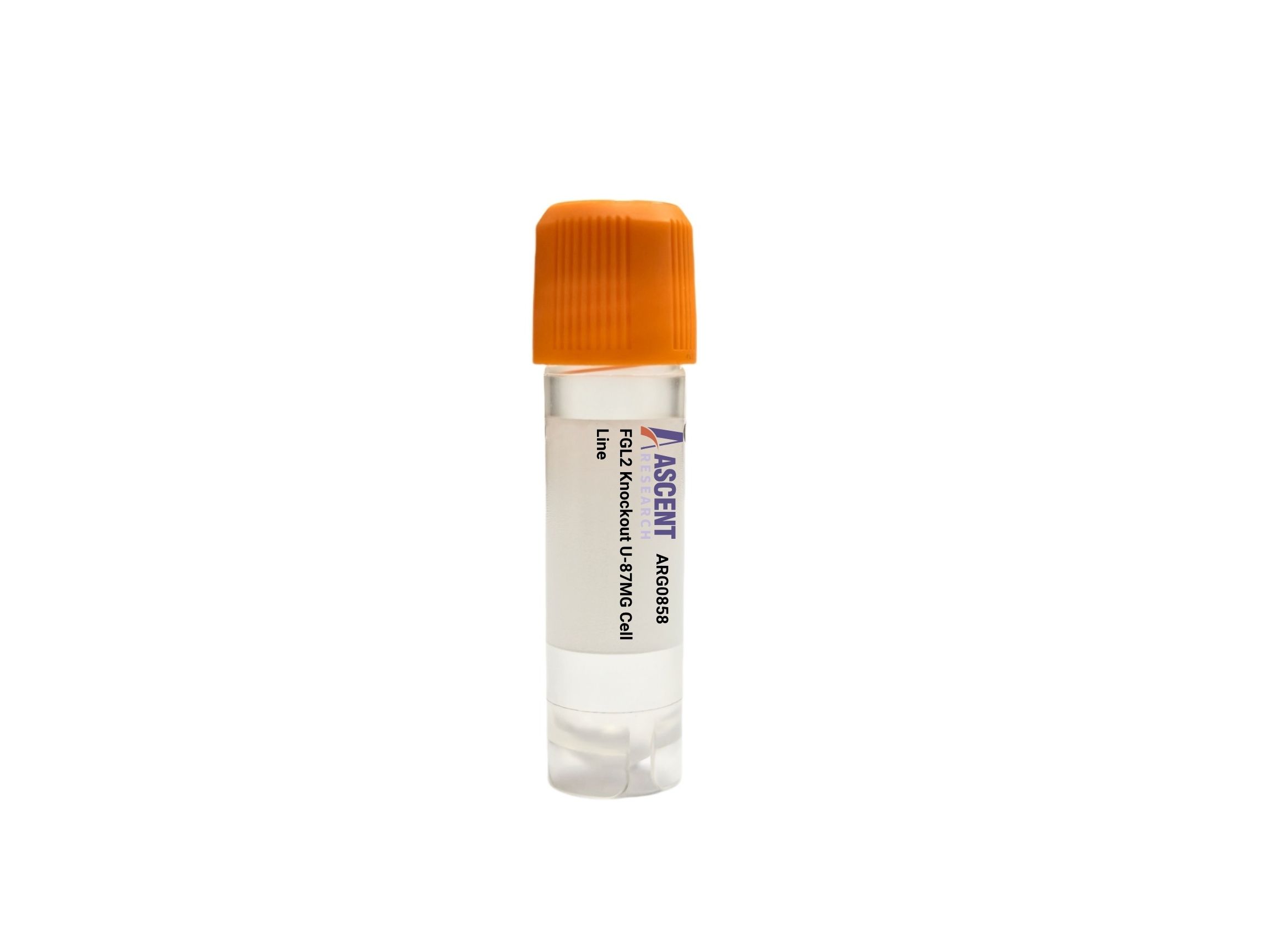
The FGL2 Knockout U-87MG Cell Line is a CRISPR/Cas9-edited knockout cell line derived from the human glioblastoma U-87MG host line, engineered for constitutive disruption of the FGL2 gene. This loss-of-function model eliminates production of the secreted immunosuppressive protein sFGL2, providing a genetically defined tool for dissecting FGL2-mediated immune regulatory mechanisms in a glioblastoma context. The cell line is suited for functional studies where ablation of FGL2 expression is required, offering a stable and reproducible platform for tumor immunology and drug target validation investigations.
The parental U-87MG cell line, originally isolated from a malignant astrocyte-derived tumor, is a well-established model for glioblastoma multiforme. These cells exhibit an epithelial-like morphology and are widely utilized in neuro-oncology research for their reproducible growth characteristics and relevance to human disease. U-87MG cells recapitulate key aspects of glioblastoma biology, including invasive potential, aberrant signaling pathways, and interactions with the tumor microenvironment, making them an ideal host for studying gene function in this aggressive brain cancer.
FGL2 encodes a secreted fibrinogen-like protein with dual procoagulant and immunosuppressive activities. The secreted isoform sFGL2 binds with high affinity to the inhibitory receptor Fc??RIIB on antigen-presenting cells, triggering downstream signaling through SAP and SHP-1 phosphatases that ultimately inhibit NF-??B activation and induce T cell anergy. sFGL2 also promotes regulatory T cell differentiation and enhances production of immunosuppressive cytokines such as IL-10 and TGF-??. Expression of FGL2 is driven by inflammatory stimuli including IFN-??, TNF-??, and LPS, acting through transcription factors STAT1 and NF-??B. Additionally, FGL2 interacts with coagulation factors thrombin and factor X, linking immune regulation to the coagulation cascade.
In glioblastoma, FGL2 contributes to an immunosuppressive tumor microenvironment that facilitates immune evasion and tumor progression. U-87MG cells express FGL2, and its secreted product can suppress effector T cell responses and foster regulatory T cell accumulation within the tumor milieu. Disruption of FGL2 in this cell line thus provides a powerful model to investigate how tumor-intrinsic FGL2 shapes anti-tumor immunity, potentially revealing vulnerabilities that can be exploited for immunotherapeutic intervention. The knockout U-87MG line enables direct assessment of FGL2-dependent effects on immune cell function, cytokine networks, and tumor growth in appropriate in vitro and in vivo settings.
Researchers can employ this FGL2 Knockout U-87MG Cell Line in a range of applications including glioblastoma immune evasion studies, validation of FGL2 as an immunotherapy target, and investigation of tumor microenvironment modulation. Typical readouts involve T cell proliferation assays, flow cytometric analysis of immune checkpoint molecules, and cytokine profiling by ELISA. Additional uses include co-culture experiments with peripheral blood mononuclear cells and mechanistic studies of Fc??RIIB-dependent signaling. Standard characterization assays such as Western blotting, RT-qPCR, and migration assays confirm target gene disruption and functional consequences. For further technical details, please contact Ascent Research.