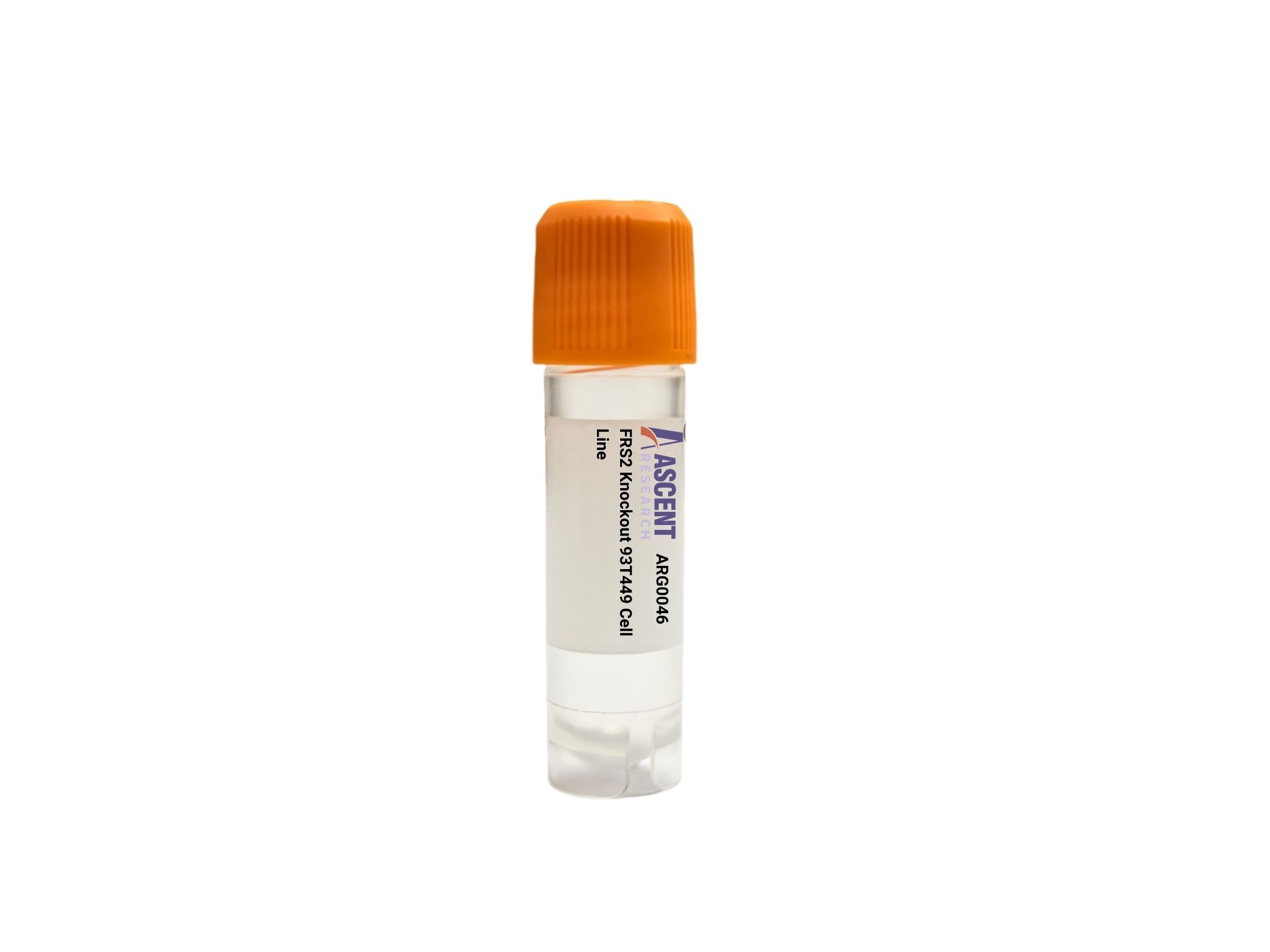
The FRS2 Knockout 93T449 Cell Line is a CRISPR/Cas9-engineered human liposarcoma cell model in which the FRS2 gene has been disrupted to eliminate functional FRS2 expression. This gene-edited derivative of the 93T449 background provides a stable in vitro system for examining the consequences of loss of a key receptor tyrosine kinase adaptor in sarcoma cells. Because FRS2 is a central mediator of fibroblast growth factor receptor signaling, this model is designed for mechanistic studies of pathway transmission from activated surface receptors to intracellular mitogenic and survival networks.
93T449 is a human liposarcoma-derived cell line used as a malignant mesenchymal tumor model for studies of soft tissue sarcoma biology. In culture, this host line is relevant for investigating signaling programs that regulate sarcoma cell growth, survival, and therapeutic response. As an in vitro system derived from liposarcoma, 93T449 is frequently applied to studies of oncogenic signaling dependencies, pathway-targeted drug response, and cellular phenotypes associated with aggressive mesenchymal malignancy. Its utility makes it a suitable background in which to interrogate how specific signaling adaptors contribute to tumor-associated receptor tyrosine kinase output.
FRS2 encodes a membrane-associated docking adaptor that functions downstream of activated FGFR1, FGFR2, FGFR3, and FGFR4. Following stimulation by FGF ligands such as FGF2 and receptor activation facilitated by heparan sulfate proteoglycans, FRS2 becomes tyrosine-phosphorylated and recruits signaling intermediates including GRB2, GAB1, and SHP2/PTPN11. Through these interactions, FRS2 mediates signaling to the GRB2-SOS1 complex, RAS, RAF, MEK1/2, and ERK1/2, while also coupling FGFR activation to PI3K and AKT signaling. Representative pathway components linked to this signaling axis include HRAS, BRAF, MAP2K1, MAPK3, PIK3CA, and AKT1, with downstream transcriptional outputs that can include immediate-early genes such as EGR1 and FOS. FRS2 also interacts with factors such as CBL and SRC family kinases, placing it within a broader receptor tyrosine kinase adaptor network relevant to FGFR-driven cancers and therapeutic resistance.
In the context of a liposarcoma cell line, FRS2 loss provides a direct approach for studying canonical FGFR pathway dependency and the extent to which sarcoma cell behavior relies on adaptor-mediated transmission to ERK and AKT effector arms. This model can support investigations of altered proliferative capacity, survival signaling, pathway rewiring, and gene-expression changes associated with disruption of proximal FGFR signal propagation.
The cell line is suitable for western blot analysis of total and phospho-proteins, including phospho-ERK and phospho-AKT readouts after FGF or inhibitor treatment, as well as RT-qPCR or RNA-seq profiling of pathway-responsive transcriptional programs. Co-immunoprecipitation and immunofluorescence can be used to examine changes in receptor-associated complexes and signaling localization, while cell proliferation, apoptosis, colony formation, migration, and invasion assays enable functional characterization of FRS2-dependent phenotypes. The model is also applicable to drug sensitivity studies, synthetic lethality screens, and combination-treatment experiments aimed at defining vulnerabilities linked to FGFR adaptor loss in soft tissue sarcoma cells. Researchers may contact Ascent Research for additional technical information, product details, or related gene-edited cell models.