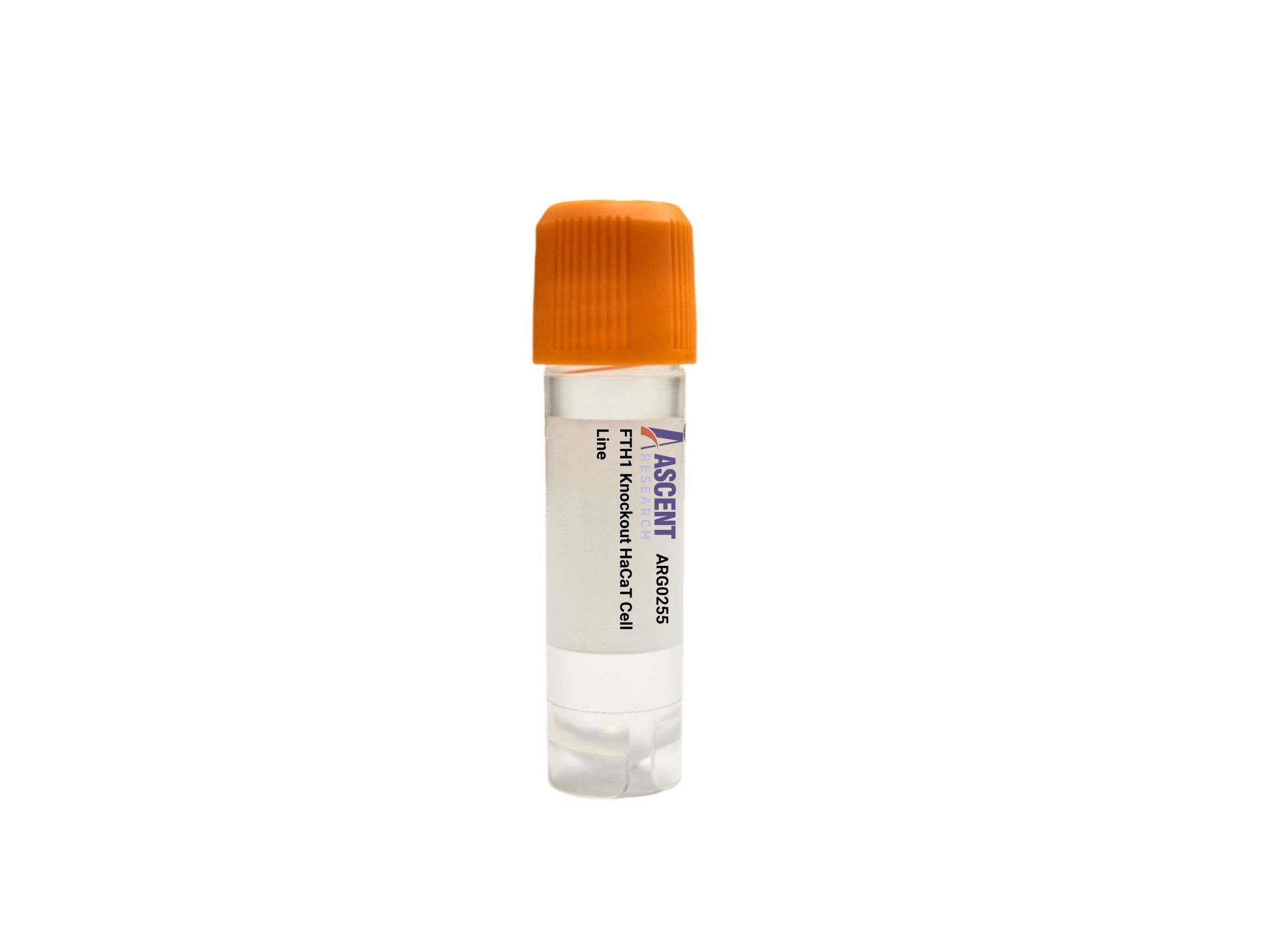
The FTH1 Knockout HaCaT Cell Line is a CRISPR/Cas9-edited human cell line engineered to disrupt the FTH1 gene in the immortalized keratinocyte HaCaT background. This loss-of-function model enables investigation of ferritin heavy chain (FTH1) function in iron storage, redox regulation, and ferroptosis susceptibility. By eliminating FTH1 expression, this cell line serves as a powerful tool for dissecting the molecular mechanisms governing cellular iron homeostasis and oxidative stress responses in a skin-derived epithelial context.
HaCaT cells are spontaneously immortalized human keratinocytes isolated from adult skin that retain the capacity for epidermal differentiation and barrier formation without tumorigenic transformation. Because they faithfully recapitulate keratinocyte physiology, HaCaT cells are widely used to study skin biology, wound healing, and disease-associated processes. In the context of FTH1 knockout, this host background provides a physiologically relevant epithelial platform to examine iron-dependent cytotoxicity and ferroptosis??a regulated cell death pathway triggered by lipid peroxidation??within cells that naturally encounter environmental oxidative challenges.
FTH1 encodes the heavy subunit of ferritin, which assembles with ferritin light chain (FTL) into a 24-mer nanocage that sequesters excess intracellular iron and exhibits ferroxidase activity to convert Fe2? to Fe3?, thereby mitigating iron-catalyzed reactive oxygen species (ROS) generation. FTH1 expression is post-transcriptionally regulated by iron regulatory proteins IRP1 and IRP2 through iron-responsive elements (IRE), and transcriptionally induced by the stress-responsive factor NFE2L2 (NRF2) under oxidative stress. In the iron homeostasis network, FTH1 acts downstream of the transferrin receptor (TFR1)-mediated iron import and interacts with NCOA4, the receptor for ferritinophagy, which delivers ferritin to lysosomes for degradation. Disruption of FTH1 destabilizes the ferritin complex, expands the labile iron pool, and sensitizes cells to ferroptosis by promoting lipid ROS accumulation, a process governed by GPX4, SLC7A11, and ACSL4.
In keratinocytes, tightly regulated iron homeostasis is essential for maintaining barrier integrity and redox balance, as the skin is continuously exposed to UV radiation and oxidative stress. FTH1 depletion in HaCaT cells cripples the primary intracellular iron-buffering system, likely leading to elevated labile iron levels and enhanced susceptibility to ferroptosis upon challenge with erastin or RSL3??compounds that inhibit system Xc? or GPX4. This knockout model thus provides a direct means to assess how iron dysregulation impacts keratinocyte viability, differentiation, and inflammatory responses, and to explore the interplay between ferritinophagy adaptor NCOA4 and ferroptosis execution in an epithelial context relevant to hyperproliferative and neoplastic skin disorders.
Researchers can employ the FTH1 Knockout HaCaT Cell Line to dissect iron-dependent signaling in epithelial cells by quantifying FTH1 and ferritinophagy markers via western blotting and RT-qPCR, measuring labile iron pools with FerroOrange, and monitoring lipid peroxidation using C11-BODIPY. This model is well suited for gauging ferroptosis sensitivity through cell viability assays following erastin or RSL3 treatment, as well as for assessing ROS levels and ferritinophagy flux under various stressors. Additional applications include screening ferroptosis-modulating compounds, investigating the NRF2?Cferritin axis in skin protection, and examining the crosstalk between iron overload and keratinocyte transformation. For detailed information on validation data, culture conditions, or bulk ordering, please contact Ascent Research.