Quick Order Cart

Cat. No. ARG0399

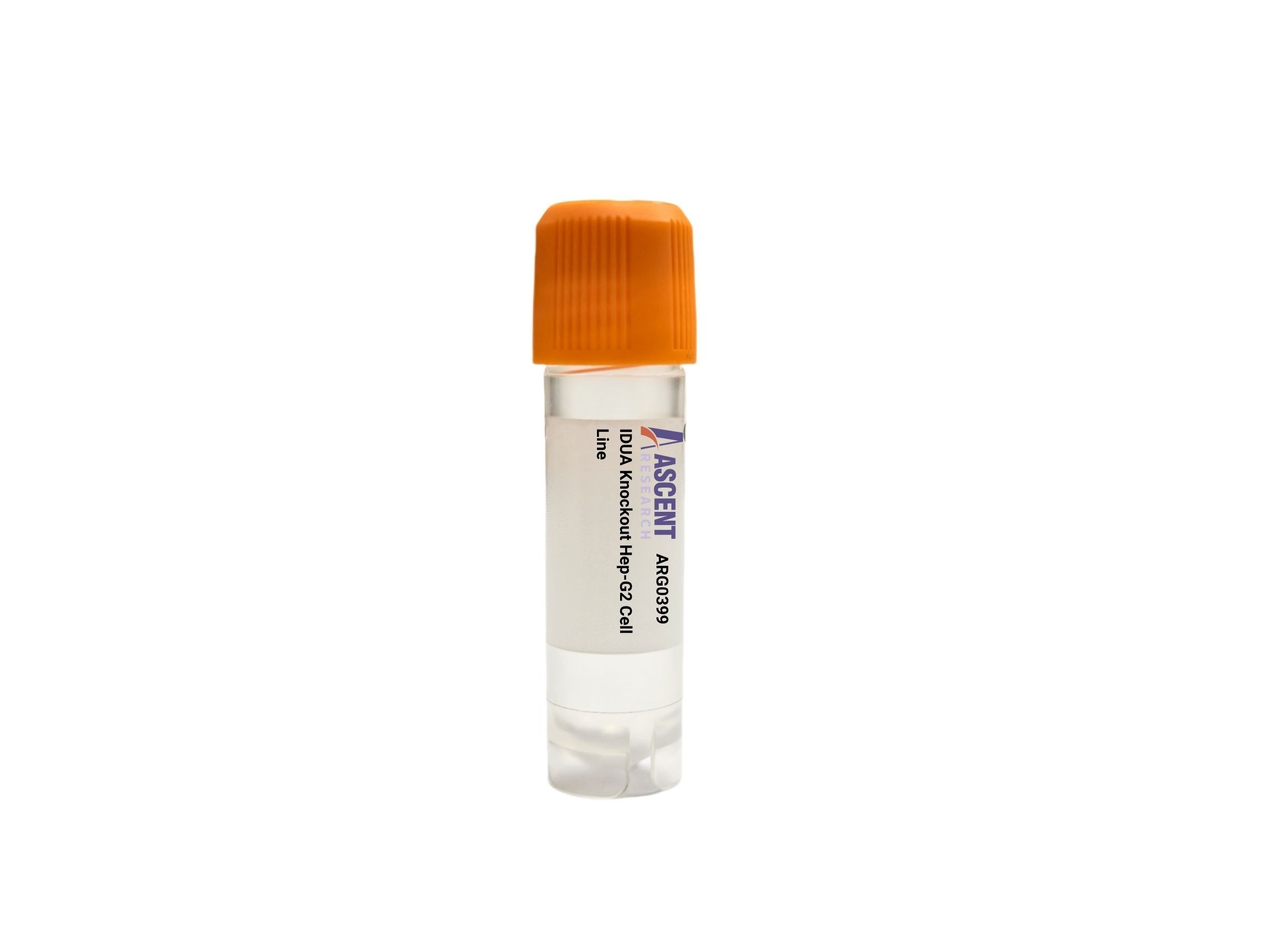
IDUA Knockout Hep-G2 Cell Line

  • Product Type:

    Genome-edited Cells

  • Tissue Source:

    Liver

  • Disease:

    Hepatoblastoma

  • Gene Species:

    Homo sapiens (Human)

The IDUA Knockout Hep-G2 Cell Line is a CRISPR/Cas9-edited human hepatocellular carcinoma cell line with targeted disruption of the IDUA gene, encoding lysosomal alpha-L-iduronidase. This knockout model abolishes enzyme activity, creating a loss-of-function system for studying glycosaminoglycan degradation and related lysosomal storage diseases. IDUA expression is regulated by TFEB and MITF, and its absence leads to accumulation of dermatan and heparan sulfates, lysosomal dysfunction, and impaired autophagy. The Hep-G2 background provides a liver-specific platform for mucopolysaccharidosis type I modeling, enzyme replacement therapy screening, and hepatic glycosaminoglycan metabolism research.

Inquire Now

In stock

Ships next business day


Ask a Question

Shipping Info:

Cryopreserved in vials and shipped on dry ice


Disclaimer:

For Research Use Only

  • Characteristics

    Host Cell

    Hep-G2

    Morphology

    Epithelial-like

    Age

    15 years

    Sex of Donor

    Male

    Gene Name

    IDUA

    Gene Alias

    alpha-L-iduronidase; IDA, MPS1, MPSI

    Gene Species

    Homo sapiens (Human)

    Gene Identifier

    NCBI Gene ID 3425

    Gene Family

    Glycoside hydrolase family

  • Culture Conditions

    Temperature

    37°C

    Atmosphere

    5% CO₂

  • Quality Control

    Sterility testing

    Daily monitoring confirms that the cells are free from bacterial, yeast, and fungal contamination.

    Mycoplasma testing

    Negative for mycoplasma through PCR analysis

    Pathogens

    Cells tested negative for HIV-1, HBV, and HCV.

  • Disclaimer

    Intended Use

    This product is intended for laboratory in vitro use only. lt is not intended for diagnostic, therapeutic, or clinical applications.

    Disclaimer

    Ascent Research endeavors to provide accurate and up-to-date product information. However, no warranties or representations are made regarding its completeness or reliability. References to scientific literature and patents are for informational purposes only, and the customer assumes sole responsibility for verifying their accuracy.

    By accepting this product, the customer acknowledges and agrees to assume all risks associated with its receipt, handling, storage, disposal, and use, including compliance with all applicable safety and environmental regulations and precautions. Relevant laws, regulations, and ethical guidelines must be followed in conducting any research, modifications, or derivatives derived from this product.

    This product is provided "AS IS", and except as expressly stated herein, Ascent Research disclaims all other warranties, express or implied. Under no circumstances shall Ascent Research, its affiliates, or representatives be liable for indirect, incidental, consequential, or punitive damages arising from the use of this material. While Ascent Research employs rigorous quality control measures, we shall not be held responsible for damages resulting from misidentification or misinterpretation of the provided materials.

Description

The IDUA Knockout Hep-G2 Cell Line is a CRISPR/Cas9-edited knockout cell line derived from the human hepatocellular carcinoma Hep-G2 cell line. This product features targeted disruption of the IDUA gene, which encodes the lysosomal enzyme alpha-L-iduronidase, generating a loss-of-function model for this critical glycosaminoglycan-degrading enzyme. By abrogating IDUA expression, this knockout cell line enables researchers to dissect the role of alpha-L-iduronidase in lysosomal catabolism and to model related lysosomal storage disorders in a liver-derived cellular context.

The Hep-G2 host cell line, originating from a 15-year-old male hepatocellular carcinoma patient, exhibits adherent epithelial morphology and is widely employed as a model for hepatic metabolism, toxicity, and drug screening. Hep-G2 cells retain many liver-specific functions, including synthesis and secretion of plasma proteins, cholesterol metabolism, and phase I/II enzyme activities, making them a physiologically relevant platform for studying hepatocyte biology. The integration of IDUA knockout into this established hepatic background provides a nuanced system for investigating liver-specific contributions to glycosaminoglycan metabolism and lysosomal homeostasis.

Mechanistically, IDUA encodes alpha-L-iduronidase, the enzyme responsible for hydrolyzing terminal iduronic acid residues in the glycosaminoglycans dermatan sulfate and heparan sulfate within lysosomes. Its expression is regulated by the transcription factors TFEB and MITF, master regulators of lysosomal biogenesis. Post-translationally, alpha-L-iduronidase is targeted to lysosomes via the mannose-6-phosphate receptor and undergoes proteolytic processing. In the absence of IDUA activity, dermatan and heparan sulfates accumulate, leading to lysosomal dysfunction, impaired autophagy, and disrupted cellular homeostasis. Representative pathway components??including IDUA, dermatan sulfate, heparan sulfate, and the mannose-6-phosphate receptor??constitute the core molecular network affected by this knockout.

In Hep-G2 hepatocellular carcinoma cells, IDUA knockout models mucopolysaccharidosis type I (MPS I), encompassing Hurler and Scheie syndromes. This liver-centric model is valuable as the liver is central for enzyme replacement therapy and susceptible to glycosaminoglycan-mediated pathology. It recapitulates lysosomal storage disorder features, including lysosomal engorgement and autophagic block, enabling study of hepatic metabolic dysregulation and toxicity from glycosaminoglycan accumulation. Additionally, it provides a system to examine how lysosomal dysfunction intersects with liver-specific pathways such as bile acid synthesis and detoxification.

This cell line supports a broad spectrum of research applications, including disease modeling of MPS I, screening of candidate enzyme replacement therapies, and elucidation of glycosaminoglycan catabolic pathways. Representative assays include IDUA activity measurement, quantitative PCR and Western blotting for IDUA expression, DMMB assay for glycosaminoglycan quantification, LAMP1 immunofluorescence, LC-MS/MS for dermatan and heparan sulfate profiling, lysosomal pH measurement, autophagy flux assessment (LC3), apoptosis assays, and RNA-seq transcriptomics. For further details, please contact Ascent Research.


Reset Password

    Reach Us Questions? Click Me Here!

    Fill out the form below and a member of our team will contact you shortly!

    *Required field


      Reach Us

      Fill out the form below and a member of our team will contact you shortly!

      *Required field

      Product Inquiry (Optional)