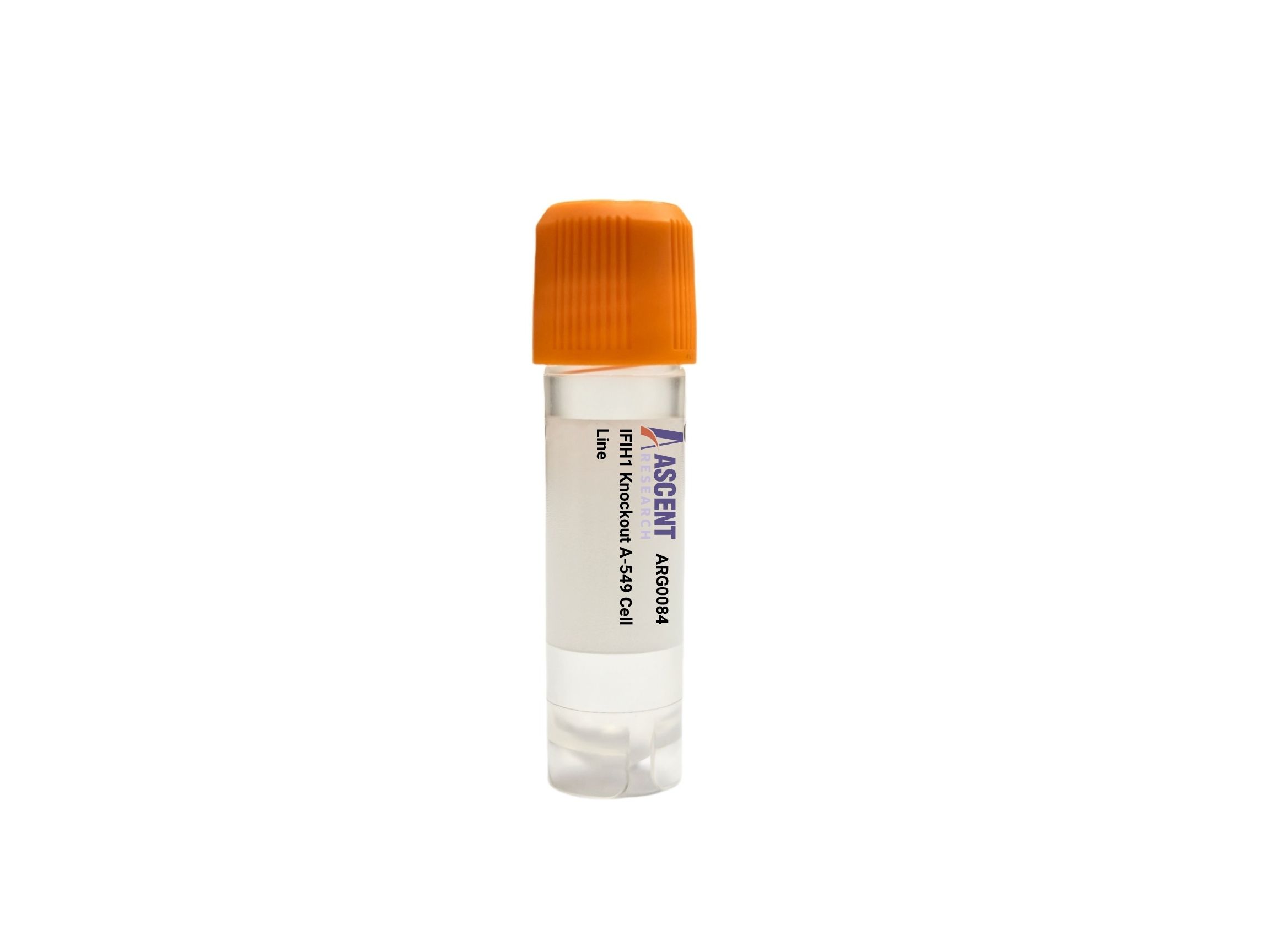
The IFIH1 Knockout A-549 Cell Line is a CRISPR/Cas9-engineered human cell model in which the IFIH1 locus has been disrupted to abolish functional IFIH1/MDA5 expression. This stable knockout line is generated in A-549 cells, a human alveolar epithelial carcinoma cell line, and provides an in vitro system for interrogating dsRNA sensing and antiviral signal transduction in a respiratory epithelial background. The model is designed for researchers studying innate immunity, interferon biology, epithelial inflammatory signaling, and host-pathogen interactions in the lung.
A-549 cells are derived from human lung adenocarcinoma and exhibit alveolar type II-like epithelial features that make them widely used in airway and pulmonary research. As a respiratory epithelial model, A-549 cells are routinely applied to studies of viral infection, interferon responses, epithelial cytokine production, and pulmonary toxicology. Their relevance to airway biology makes them particularly suitable for investigating innate antiviral signaling in epithelial cells, including mechanisms that influence viral replication, inflammatory gene expression, and epithelial responses to exogenous nucleic acids or respiratory pathogens.
IFIH1 encodes MDA5, a cytosolic pattern-recognition receptor activated by long double-stranded RNA, including viral dsRNA and synthetic poly(I:C). In canonical RIG-I-like receptor signaling, IFIH1 acts upstream of MAVS and promotes activation of TBK1 and IKBKE, leading to phosphorylation and activation of IRF3 and IRF7, while also contributing to NFKB1/RELA-dependent inflammatory transcriptional programs. IFIH1 function is regulated in the context of viral infection by dsRNA generated during EMCV infection and SARS-CoV-2 RNA replication, and its expression can be modulated downstream of IFN-beta, IFN-alpha, JAK1, TYK2, STAT1, and IRF1. IFIH1 also interacts with DHX58/LGP2, DDX58/RIG-I, TRIM65, TRIM13, TRAF3, and TRAF6. Downstream consequences of pathway activation include induction of IFNB1, IFNL1, CXCL10, CCL5, ISG15, IFIT1, MX1, and OAS1, linking this pathway to antiviral defense, inflammatory lung disease, COVID-19 research, influenza and picornavirus infection, and interferon-associated autoimmune disorders such as systemic lupus erythematosus and Aicardi-Goutieres syndrome-related interferonopathy.
In the A-549 background, IFIH1 loss provides a focused system to examine how epithelial cells detect cytosolic dsRNA and propagate antiviral cytokine responses. Because A-549 cells are a commonly used respiratory infection model, disruption of IFIH1 enables mechanistic comparison of MDA5-dependent versus MDA5-independent signaling, including pathway dependence on MAVS-TBK1-IRF3/IRF7 and effects on epithelial inflammatory output. This is particularly relevant for defining host-factor requirements during viral challenge and for characterizing how impaired dsRNA sensing alters epithelial interferon competence.
This knockout cell line is suitable for RT-qPCR profiling of IFNB1, IFNL1, CXCL10, ISG15, IFIT1, MX1, and OAS1 after poly(I:C) transfection or viral infection; western blot or phospho-analysis of TBK1 and IRF3; ELISA-based measurement of IFN-beta or CXCL10 secretion; RNA-seq analysis of interferon-stimulated transcriptional programs; interferon reporter assays; immunofluorescence and flow cytometry for pathway readouts; co-immunoprecipitation studies of MAVS- or LGP2-associated signaling complexes; and plaque assay or viral RNA quantification to evaluate effects on viral replication. Researchers may contact Ascent Research for additional technical information, product details, or related gene-edited cell models.