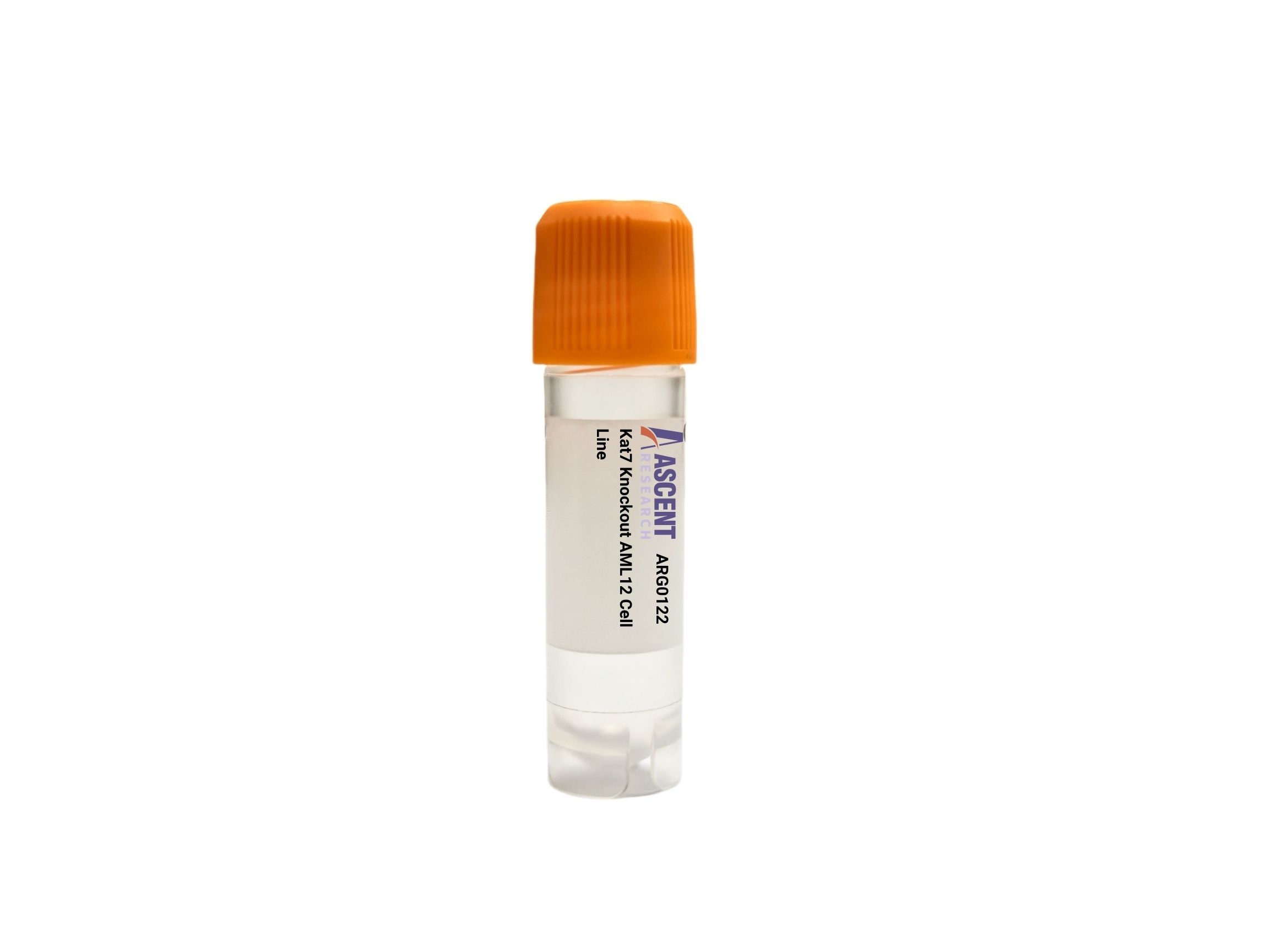
The Kat7 Knockout AML12 Cell Line is a CRISPR/Cas9-engineered mouse hepatocyte model in which the Kat7 gene has been disrupted to abolish functional KAT7 expression. This stable knockout cell line is generated in AML12 cells, a nontransformed hepatocyte cell line that retains differentiated hepatic features and is broadly used for mechanistic studies of liver biology. The model provides a defined in vitro system for examining the consequences of KAT7 loss in parenchymal liver cells, particularly in the context of chromatin regulation, transcriptional control, and replication-associated processes.
AML12 is an immortalized mouse hepatocyte line derived for studies of hepatic metabolism and stress-responsive signaling while preserving many functional characteristics of liver parenchymal cells. It is widely used to investigate insulin-responsive metabolic programs, lipid handling, oxidative stress responses, and hepatocellular injury mechanisms. Because AML12 cells support analysis of differentiated hepatocyte functions alongside proliferative and stress-induced phenotypes, they are well suited for evaluating how epigenetic regulators influence liver metabolic gene expression, injury adaptation, and senescence-related transcriptional states relevant to fatty liver disease, metabolic liver disease, and hepatocellular carcinoma research.
KAT7, also known as HBO1, is a MYST family lysine acetyltransferase that acetylates histone H3 and histone H4 and functions in chromatin remodeling, transcriptional regulation, DNA replication licensing, and cell-cycle control. KAT7 forms complexes with scaffold and adaptor proteins including JADE1, JADE2, JADE3, BRPF1, BRPF2, BRPF3, ING4, and ING5, and it acts in proximity to replication-associated factors such as MCM2 and ORC1. Its recruitment and activity are regulated by growth factor signaling, oxidative stress, DNA damage, E2F-associated cell-cycle cues, and chromatin targeting by transcription factors or scaffold complexes. Downstream, KAT7 promotes H3 and H4 acetylation, supports chromatin accessibility, facilitates replication origin activity involving the ORC complex, CDC6, CDT1, and the MCM2-7 complex, and influences expression of cell-cycle and senescence-associated genes.
In AML12 hepatocytes, Kat7 loss is a relevant perturbation for interrogating how histone acetylation interfaces with liver-specific transcriptional programs and stress adaptation. Disruption of Kat7 is expected to alter acetylation-dependent chromatin states that support hepatocyte metabolic transcription, proliferative capacity, and DNA damage responses. This makes the model useful for studying pathway dependencies linking epigenetic regulation to hepatocyte homeostasis, aging-associated phenotypes, and disease-related transcriptional reprogramming.
Researchers can apply this cell line in western blot and immunofluorescence assays to assess changes in histone H3/H4 acetylation, in RT-qPCR and RNA-seq workflows to profile metabolic, cell-cycle, or senescence-associated transcriptional outputs, and in ChIP-qPCR or ChIP-seq experiments to map KAT7-dependent chromatin effects at specific loci. EdU incorporation assays, cell-cycle analysis, and apoptosis assays can be used to evaluate replication and proliferative phenotypes, while senescence-associated beta-galactosidase assays can support characterization of senescence programs. Co-immunoprecipitation, chromatin accessibility assays, and metabolic assays further enable mechanistic studies of KAT7-containing complexes and hepatocyte functional responses under oxidative stress, DNA damage, or hepatotoxic challenge. Researchers may contact Ascent Research for additional technical information, product details, or related gene-edited cell models.