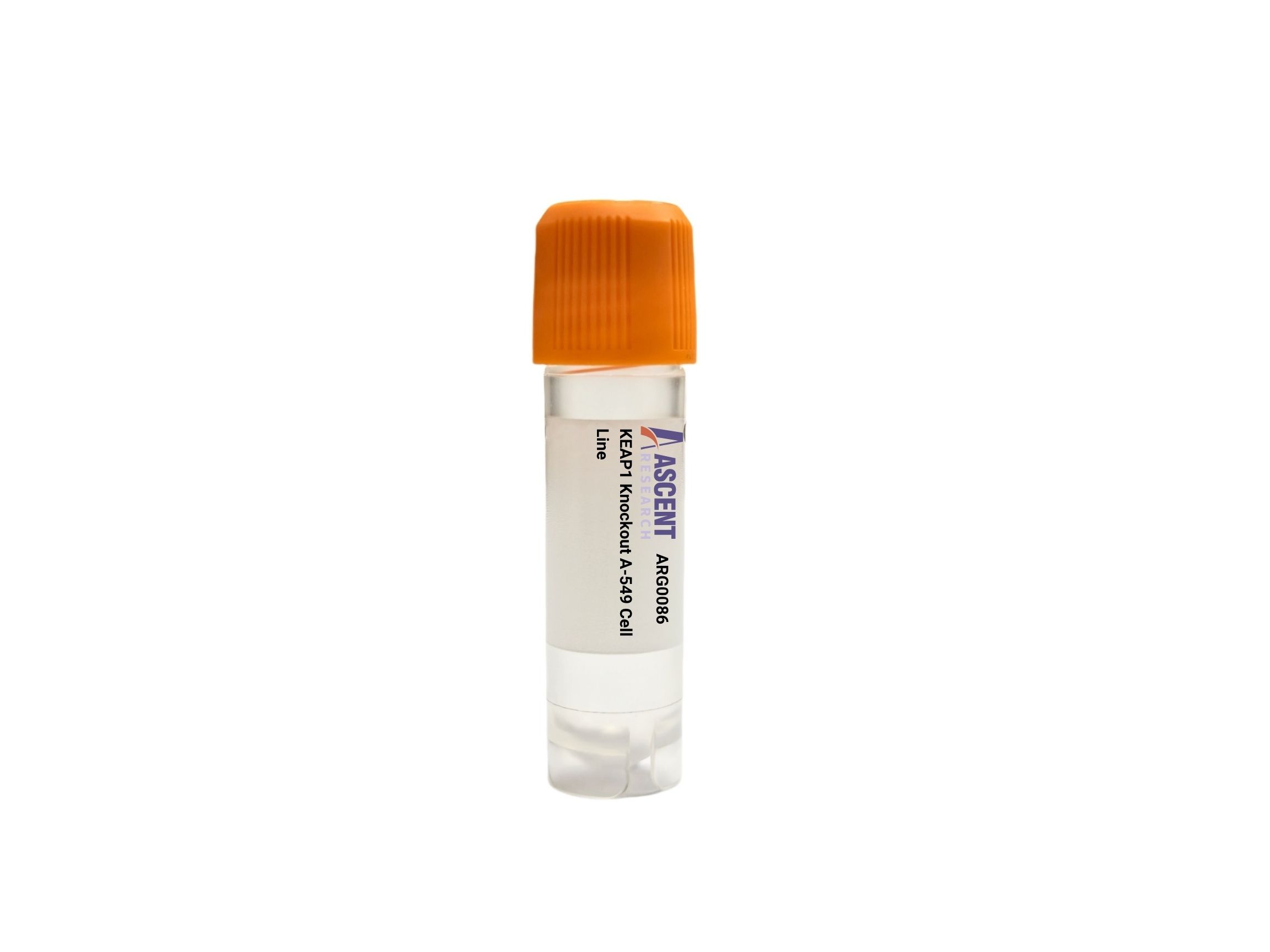
The KEAP1 Knockout A-549 Cell Line is a human CRISPR/Cas9-engineered cell model in which the KEAP1 gene has been disrupted to eliminate functional KEAP1 expression. This stable in vitro knockout system is generated in the A-549 background, a human lung adenocarcinoma epithelial cell line, and is intended for mechanistic studies of redox-regulated signaling, cancer cell adaptation, and therapeutic response. As a gene-edited derivative of a widely used pulmonary tumor model, it provides a defined platform for examining the cellular consequences of KEAP1 loss in a lung epithelial-like cancer context.
A-549 cells are derived from human non-small cell lung cancer and exhibit epithelial characteristics relevant to lung adenocarcinoma biology. This host line is extensively used in studies of pulmonary cell biology, xenobiotic metabolism, oxidative stress signaling, and drug sensitivity, in part because it recapitulates key features of alveolar epithelial-like tumor cells and supports robust molecular and pharmacologic interrogation. The model is therefore suitable for investigating disease-relevant processes in lung cancer, as well as broader questions in toxicology, redox homeostasis, and adaptation to environmental or therapeutic stress.
KEAP1 is a redox-sensitive substrate adaptor that forms a functional complex with CUL3 and RBX1 to promote constitutive ubiquitination and proteasomal degradation of NFE2L2/NRF2 under basal conditions. Its activity is regulated by reactive oxygen species, electrophiles, lipid peroxidation products, and NRF2-inducing oxidants, and is further modulated by interacting factors including SQSTM1/p62, PGAM5, PALB2, IKBKB, and HSP90. Disruption of KEAP1 relieves repression of NRF2, resulting in NRF2 stabilization, nuclear accumulation, and transcriptional activation of ARE-containing target genes such as HMOX1, NQO1, GCLC, GCLM, SLC7A11, TXNRD1, GSTP1, AKR1C1, and FTH1. Through these outputs, the KEAP1-NRF2 axis acts upstream of antioxidant defense, glutathione metabolism, xenobiotic detoxification, reactive oxygen species homeostasis, ferroptosis regulation, and metabolic reprogramming.
In the A-549 background, KEAP1 loss is particularly relevant for studying lung adenocarcinoma-associated redox adaptation, treatment resistance, and pathway dependency. Because A-549 cells are commonly used to model oxidative stress responses and pulmonary xenobiotic biology, KEAP1 knockout provides a useful system for defining how sustained NRF2 activation reshapes transcriptional programs, stress tolerance, and sensitivity to chemotherapeutic agents, radiation, or ferroptosis-inducing conditions in non-small cell lung cancer.
This cell line can be applied in western blot and immunofluorescence workflows to assess NRF2 stabilization and nuclear localization; RT-qPCR, RNA-seq, and ARE reporter assays to quantify activation of HMOX1, NQO1, GCLC, SLC7A11, and related target genes; and co-immunoprecipitation or ubiquitination assays to study disruption of KEAP1-CUL3-RBX1-mediated substrate regulation. It is also suitable for ROS measurements, glutathione assays, flow cytometry, metabolic profiling, colony formation assays, ferroptosis assays, and drug sensitivity studies designed to interrogate chemoresistance, redox liabilities, and synthetic lethal interactions. Researchers may contact Ascent Research for additional technical information, product details, or related gene-edited cell models.