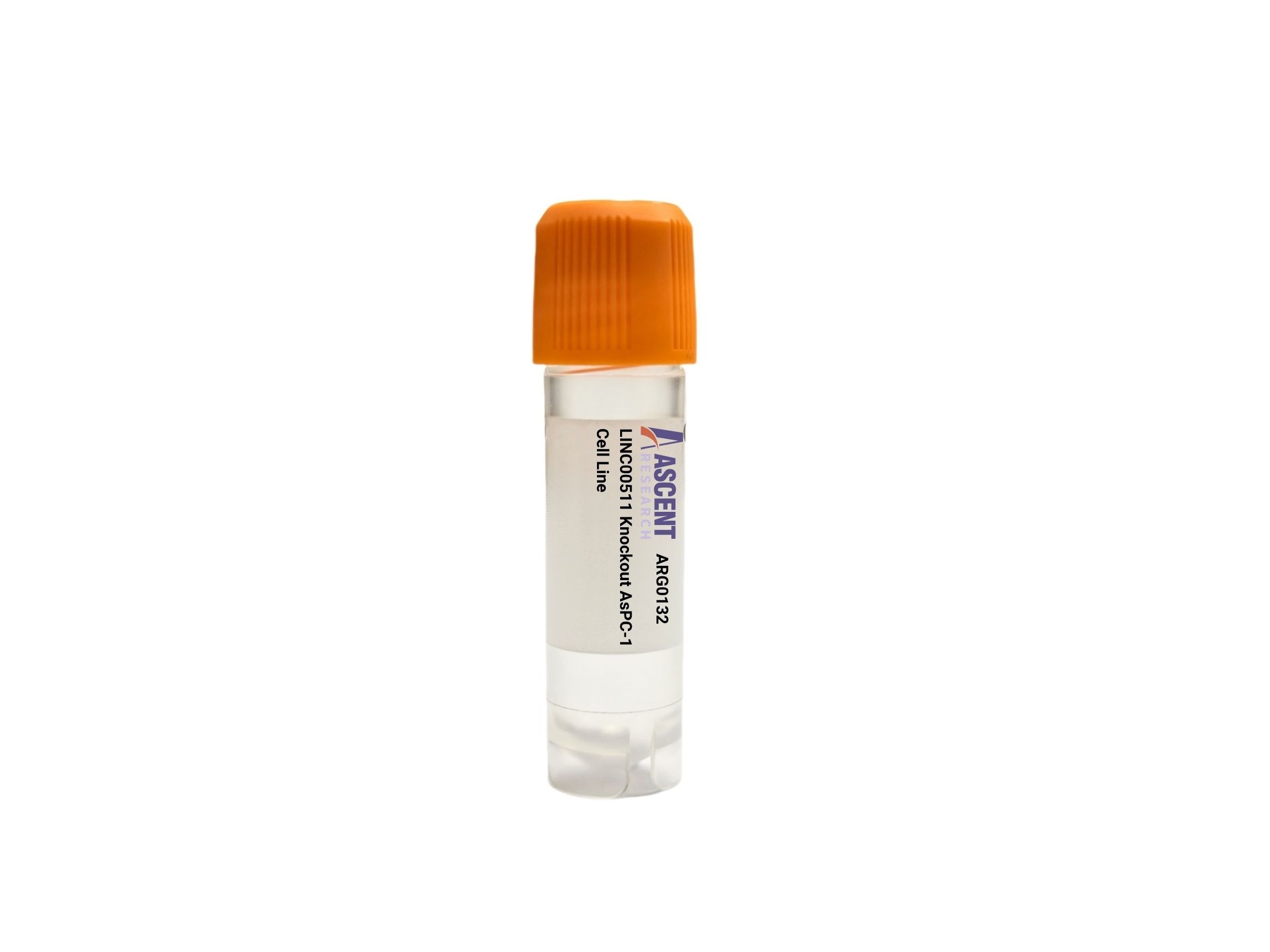
The LINC00511 Knockout AsPC-1 Cell Line is a CRISPR/Cas9-engineered human pancreatic cancer model in which the LINC00511 locus has been disrupted to abolish functional lncRNA expression. This stable in vitro knockout line is generated in AsPC-1 cells, a malignant epithelial-like pancreatic ductal adenocarcinoma background, and is intended for mechanistic studies of lncRNA-dependent regulation in aggressive pancreatic cancer. The model enables controlled interrogation of how loss of LINC00511 alters transcriptional and post-transcriptional programs linked to tumor growth, survival, invasion, and therapeutic response.
AsPC-1 is derived from ascites of metastatic human pancreatic ductal adenocarcinoma and is widely used as a high-aggressiveness PDAC model. Because it recapitulates features relevant to advanced pancreatic malignancy, including invasive behavior, metastatic potential, and treatment resistance, AsPC-1 is broadly applied in studies of pancreatic tumor progression and response to anticancer agents. In this host-cell context, gene perturbation studies are particularly informative for defining drivers of epithelial-mesenchymal transition, anchorage-independent growth, migratory activity, and stress-adaptive survival pathways relevant to metastatic disease.
LINC00511 is a pro-oncogenic long non-coding RNA implicated in chromatin-associated transcriptional control and ceRNA-mediated post-transcriptional regulation. Its expression can be regulated by E2F1, c-MYC, oncogenic stress, TGF-beta-related tumor signaling, and copy-number or epigenetic dysregulation. Mechanistically, LINC00511 has been associated with interaction with EZH2, the PRC2 complex, LSD1, and AGO2-associated RNA silencing machinery, consistent with roles in repression of differentiation-associated genes and modulation of microRNA availability. Through interactions involving the miR-29 family, miR-185, miR-195, and miR-324-5p, LINC00511 can act upstream of transcripts linked to cell-cycle progression, survival, and EMT, including CDK4, CDK6, CCND1, BCL2, VIM, CDH1, MMP2, MMP9, and MYC. These effects intersect with PI3K-AKT-MTOR and Wnt-beta-catenin pathway components such as PIK3CA, AKT1, MTOR, GSK3B, and CTNNB1, as well as TGFBR1-SMAD2-SMAD3 signaling and EMT regulators including ZEB1.
In AsPC-1 cells, knockout of LINC00511 provides a biologically relevant framework for testing how lncRNA loss reshapes pancreatic cancer phenotypes. This model is useful for dissecting whether aggressive PDAC behavior depends on LINC00511-mediated maintenance of proliferative transcriptional states, anti-apoptotic signaling, mesenchymal marker expression, or invasion-associated matrix remodeling. It also supports pathway-dependency studies linking lncRNA loss to altered expression of CDH1 and VIM or to changes in beta-catenin- and TGF-beta-associated programs.
The cell line is suitable for RT-qPCR confirmation of transcript loss, RNA-seq profiling of downstream gene-expression changes, and ceRNA network analysis involving candidate microRNAs and AGO2-associated complexes. Functional applications include cell proliferation and colony formation assays, apoptosis assays, flow-cytometric cell-cycle analysis, wound-healing, migration, and Matrigel invasion assays, as well as western blotting and immunofluorescence for markers such as CDH1, VIM, and pathway effectors in PI3K-AKT or Wnt-beta-catenin signaling. The model can also be applied in RNA immunoprecipitation, ChIP-qPCR for chromatin-regulatory mechanisms involving EZH2 or LSD1, reporter assays, and drug sensitivity studies addressing chemoresistance and pathway-targeted therapeutic response in pancreatic ductal adenocarcinoma. Researchers may contact Ascent Research for additional technical information, product details, or related gene-edited cell models.