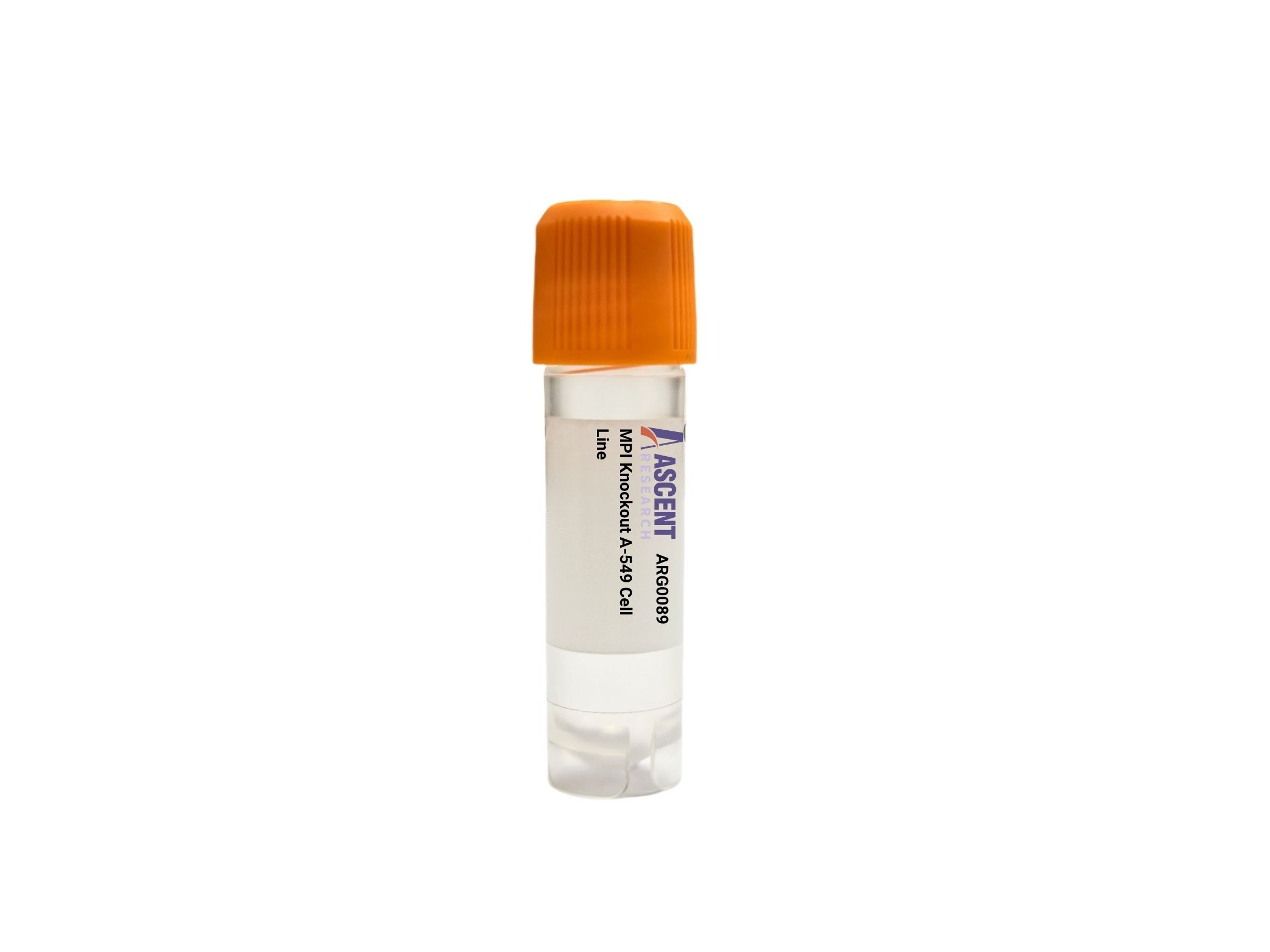
MPI Knockout A-549 Cell Line is a CRISPR/Cas9-engineered human cell model in which the MPI gene has been disrupted to eliminate functional mannose phosphate isomerase expression. This stable knockout line is generated in A-549 cells, a human lung adenocarcinoma epithelial cell line, and provides an in vitro system for investigating the consequences of MPI loss on carbohydrate flux, glycoprotein biosynthesis, and stress signaling. The model is designed for mechanistic studies requiring a defined perturbation of mannose phosphate isomerase function in a cancer-relevant epithelial background.
A-549 cells exhibit epithelial morphology and are broadly used as a model of non-small cell lung cancer and alveolar type II-like pulmonary epithelial biology. Because this line retains features relevant to epithelial tumor signaling, metabolic adaptation, and lung cancer cell physiology, it is widely applied in studies of growth control, nutrient utilization, and therapeutic response. Its established use in pulmonary oncology and cell metabolism makes A-549 a practical host for evaluating how specific gene disruptions alter epithelial cancer cell behavior under basal and stress-inducing culture conditions.
MPI catalyzes the reversible interconversion of fructose-6-phosphate and mannose-6-phosphate, thereby linking central carbon metabolism to mannose metabolism, GDP-mannose synthesis, and N-linked glycosylation precursor supply. MPI functions upstream of mannose-6-phosphate-dependent pathways involving PMM2, mannose-1-phosphate, GMPPA, GMPPB, and the DPM1-DPM2-DPM3 complex that generates dolichol-phosphate-mannose for lipid-linked oligosaccharide biosynthesis. Through these processes, MPI supports ALG family glycosyltransferase activity, oligosaccharyltransferase-mediated glycan transfer, and calnexin/calreticulin-dependent protein folding quality control in the endoplasmic reticulum. Its activity is regulated by glucose availability, mannose availability, substrate flux through phosphoglucose isomerase-linked metabolism, nutrient stress, and ER stress. Loss of MPI is expected to act upstream of reduced mannose-6-phosphate and impaired N-glycan maturation, with downstream consequences that may include altered glycoprotein folding efficiency and induction of integrated stress response and unfolded protein response markers such as ATF4 and DDIT3/CHOP.
In the A-549 background, MPI knockout provides a relevant platform for examining how glycosylation precursor insufficiency intersects with lung cancer metabolism and epithelial stress adaptation. Because alveolar epithelial-like tumor cells are sensitive to metabolic state and secretory pathway integrity, this model can be used to interrogate mannose dependency, nutrient limitation phenotypes, ER homeostasis, and proliferation or survival responses associated with glycosylation stress.
This cell line is suitable for CRISPR genotyping and confirmation of MPI loss by western blotting, as well as RT-qPCR or RNA-seq analysis of stress-response transcriptional programs. Researchers can assess glycosylation phenotypes using lectin blotting, flow cytometry of cell-surface glycans, or N-glycan profiling by mass spectrometry, and can relate these findings to metabolic assays, mannose rescue experiments, proliferation measurements, apoptosis assays, ER stress reporter assays, and drug sensitivity studies under defined nutrient conditions. Such applications are relevant to investigations of congenital disorders of glycosylation, ER stress-associated disease mechanisms, metabolic vulnerability mapping, and lung cancer therapeutic response. Researchers may contact Ascent Research for additional technical information, product details, or related gene-edited cell models.