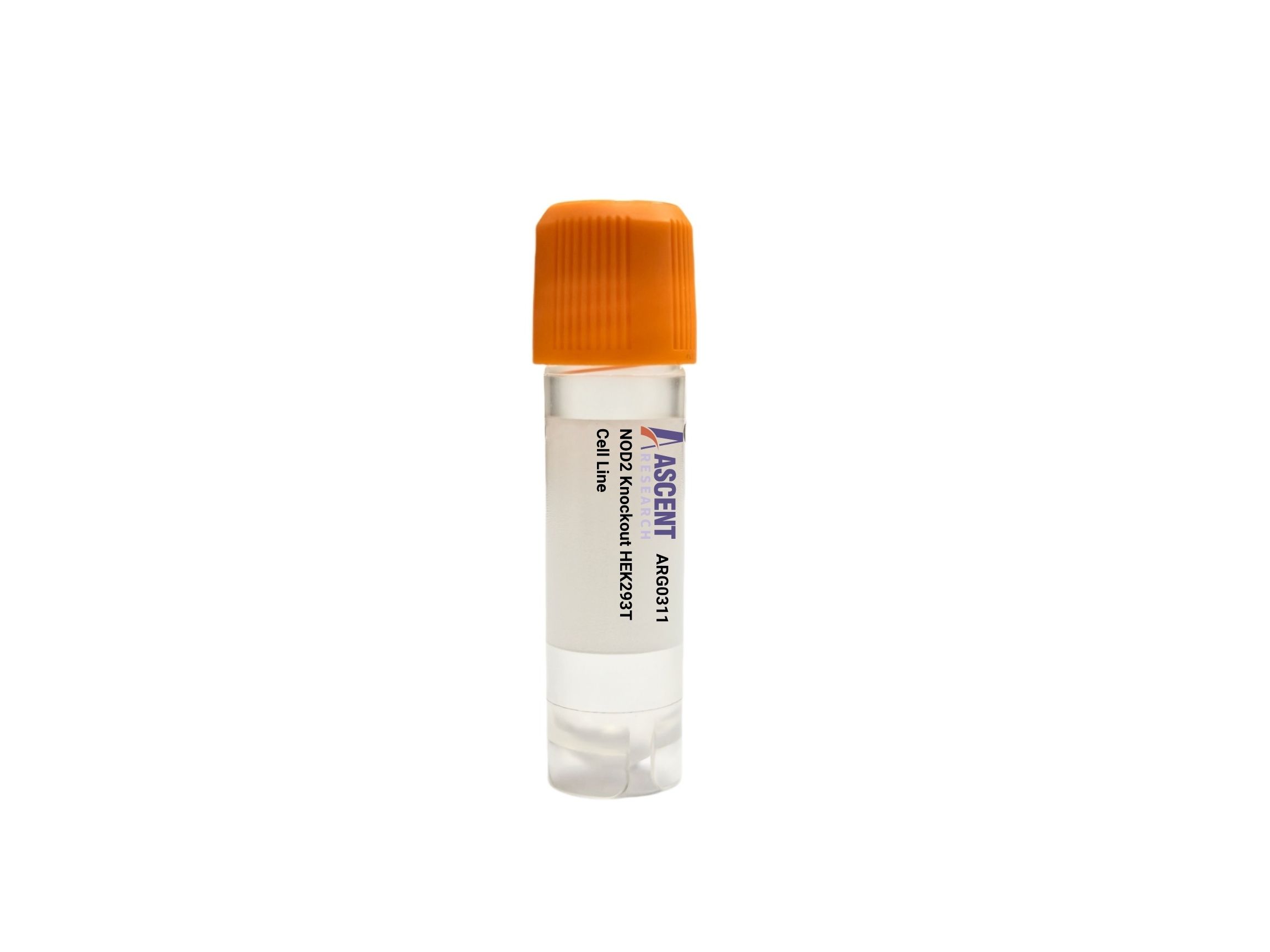
The NOD2 Knockout HEK293T Cell Line is a CRISPR/Cas9-edited knockout cell line designed to eliminate NOD2 gene function in human embryonic kidney epithelial cells. This product provides a defined loss-of-function model for investigating nucleotide-binding oligomerization domain-containing protein 2 (NOD2)-mediated innate immune signaling. By disrupting the endogenous NOD2 locus, researchers can assess NOD2-dependent cellular responses with minimal interference from wild-type protein. The knockout cell line serves as a critical tool for dissecting NOD2-specific contributions to pattern recognition receptor pathways and inflammatory cascades.
The parental HEK293T cell line is a widely adopted host for protein expression and viral production, characterized by its human embryonic kidney origin and stable integration of adenovirus 5 DNA encoding the SV40 large T antigen. This genetic background confers high transfection efficiency and robust episomal replication of plasmids containing the SV40 origin, making HEK293T cells a versatile platform for heterologous gene expression. As epithelial cells, they lack many endogenous innate immune receptors, offering a relatively clean background for studying exogenously introduced signaling components. The derivation and properties of HEK293T cells make them particularly well-suited for biochemical and cell-based assays requiring efficient DNA delivery and protein production.
NOD2 functions as an intracellular sensor of bacterial peptidoglycan, specifically recognizing the muramyl dipeptide (MDP) motif. Upon ligand binding, NOD2 undergoes conformational changes that promote homotypic CARD?CCARD interactions with the adaptor kinase RIPK2. This engagement triggers the assembly and activation of the TAK1 kinase complex, which subsequently phosphorylates and activates the IKK complex and MAPK kinases, leading to nuclear translocation of NF-??B and activation of JNK and p38 MAPK pathways. These signaling cascades drive the transcription of pro-inflammatory cytokines such as IL-6, TNF-??, and IL-1??, as well as chemokines and antimicrobial peptides. NOD2 activity is modulated by upstream regulators including LRRK2 and TNF-??, and it physically interacts with a network of proteins that includes CARD9, ATG16L1, ERBIN, SGT1, and HSP90. Representative pathway components downstream of NOD2 include RIPK2, TAK1, the IKK complex, NF-??B, JNK, p38, and AP-1 transcription factors. This intricate signaling network positions NOD2 as a central mediator of innate immunity and inflammatory homeostasis.
In the HEK293T context, knockout of NOD2 eliminates endogenous responses to MDP, enabling clean reconstitution experiments with wild-type or disease-associated NOD2 variants. Because HEK293T cells exhibit minimal background expression of other NLR family members, the knockout line provides a specific platform for studying NOD2-dependent NF-??B and MAPK activation without confounding signals from related sensors. This is particularly valuable for investigating NOD2 mutations linked to Crohn??s disease, Blau syndrome, and early-onset sarcoidosis, as researchers can introduce mutant forms and directly compare signaling outputs. Furthermore, the high transfection efficiency of HEK293T cells supports co-expression of interacting partners like RIPK2 and ATG16L1, facilitating detailed structure?Cfunction analyses and drug?Ctarget interaction studies. The knockout cell line thus bridges basic NOD2 biochemistry and translational research aimed at modulating NOD2 activity in inflammatory bowel disease.
Typical applications of the NOD2 Knockout HEK293T Cell Line span innate immunity research, host?Cpathogen interaction studies, and drug discovery. Researchers can stimulate cells with MDP and measure NF-??B activation via luciferase reporter assays, quantify phospho-NF-??B p65 and phospho-JNK levels by western blotting, or assess cytokine mRNA induction by RT-qPCR for IL-6 and TNF-??. ELISA-based detection of secreted cytokines and chemokines further validates functional outcomes. Co-immunoprecipitation experiments confirm the NOD2?CRIPK2 interaction, while flow cytometry enables single-cell analysis of NF-??B activation. Immunofluorescence can monitor NOD2 subcellular localization in the absence of endogenous protein. These assays support screening of small-molecule inhibitors of NOD2 signaling and evaluation of therapeutic candidates targeting the NOD-like receptor pathway. For additional information or inquiries, please contact Ascent Research.