Quick Order Cart

Cat. No. ARG0313

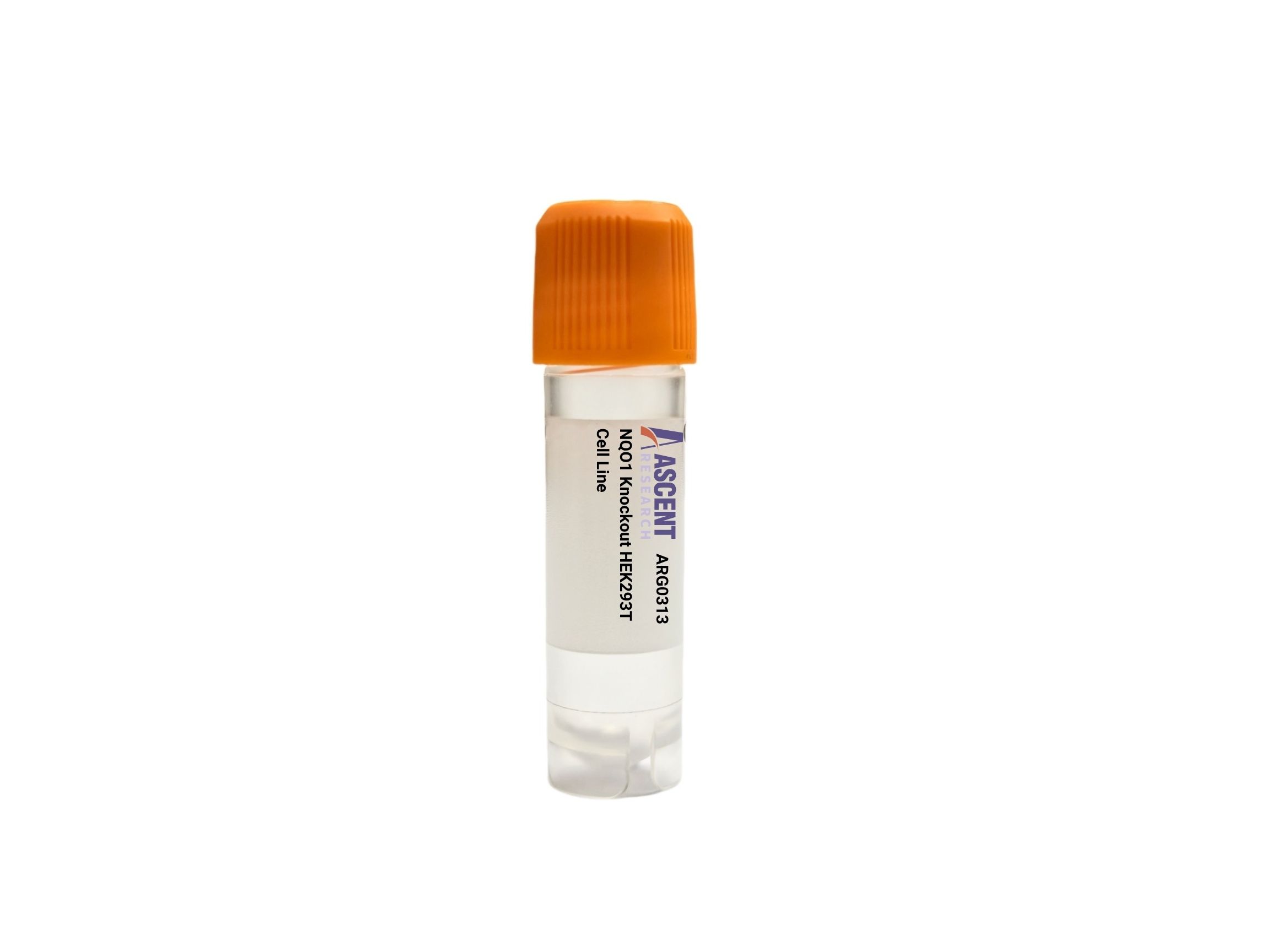
NQO1 Knockout HEK293T Cell Line

  • Product Type:

    Genome-edited Cells

  • Tissue Source:

    Kidney

  • Gene Species:

    Homo sapiens (Human)

The NQO1 Knockout HEK293T Cell Line is a CRISPR/Cas9-edited knockout cell line that disrupts NQO1 gene expression, enabling loss-of-function studies of this key antioxidant and detoxification enzyme. NQO1 catalyzes quinone reduction and is regulated by NRF2, interacting with p53 to link redox balance and genomic stability. This model, in the widely used HEK293T background, is ideal for investigating oxidative stress responses, drug bioactivation, and p53 signaling. Applications include ROS detection, enzymatic assays, and drug sensitivity testing. Contact Ascent Research for details.

Inquire Now

In stock

Ships next business day


Ask a Question

Shipping Info:

Cryopreserved in vials and shipped on dry ice


Disclaimer:

For Research Use Only

  • Characteristics

    Host Cell

    HEK293T

    Age

    Fetus

    Sex of Donor

    Female

    Gene Name

    Nqo1

    Gene Species

    Homo sapiens (Human)

    Gene Identifier

    NCBI Gene ID 1728

  • Culture Conditions

    Temperature

    37°C

    Atmosphere

    5% CO₂

  • Quality Control

    Sterility testing

    Daily monitoring confirms that the cells are free from bacterial, yeast, and fungal contamination.

    Mycoplasma testing

    Negative for mycoplasma through PCR analysis

    Pathogens

    Cells tested negative for HIV-1, HBV, and HCV.

  • Disclaimer

    Intended Use

    This product is intended for laboratory in vitro use only. lt is not intended for diagnostic, therapeutic, or clinical applications.

    Disclaimer

    Ascent Research endeavors to provide accurate and up-to-date product information. However, no warranties or representations are made regarding its completeness or reliability. References to scientific literature and patents are for informational purposes only, and the customer assumes sole responsibility for verifying their accuracy.

    By accepting this product, the customer acknowledges and agrees to assume all risks associated with its receipt, handling, storage, disposal, and use, including compliance with all applicable safety and environmental regulations and precautions. Relevant laws, regulations, and ethical guidelines must be followed in conducting any research, modifications, or derivatives derived from this product.

    This product is provided "AS IS", and except as expressly stated herein, Ascent Research disclaims all other warranties, express or implied. Under no circumstances shall Ascent Research, its affiliates, or representatives be liable for indirect, incidental, consequential, or punitive damages arising from the use of this material. While Ascent Research employs rigorous quality control measures, we shall not be held responsible for damages resulting from misidentification or misinterpretation of the provided materials.

Description

The NQO1 Knockout HEK293T Cell Line is a CRISPR/Cas9-edited knockout cell line in which the NQO1 gene has been disrupted to abolish protein expression. This model provides a defined loss-of-function platform for investigating the roles of NAD(P)H quinone dehydrogenase 1 in redox homeostasis, xenobiotic metabolism, and tumor suppressor pathways. The knockout was generated using CRISPR/Cas9-mediated gene editing, ensuring a stable, heritable disruption of the target locus.

The host HEK293T cell line is a derivative of human embryonic kidney cells that expresses the SV40 large T-antigen, enabling high transfection efficiency and episomal plasmid replication. As an epithelial cell line widely used in molecular biology, HEK293T supports robust protein expression, viral production, and gene function studies. Its well-characterized background makes it an ideal system for creating isogenic knockout models for downstream applications.

NQO1 encodes a flavoprotein that catalyzes obligate two-electron reduction of quinones to hydroquinones, bypassing semiquinone radicals and mitigating oxidative stress. This reaction is part of the NRF2?CKEAP1 antioxidant response pathway, where NRF2 transcriptionally activates NQO1 via the antioxidant response element (ARE). Beyond its enzymatic function, NQO1 physically binds and stabilizes p53, inhibiting its degradation and linking detoxification to genomic stability. Additional interacting factors such as HSP90, Parkin, and SIRT1 further embed NQO1 in networks governing protein folding, mitophagy, and metabolic sensing. Upstream regulators including HIF1A, AhR, and estrogen receptor modulate NQO1 expression under diverse conditions.

In HEK293T cells, elimination of NQO1 enables dissection of its contributions to basal and stress-induced cytoprotection. The knockout line facilitates study of NQO1-dependent p53 stabilization, HIF-1?? regulation, and NAD+/NADH homeostasis. Given the kidney-derived origin of the host, this model is also relevant for examining NQO1 function in renal detoxification and hormone-responsive pathways.

Typical applications include measuring NQO1 enzymatic activity, Western blotting and RT-qPCR for target validation, ROS detection assays (DCFDA), cell viability testing under oxidative challenge, p53 stabilization experiments, and drug sensitivity profiling with agents such as ??-lapachone and mitomycin C. This cell line supports research in oxidative stress, cancer biology, neuroprotection, and drug resistance. For further information, please contact Ascent Research.


Reset Password

    Reach Us Questions? Click Me Here!

    Fill out the form below and a member of our team will contact you shortly!

    *Required field


      Reach Us

      Fill out the form below and a member of our team will contact you shortly!

      *Required field

      Product Inquiry (Optional)