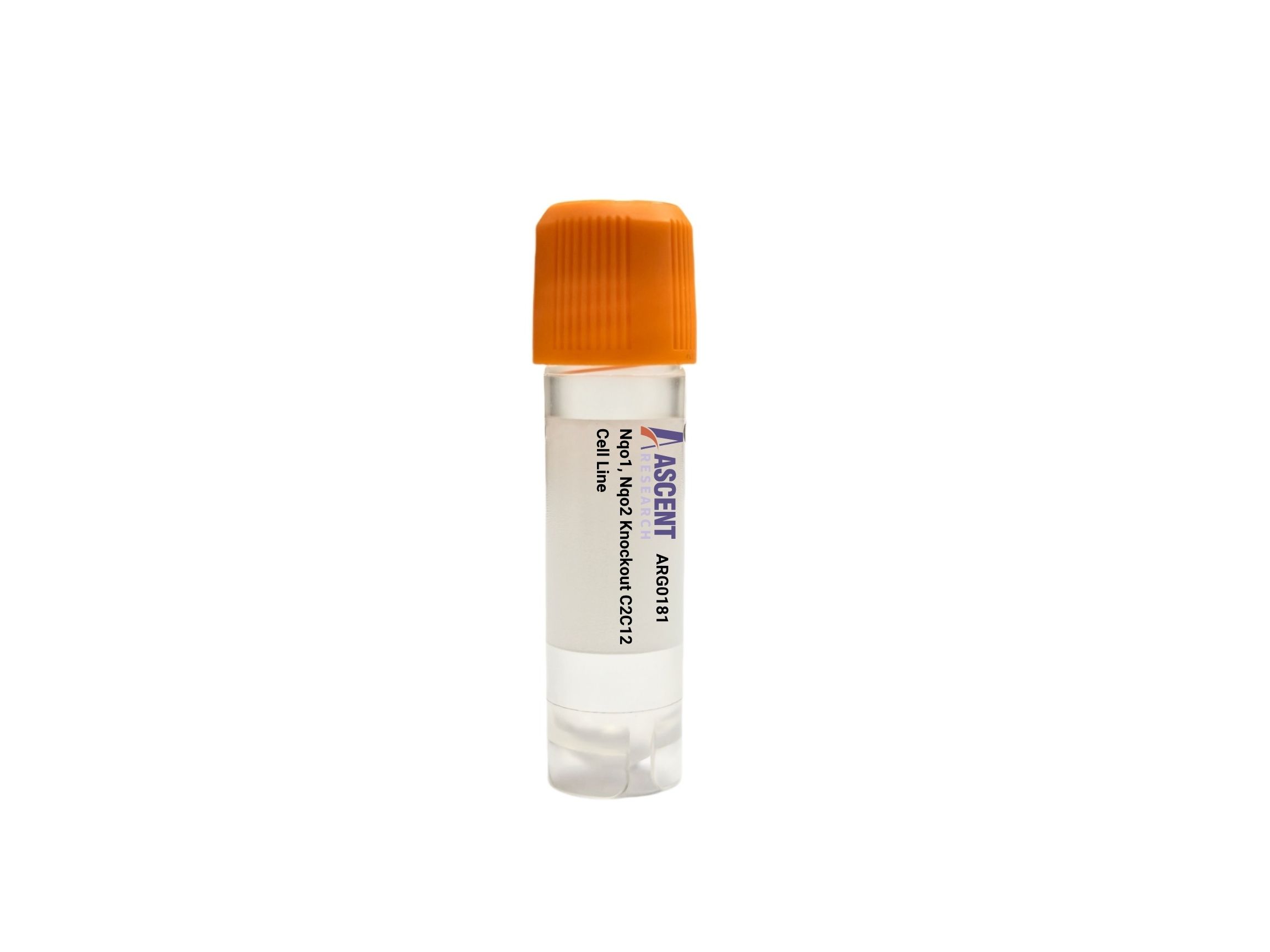
The Nqo1, Nqo2 Knockout C2C12 Cell Line is a CRISPR/Cas9-engineered mouse myoblast model in which Nqo1 and Nqo2 have been disrupted to eliminate functional expression of these quinone reductases. This stable in vitro system is designed for mechanistic studies of cellular redox control, xenobiotic metabolism, and stress adaptation in skeletal muscle precursor cells. By combining dual-gene loss with the well-characterized C2C12 background, the model enables controlled analysis of quinone detoxification pathways in a biologically relevant myogenic context.
C2C12 cells are a murine myoblast line derived from adult skeletal muscle satellite cells and are extensively used to study myogenesis, muscle metabolism, oxidative injury, and differentiation. Under proliferative conditions, they function as skeletal muscle precursor cells, while differentiation conditions drive fusion into multinucleated myotubes. This transition makes C2C12 a useful platform for evaluating how redox status influences both proliferative myoblast biology and differentiated muscle phenotypes. The line is therefore broadly relevant to studies of muscle stress responses, metabolic disease, degenerative processes, and inflammation-associated tissue damage.
NQO1 and NQO2 are cytosolic flavoproteins that catalyze largely two-electron reduction of quinones and related redox-active substrates, thereby limiting semiquinone formation, redox cycling, and reactive oxygen species generation. Their activity depends on cofactors and interacting factors including FAD and NAD(P)H, and they function within the broader NRF2-KEAP1 stress response network. Nqo1 is transcriptionally induced downstream of NFE2L2/NRF2, which is negatively regulated by KEAP1 and CUL3 and cooperates with small MAF proteins at antioxidant response elements; this same axis also promotes expression of HMOX1, GCLC, GCLM, TXNRD1, and GSTP1. Upstream modulation by oxidative stress, electrophiles, quinones, AHR signaling, tert-butylhydroquinone, or sulforaphane links these enzymes to phase II metabolism and glutathione-dependent defense. Loss of Nqo1/Nqo2 is therefore expected to affect cellular ROS levels, glutathione redox balance, lipid peroxidation, NAD(P)H consumption, and survival under redox stress.
In the C2C12 setting, combined Nqo1/Nqo2 deficiency provides a relevant model to examine how impaired quinone handling alters muscle-cell behavior during proliferation or differentiation. Because myoblast fusion and myotube maturation are sensitive to oxidative tone, this background can be used to investigate redox-dependent effects on myogenic differentiation under electrophilic or mitochondrial stress. The model is also useful for studying toxicant-induced cell injury, oxidative stress-related muscle damage, and susceptibility pathways relevant to myopathy, metabolic dysfunction, and degenerative disease.
Applications include western blotting and RT-qPCR analysis of NRF2-responsive genes such as Nqo1, Hmox1, Gclc, Gclm, and Txnrd1; RNA-seq for pathway-level responses to quinones or electrophiles; intracellular ROS and glutathione measurements to quantify redox imbalance; and NAD(P)H-dependent enzyme activity assays to assess quinone detoxification capacity. Researchers may also employ viability, cytotoxicity, apoptosis, and lipid peroxidation assays to profile sensitivity to redox-cycling compounds, as well as mitochondrial function assays to examine stress coupling between cytosolic detoxification and mitochondrial homeostasis. In differentiation studies, immunofluorescence for myogenic markers, myotube formation assays, and NRF2 reporter assays can be used to define how Nqo1/Nqo2 loss reshapes stress signaling and lineage progression. Researchers may contact Ascent Research for additional technical information, product details, or related gene-edited cell models.