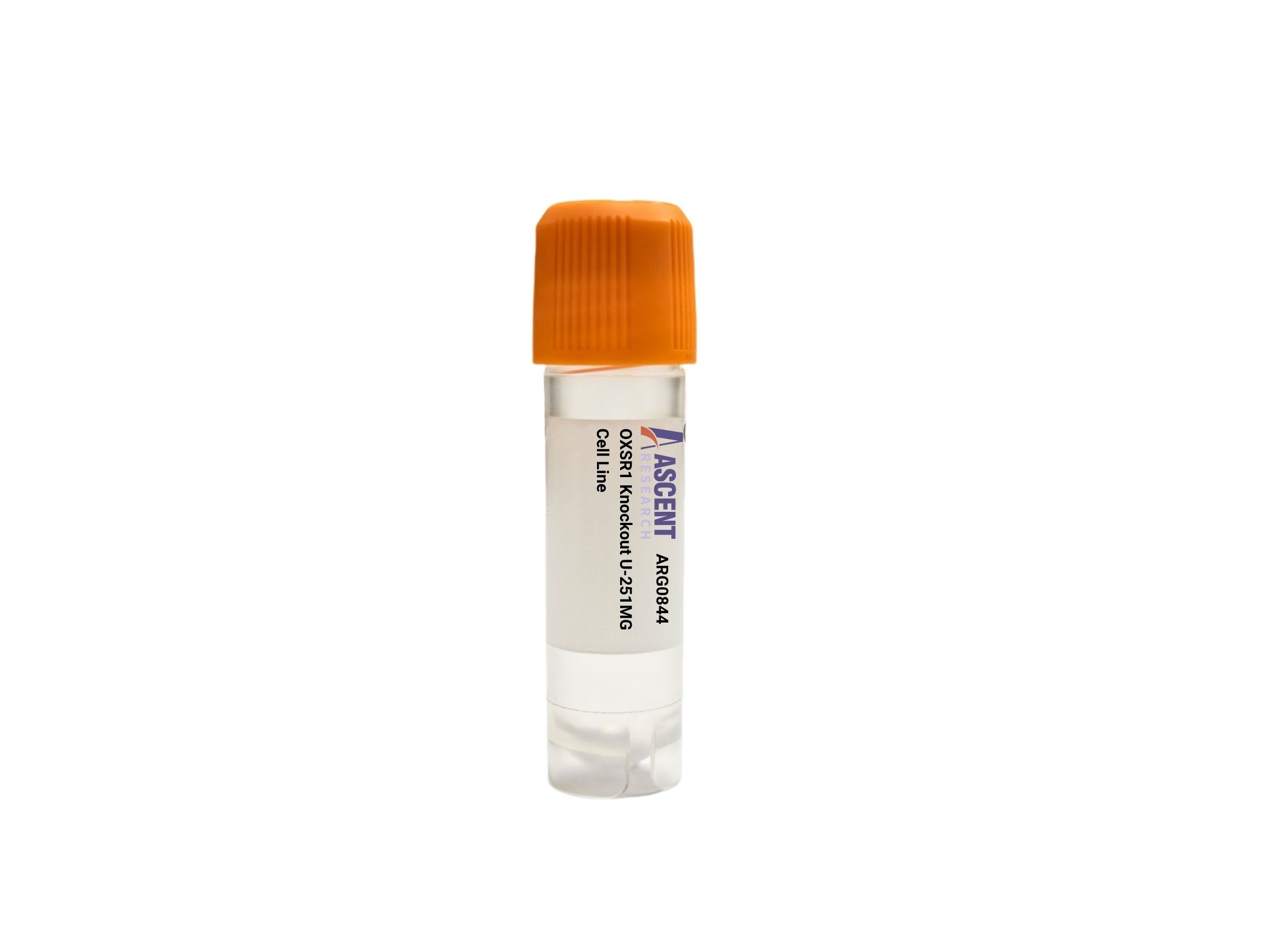
The OXSR1 Knockout U-251MG Cell Line is a CRISPR/Cas9-edited human glioblastoma model engineered for targeted disruption of the oxidative stress-responsive kinase 1 gene (OXSR1). This cell line provides a stable loss-of-function system for investigating the molecular control of cellular stress responses, apoptosis, and cell cycle regulation in a disease-relevant glioblastoma background. By abrogating OXSR1 expression, researchers can probe the kinase’s contributions to stress-activated signaling without confounding endogenous activity, enabling precise dissection of pathway dependencies in the U-251MG lineage.
Derived from a human glioblastoma multiforme (grade IV astrocytoma), the U-251MG host cell line is a well-characterized, adherent glial tumor model extensively utilized in neuro-oncology research. These cells harbor genetic aberrations typical of high-grade glioma, including TP53 mutation and PTEN loss, and exhibit aggressive growth characteristics, making them suitable for studying tumor cell biology, therapeutic response, and mechanisms of recurrence. The U-251MG background offers a clinically relevant context for examining how OXSR1 influences glioblastoma pathophysiology.
OXSR1 encodes a serine/threonine kinase that functions as a key transducer of oxidative and osmotic stress signals. It is activated by upstream stimuli such as reactive oxygen species, osmotic shock, DNA damage, and ATM/ATR kinases, and subsequently phosphorylates downstream effectors including PAK1 and the p38 MAPK module. Within the p38 branch, OXSR1 signals through MKK3/6 to activate p38 MAPK, which in turn phosphorylates transcription factors ATF2 and c-Jun to drive stress-responsive gene expression. Additionally, OXSR1-mediated phosphorylation of PAK1 intersects with the JNK pathway, and scaffold proteins like JIP1/2 facilitate assembly of these signaling complexes. This positions OXSR1 at a convergence point for coordinating cell cycle arrest, apoptosis, or survival depending on stress intensity and duration.
In the glioblastoma context, dysregulated redox homeostasis and aberrant stress signaling contribute to tumor progression, therapeutic resistance, and evasion of apoptosis. The OXSR1 Knockout U-251MG Cell Line enables the systematic study of how loss of this kinase alters glioblastoma cell behavior under oxidative challenge. By comparing knockout versus parental cells, researchers can delineate OXSR1-dependent effects on proliferation, DNA damage response, and sensitivity to chemotherapeutics or radiation, thereby identifying potential vulnerabilities in stress-adaptation pathways critical for glioma maintenance.
This knockout cell line supports a range of quantitative and functional assays tailored to glioblastoma research. Applications include western blotting to verify OXSR1 ablation and downstream phosphorylation status of p38 and PAK1, assessment of cell viability under hydrogen peroxide-induced oxidative stress, Annexin V-based apoptosis quantification, intracellular ROS measurement using DCFDA, clonogenic survival assays, and migration/invasion analyses. Transcriptomic profiling via RNA-seq can further reveal OXSR1-dependent gene networks. For additional details or custom inquiries, please contact Ascent Research.