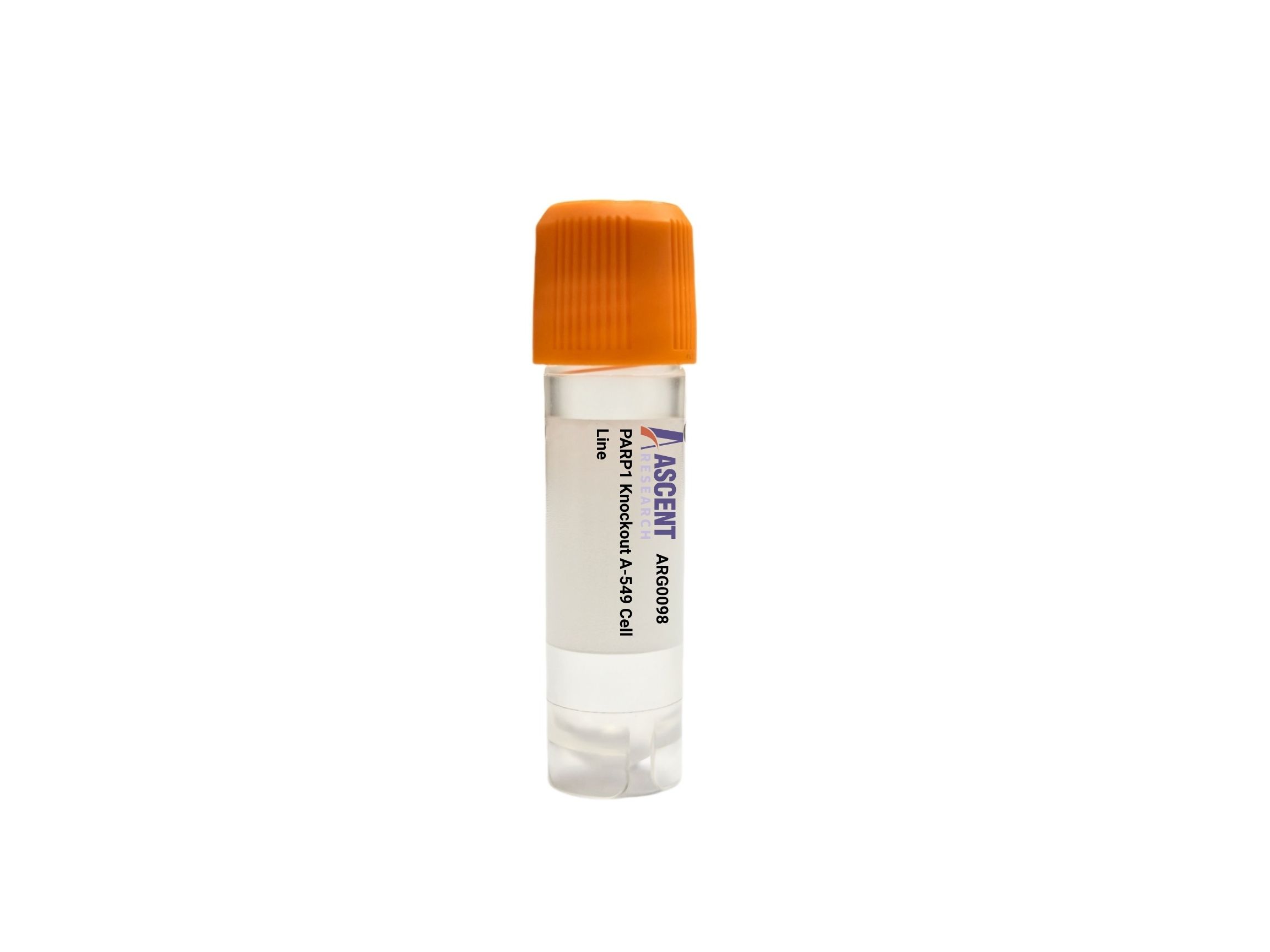
The PARP1 Knockout A-549 Cell Line is a human CRISPR/Cas9-engineered cell model in which the PARP1 gene has been disrupted to eliminate functional PARP1 expression. This stable knockout line is generated in A-549 cells, a human alveolar basal epithelial adenocarcinoma cell line, and provides an in vitro system for examining how loss of a central DNA damage sensor alters repair signaling, chromatin responses, and stress adaptation in a lung tumor epithelial context.
A-549 cells are derived from human lung adenocarcinoma and display type II alveolar-like epithelial features that make them a widely used model for pulmonary biology, epithelial stress responses, tumor cell signaling, and host-pathogen interaction studies. As a barrier-forming lung epithelial model, A-549 is particularly useful for investigating how intrinsic cancer-associated signaling programs intersect with oxidative stress, genotoxic exposure, and therapeutic response. The line is commonly used in studies of lung cancer cell survival, epithelial injury, and drug sensitivity, providing a relevant background for analysis of nuclear stress-response pathways.
PARP1 encodes a nuclear ADP-ribosyltransferase activated by DNA single-strand breaks, reactive oxygen species, ionizing radiation, alkylating agents, topoisomerase I trapping lesions, and replication stress. Upon binding DNA interruptions through its zinc-finger domains, PARP1 catalyzes synthesis of poly(ADP-ribose) on itself and nearby chromatin-associated substrates. This PARylation response promotes XRCC1 recruitment, supports POLB- and LIG3-dependent single-strand break repair, activates ALC1/CHD1L-mediated chromatin remodeling, and modulates p53 signaling. PARP1 function is further regulated within a network containing PARP2, HPF1, PARG, ARH3, ATM, ATR, DNA-PKcs, BRCA1, BRCA2, RAD51, CHEK1, CHEK2, and ??H2AX, linking it to base excision repair, replication fork stability, homologous recombination support under replication stress, non-homologous end joining modulation, and parthanatos under severe damage conditions.
In the A-549 background, PARP1 loss is a useful model for studying how lung epithelial tumor cells respond when a major single-strand break repair and chromatin-relaxation pathway is removed. Disruption of PARP1 can be used to assess altered reliance on alternative genome maintenance mechanisms, changes in replication stress handling, and modulation of NAD+ consumption and cell death signaling after genotoxic challenge. This is relevant to lung cancer biology as well as broader studies of synthetic lethality and therapeutic vulnerability in DNA repair-defective states.
This knockout cell line is suitable for mechanistic studies using western blotting and RT-qPCR to examine PARP1 pathway disruption, RNA-seq to profile damage-induced transcriptional changes, and immunofluorescence for ??H2AX or 53BP1 foci to quantify DNA damage signaling. Researchers can apply comet assays, chromatin fractionation, and replication fork assays to define repair defects and fork instability, or use flow cytometry and clonogenic survival assays to measure cell-cycle perturbation, apoptosis, and long-term survival after treatment with PARP inhibitors, alkylating agents, ionizing radiation, or topoisomerase I poisons. The model is also applicable to PARylation assays, co-immunoprecipitation studies of XRCC1- or HPF1-associated complexes, and lung cancer drug sensitivity testing focused on DNA damage response dependencies. Researchers may contact Ascent Research for additional technical information, product details, or related gene-edited cell models.