Quick Order Cart

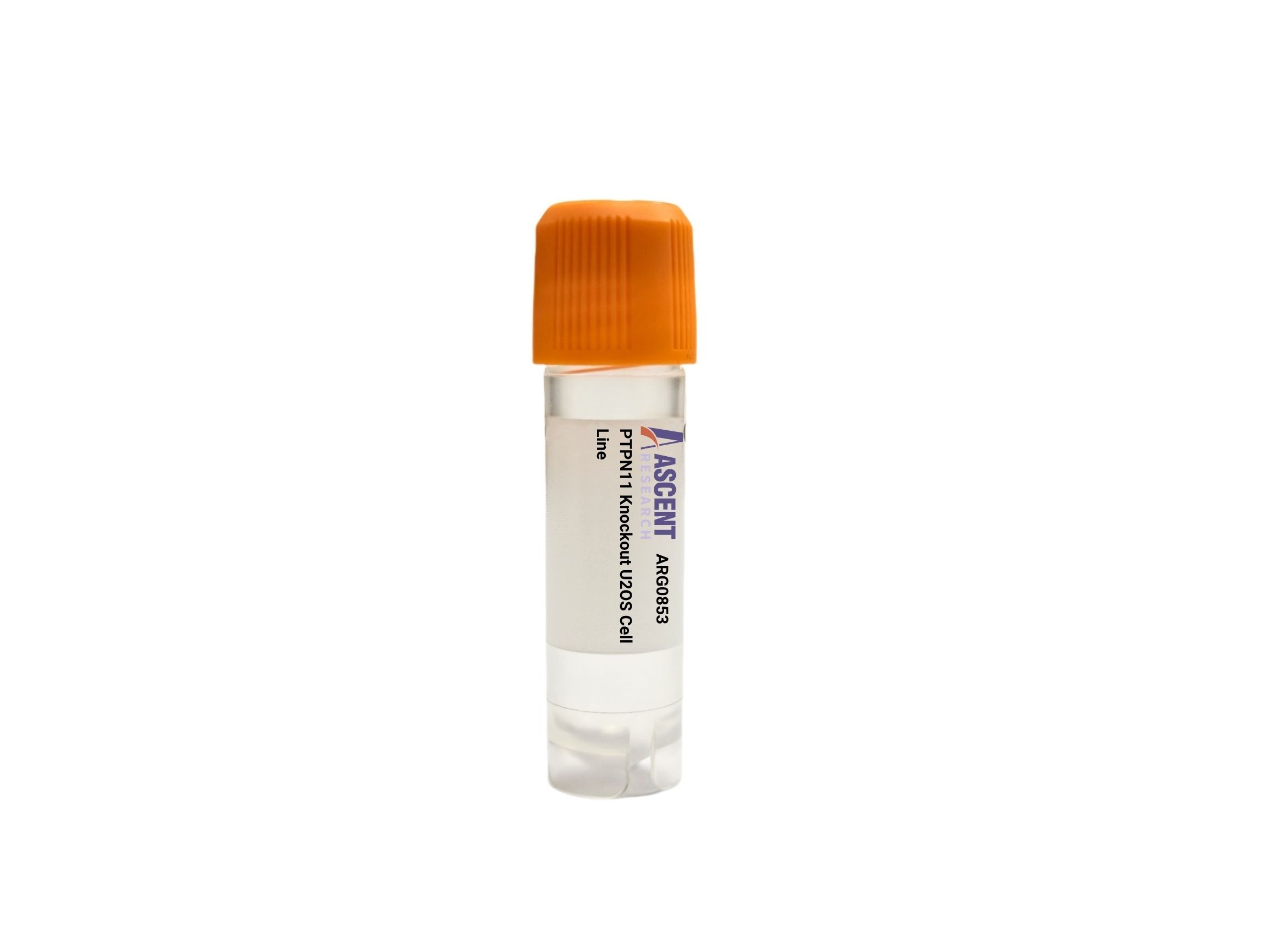
Cat. No. ARG0853

PTPN11 Knockout U2OS Cell Line

  • Product Type:

    Genome-edited Cells

  • Tissue Source:

    Bone

  • Disease:

    Osteosarcoma

  • Gene Species:

    Homo sapiens (Human)

The PTPN11 Knockout U2OS Cell Line is a CRISPR/Cas9-edited human osteosarcoma cell line with targeted disruption of the PTPN11 gene, which encodes the SHP-2 tyrosine phosphatase. SHP-2 positively regulates RAS-MAPK signaling by dephosphorylating adaptor proteins such as Gab1 and Sprouty downstream of EGFR and other receptor tyrosine kinases. This knockout model eliminates SHP-2 function, enabling dissection of its roles in cell proliferation, survival, and migration. Derived from the bone cancer-derived U2OS line, this cell line is ideal for studying RASopathy mechanisms, validating SHP-2 inhibitors, and investigating signal transduction in osteosarcoma. Applications include western blotting for phospho-ERK, proliferation assays, and phospho-signaling analysis, providing a robust tool for cancer research and drug development.

Inquire Now

In stock

Ships next business day


Ask a Question

Shipping Info:

Cryopreserved in vials and shipped on dry ice


Disclaimer:

For Research Use Only

  • Characteristics

    Host Cell

    U2OS

    Morphology

    Epithelial-like

    Age

    15 years

    Sex of Donor

    Female

    Gene Name

    PTPN11

    Gene Alias

    protein tyrosine phosphatase non-receptor type 11; BPTP3; SH-PTP2; SHP-2; PTP2C; SHP2

    Gene Species

    Homo sapiens (Human)

    Gene Identifier

    NCBI Gene ID 5781

    Gene Type

    protein coding gene

    Gene Family

    SH2 domain containing, Protein tyrosine phosphatases non-receptor type

  • Culture Conditions

    Temperature

    37°C

    Atmosphere

    5% CO₂

  • Quality Control

    Sterility testing

    Daily monitoring confirms that the cells are free from bacterial, yeast, and fungal contamination.

    Mycoplasma testing

    Negative for mycoplasma through PCR analysis

    Pathogens

    Cells tested negative for HIV-1, HBV, and HCV.

  • Disclaimer

    Intended Use

    This product is intended for laboratory in vitro use only. lt is not intended for diagnostic, therapeutic, or clinical applications.

    Disclaimer

    Ascent Research endeavors to provide accurate and up-to-date product information. However, no warranties or representations are made regarding its completeness or reliability. References to scientific literature and patents are for informational purposes only, and the customer assumes sole responsibility for verifying their accuracy.

    By accepting this product, the customer acknowledges and agrees to assume all risks associated with its receipt, handling, storage, disposal, and use, including compliance with all applicable safety and environmental regulations and precautions. Relevant laws, regulations, and ethical guidelines must be followed in conducting any research, modifications, or derivatives derived from this product.

    This product is provided "AS IS", and except as expressly stated herein, Ascent Research disclaims all other warranties, express or implied. Under no circumstances shall Ascent Research, its affiliates, or representatives be liable for indirect, incidental, consequential, or punitive damages arising from the use of this material. While Ascent Research employs rigorous quality control measures, we shall not be held responsible for damages resulting from misidentification or misinterpretation of the provided materials.

Description

The PTPN11 Knockout U2OS Cell Line is a CRISPR/Cas9-edited knockout cell line generated from the U2OS human osteosarcoma line through targeted disruption of the PTPN11 gene. This model provides a stable loss-of-function system for studying the role of SHP-2 phosphatase in oncogenic signaling and disease pathology. The use of CRISPR/Cas9 technology ensures specific gene inactivation, enabling researchers to dissect PTPN11-dependent mechanisms in a well-characterized cellular background.

The U2OS cell line was originally established from a moderately differentiated sarcoma of the tibia of a 15-year-old female patient. It is a widely utilized model in bone cancer research, characterized by adherent growth and an epithelial-like morphology. U2OS cells retain key signaling pathways relevant to osteosarcoma biology and are commonly employed for studies of cell proliferation, apoptosis, and metastasis. The PTPN11 knockout derivative is cultivated under standard conditions and maintains the essential phenotypic traits of the parental line, facilitating comparative analyses between wild-type and gene-disrupted states.

PTPN11 encodes the non-receptor protein tyrosine phosphatase SHP-2, which functions as a critical positive regulator of the RAS-MAPK pathway. Upon stimulation of upstream receptors such as EGFR, PDGFR, and FGFR, SHP-2 is recruited to phosphorylated tyrosine motifs on adaptor proteins including Gab1, Gab2, and FRS2. SHP-2 dephosphorylates inhibitory phosphotyrosines on these adaptors and on the negative regulator Sprouty, thereby relieving suppression and promoting the activation of the RAS-GTPase cycle. Through its interaction with Grb2 and Sos1, SHP-2 facilitates signal transmission to the RAF-MEK-ERK kinase cascade. In parallel, SHP-2 contributes to PI3K-AKT signaling, influencing cell survival and metabolism. Additional downstream effectors such as paxillin, STAT5A, and FAK are modulated by SHP-2 activity, linking the phosphatase to integrin-mediated adhesion and cytoskeletal dynamics.

In U2OS osteosarcoma cells, SHP-2 is implicated in the regulation of proliferative and pro-migratory signals downstream of multiple receptor tyrosine kinases. Loss of PTPN11 disrupts this signaling hub, potentially attenuating MAPK and AKT pathway outputs and altering cellular responses to growth factors and cytokines. This knockout cell line therefore offers a valuable platform for investigating how SHP-2 coordinates oncogenic pathway crosstalk in a bone cancer setting. It enables the study of SHP-2-dependent transcriptional programs, cell cycle progression, and anchorage-independent growth, all of which are relevant to osteosarcoma pathogenesis and therapeutic intervention.

This cell line supports a broad range of applications, including mechanistic studies of RAS-MAPK and JAK-STAT signaling, preclinical modeling of Noonan syndrome and juvenile myelomonocytic leukemia, and drug target validation for SHP-2 inhibitors. Representative assays include western blotting for phospho-ERK and total SHP-2, RT-qPCR for PTPN11 transcript levels, immunofluorescence localization, and phospho-signaling analysis. Functional readouts such as cell proliferation, colony formation, and migration/invasion assays can be performed to assess the impact of PTPN11 loss. The model is also suitable for co-culture experiments and high-throughput screening of small-molecule modulators. For further information or technical inquiries, please contact Ascent Research.


Reset Password

    Reach Us Questions? Click Me Here!

    Fill out the form below and a member of our team will contact you shortly!

    *Required field


      Reach Us

      Fill out the form below and a member of our team will contact you shortly!

      *Required field

      Product Inquiry (Optional)