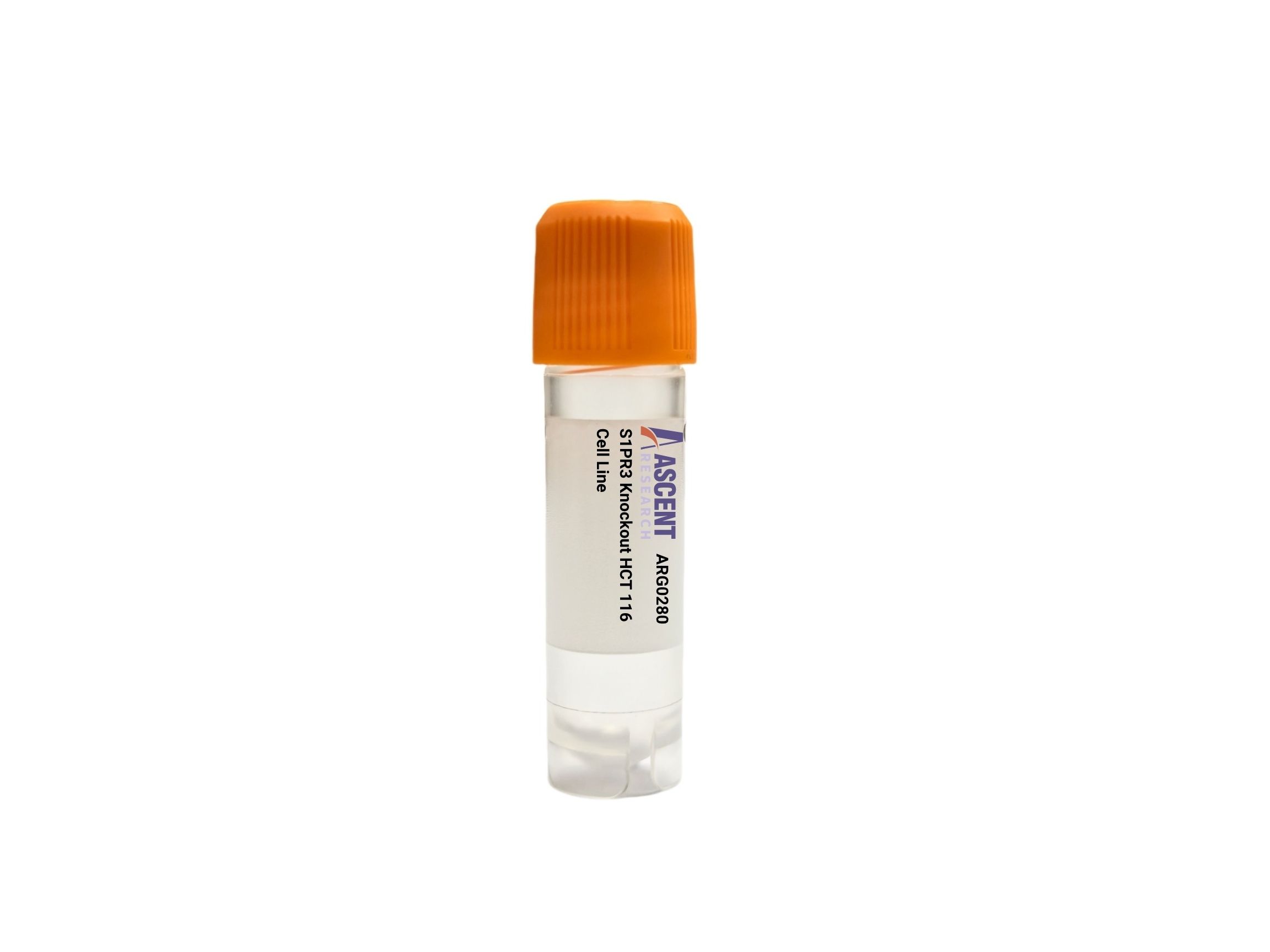
The S1PR3 Knockout HCT 116 Cell Line is a CRISPR/Cas9-edited knockout cell line featuring targeted disruption of the S1PR3 gene in the human HCT 116 colorectal carcinoma line. This loss-of-function model eliminates the sphingosine-1-phosphate receptor 3 (S1PR3), a G protein-coupled receptor for sphingosine-1-phosphate (S1P), providing a clean genetic background to dissect S1P/S1PR3 signaling in colorectal cancer.
HCT 116 is a near-diploid epithelial colorectal carcinoma cell line carrying KRAS G13D and ??-catenin (CTNNB1) mutations while retaining wild-type TP53 and proficient DNA mismatch repair. Its well-characterized genomic landscape makes it a standard platform for colorectal cancer research, drug screening, and xenograft studies, ensuring that S1PR3 knockout effects are examined within a relevant oncogenic context.
S1PR3 couples to G??i, G??q, and G??12/13 to transduce S1P signals. G??i activates PI3K/Akt and ERK1/2 pathways promoting survival and proliferation; G??q stimulates phospholipase C (PLC)-mediated calcium mobilization; and G??12/13 drives RhoA/ROCK-dependent cytoskeletal remodeling and migration. The receptor also interacts with ??-arrestin and GPCR kinases (GRKs) for signal modulation. Upstream, sphingosine kinases SPHK1/2 generate S1P, and cytokines such as TNF-?? and IL-6 can upregulate receptor expression. Downstream, S1PR3 influences transcription factors NF-??B and STAT3, linking S1P to inflammatory and mitogenic programs.
Ablation of S1PR3 in HCT 116 disrupts S1P-driven oncogenic signals that cooperate with the mutated KRAS and ??-catenin pathways. This knockout model allows dissection of S1PR3-specific contributions to cell proliferation, migration, and survival, and permits examination of altered signaling through Akt, ERK1/2, RhoA, Rac, and calcium fluxes within a defined colorectal cancer background that includes wild-type p53.
Applications include Western blot analysis of phospho-Akt and phospho-ERK, Transwell migration/invasion assays, MTT proliferation measurements, and calcium flux experiments. RT-qPCR can assess changes in downstream gene expression, while flow cytometry enables apoptosis detection. In vivo xenograft tumor models are suitable for evaluating S1PR3??s role in tumorigenesis. The cell line supports GPCR functional studies, drug target validation, and S1P pathway research. For further information, contact Ascent Research.