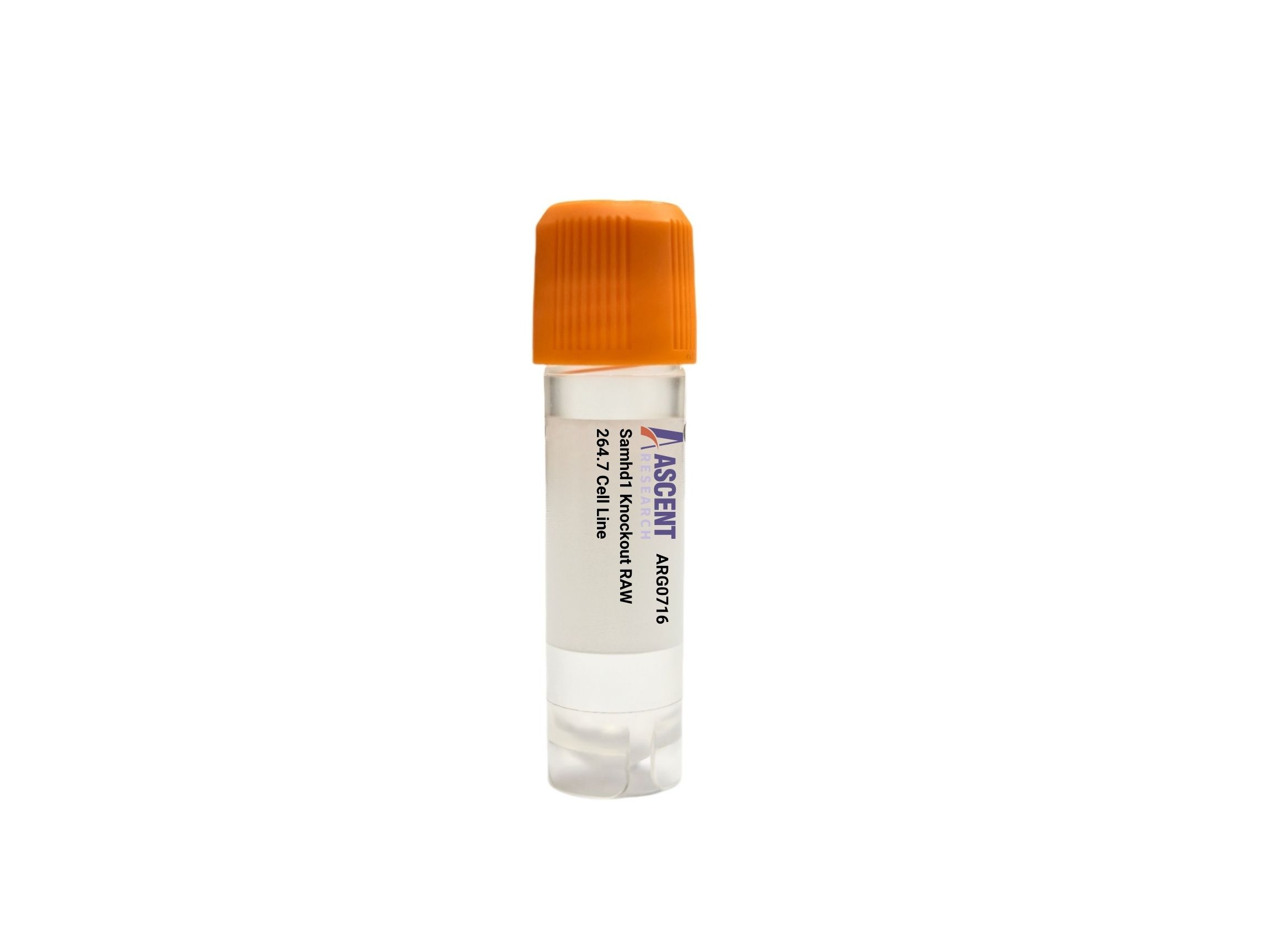
The Samhd1 Knockout RAW 264.7 Cell Line is a CRISPR/Cas9-edited knockout cell line derived from the RAW 264.7 murine macrophage cell line, in which the gene encoding SAMHD1 (SAM and HD domain containing deoxynucleoside triphosphate triphosphohydrolase 1) has been disrupted to eliminate functional protein expression. This loss-of-function model enables precise interrogation of SAMHD1-dependent mechanisms in a monocyte/macrophage context. The knockout product format provides a stable, homogenous population for reproducible experimental outcomes in studies ranging from host-pathogen interactions to innate immune signaling.
The parental RAW 264.7 cell line originates from a BALB/c mouse macrophage tumor induced by Abelson murine leukemia virus and is widely employed as a model for macrophage biology. These adherent, phagocytic cells exhibit robust antigen presentation capacity and secrete a broad repertoire of cytokines upon activation, making them a relevant system for investigating immune responses. Their rapid proliferation and ease of genetic manipulation further establish RAW 264.7 cells as a standard host for studying intracellular pathogens, including retroviruses, bacteria, and protozoa.
SAMHD1 functions as a dNTPase that hydrolyzes deoxynucleoside triphosphates to the corresponding nucleosides and inorganic triphosphate, thereby maintaining low intracellular dNTP pools. This activity is a critical restriction mechanism against retroviruses such as HIV-1, as it limits the availability of substrates for viral reverse transcription. SAMHD1 is transcriptionally induced by interferons alpha/beta and gamma via JAK-STAT signaling downstream of the IFNAR and IFNGR receptors, and its enzyme activity is regulated by phosphorylation at threonine 592 through cyclin-dependent kinases CDK1 and CDK2 in complex with cyclin A. Additionally, the cGAS-STING pathway??sensing cytosolic DNA??activatess TBK1 and IRF3, which further potentiates the antiviral state including SAMHD1 expression. Lentiviral Vpx proteins (e.g., from HIV-2 and certain SIV strains) counteract SAMHD1 by recruiting it to the DCAF1?CCRL4 E3 ubiquitin ligase complex, leading to its proteasomal degradation. In turn, SAMHD1 depletion elevates dNTP pools, promotes reverse transcription, and can impact DNA damage response and apoptosis pathways, interacting with factors such as PCNA, STING, and MRE11.
In the macrophage background, SAMHD1 knockout profoundly alters the cell’s intrinsic immune status. RAW 264.7 cells are naturally non-cycling or slowly cycling, conditions under which SAMHD1 dNTPase activity is typically high, rendering them refractory to retroviral infection. Disruption of Samhd1 relieves this block and permits efficient early reverse transcription, making this knockout line a powerful tool for dissecting post-entry restriction steps. Moreover, the interplay between SAMHD1 and the interferon system is central to the pathogenesis of Aicardi-Gouti??res syndrome and systemic lupus erythematosus, where dysregulated nucleotide metabolism triggers autoinflammatory responses. This model thus recapitulates a key node at the intersection of nucleotide homeostasis, antiviral defense, and autoimmunity.
Researchers can employ this cell line in a wide range of functional assays. Infection experiments with HIV-1 or HIV-2-based vectors, in the presence or absence of Vpx, allow direct measurement of SAMHD1 restriction activity; dNTP quantification by HPLC or enzymatic methods reveals changes in nucleotide pools. Interferon stimulation assays coupled with RNA-seq or RT-qPCR can profile transcriptional programs downstream of SAMHD1, while co-immunoprecipitation and western blotting validate protein-protein interactions with STING, PCNA, or viral accessory factors. Flow cytometry and cell cycle synchronization further enable correlation of restriction potency with cell cycle phase. The Samhd1 knockout RAW 264.7 line thus serves as a versatile platform for investigating innate antiviral mechanisms, cancer cell metabolism, and therapeutic interventions targeting the dNTP regulation axis. For additional information or custom requests, please contact Ascent Research.