Quick Order Cart

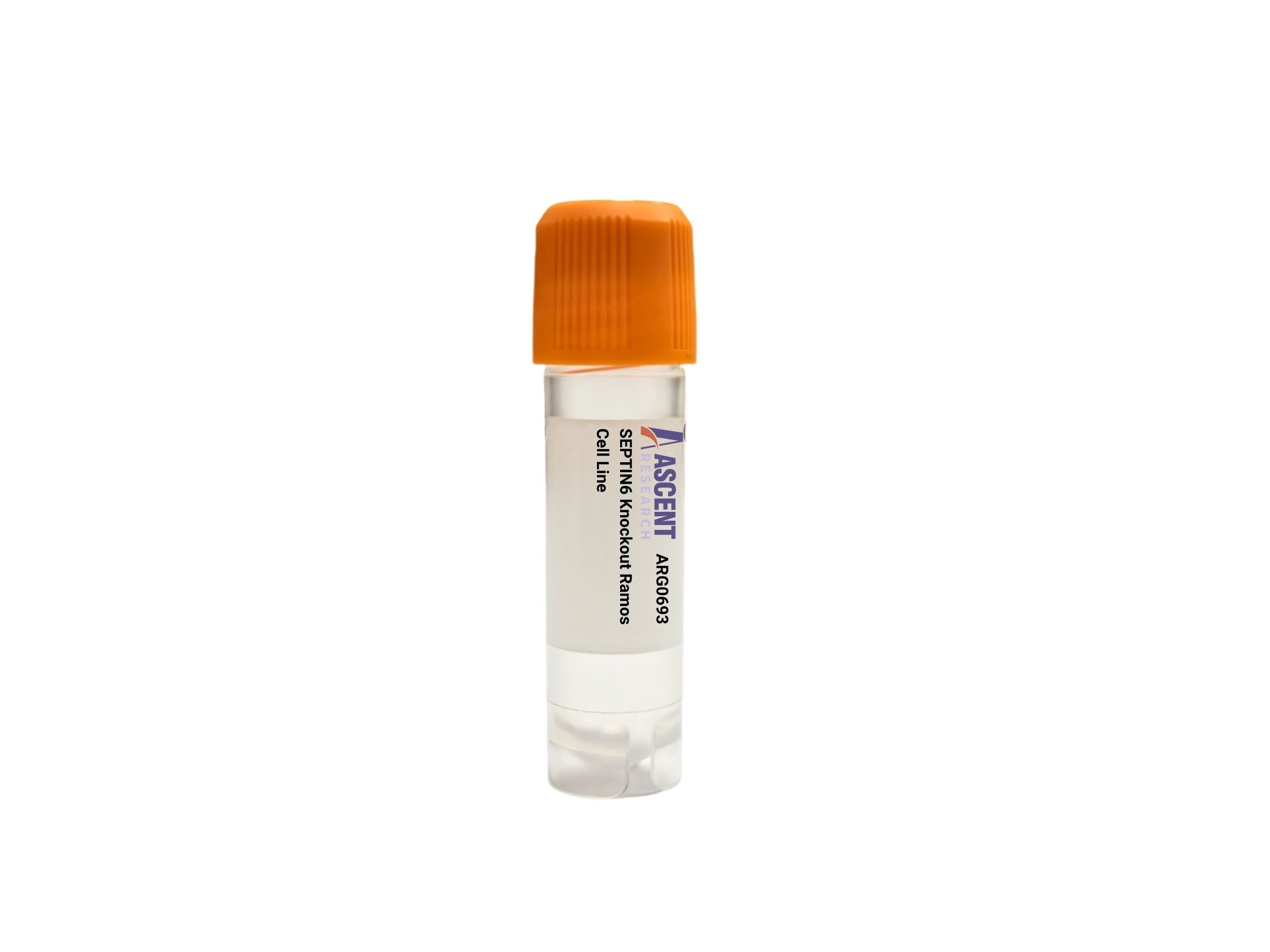
Cat. No. ARG0693

SEPTIN6 Knockout Ramos Cell Line

  • Product Type:

    Genome-edited Cells

  • Tissue Source:

    Ascites

  • Disease:

    Burkitt lymphoma

  • Gene Species:

    Homo sapiens (Human)

The SEPTIN6 Knockout Ramos Cell Line is a CRISPR/Cas9-edited human B-lymphocyte line derived from the EBV-negative, MYC-translocated Burkitt's lymphoma Ramos background. This model disrupts the GTP-binding septin SEPTIN6, a scaffold protein that assembles into heteromeric filaments essential for cytokinesis and genomic stability. SEPTIN6 functions downstream of CDK1 and Aurora B kinase and interacts with anillin, myosin II, and the exocyst complex to coordinate actomyosin ring contraction and membrane abscission. This knockout line enables investigation of septin-dependent mechanisms in B-cell malignancies, including cytokinesis defects, drug sensitivity profiles, and synthetic lethal interactions. It is suited for Western blotting, immunofluorescence microscopy, flow cytometry, time-lapse imaging, and viability or apoptosis assays.

Inquire Now

In stock

Ships next business day


Ask a Question

Shipping Info:

Cryopreserved in vials and shipped on dry ice


Disclaimer:

For Research Use Only

  • Characteristics

    Host Cell

    Ramos

    Morphology

    Lymphocyte-like

    Age

    3 years

    Sex of Donor

    Male

    Gene Name

    SEPTIN6

    Gene Species

    Homo sapiens (Human)

    Gene Identifier

    NCBI Gene ID 23157

  • Culture Conditions

    Temperature

    37°C

    Atmosphere

    5% CO₂

  • Quality Control

    Sterility testing

    Daily monitoring confirms that the cells are free from bacterial, yeast, and fungal contamination.

    Mycoplasma testing

    Negative for mycoplasma through PCR analysis

    Pathogens

    Cells tested negative for HIV-1, HBV, and HCV.

  • Disclaimer

    Intended Use

    This product is intended for laboratory in vitro use only. lt is not intended for diagnostic, therapeutic, or clinical applications.

    Disclaimer

    Ascent Research endeavors to provide accurate and up-to-date product information. However, no warranties or representations are made regarding its completeness or reliability. References to scientific literature and patents are for informational purposes only, and the customer assumes sole responsibility for verifying their accuracy.

    By accepting this product, the customer acknowledges and agrees to assume all risks associated with its receipt, handling, storage, disposal, and use, including compliance with all applicable safety and environmental regulations and precautions. Relevant laws, regulations, and ethical guidelines must be followed in conducting any research, modifications, or derivatives derived from this product.

    This product is provided "AS IS", and except as expressly stated herein, Ascent Research disclaims all other warranties, express or implied. Under no circumstances shall Ascent Research, its affiliates, or representatives be liable for indirect, incidental, consequential, or punitive damages arising from the use of this material. While Ascent Research employs rigorous quality control measures, we shall not be held responsible for damages resulting from misidentification or misinterpretation of the provided materials.

Description

The SEPTIN6 Knockout Ramos Cell Line is a CRISPR/Cas9-edited human B-lymphocyte knockout cell line engineered to disrupt the SEPTIN6 gene in the Ramos background. This product provides a stable loss-of-function model for investigating septin biology in a lymphoid cellular context. By leveraging CRISPR/Cas9-mediated gene targeting, the line offers researchers a defined genetic tool to dissect SEPTIN6-dependent cellular processes without reliance on transient suppression methods.

The host Ramos cell line is an EBV-negative, MYC translocation t(8;14)-driven Burkitt’s lymphoma model of mature B lymphocyte origin. These cells retain key features of antibody-producing immune cells and are extensively used to study humoral immunity and B-cell oncogenesis. Their rapid proliferation, aberrant cell cycle regulation, and underlying genomic instability establish a pertinent system for probing mitotic and cytoskeletal gene functions.

SEPTIN6 encodes a GTP-binding protein that assembles into heteromeric septin filaments, typically together with SEPT2 and SEPT7. These structures concentrate at the cleavage furrow and function as scaffolds that coordinate actomyosin ring contraction and membrane abscission during cytokinesis. Mechanistically, SEPTIN6 interacts with anillin, myosin II, and components of the exocyst complex such as EXOC4/Sec8. Its activity is regulated by upstream kinases including CDK1, Aurora B kinase, and PLK1, and it operates within pathways involving CDC42, RHO, ROCK, and citron kinase. Through these interactions, SEPTIN6 helps maintain genomic stability by ensuring faithful completion of cell division.

Disruption of SEPTIN6 in the Ramos B-cell lymphoma context provides a powerful model to examine how cytokinesis failure contributes to malignant progression. Given the MYC-driven proliferative pressure and inherent chromosomal instability of this cell line, loss of SEPTIN6-mediated cytokinetic coordination may exacerbate aneuploidy and influence therapeutic responses. The knockout line thus enables dissection of septin-dependent tumor-suppressive or oncogenic mechanisms in B-cell malignancies and facilitates assessment of drug sensitivity, such as to Aurora kinase inhibitors.

Typical research applications include investigation of cytokinesis defects in lymphoma, characterization of septin scaffold functions during B-cell division, screening for synthetic lethal interactions, and evaluation of chemotherapeutic sensitivity in Burkitt’s lymphoma models. The line is validated for use in Western blotting of septin complex and cell cycle markers, flow cytometric cell cycle analysis with propidium iodide staining, immunofluorescence microscopy for septin localization, time-lapse imaging of cell division, MTS viability assays, Annexin V apoptosis assays, and drug sensitivity panels. For additional information or to request a quote, please contact Ascent Research.


Reset Password

    Reach Us Questions? Click Me Here!

    Fill out the form below and a member of our team will contact you shortly!

    *Required field


      Reach Us

      Fill out the form below and a member of our team will contact you shortly!

      *Required field

      Product Inquiry (Optional)