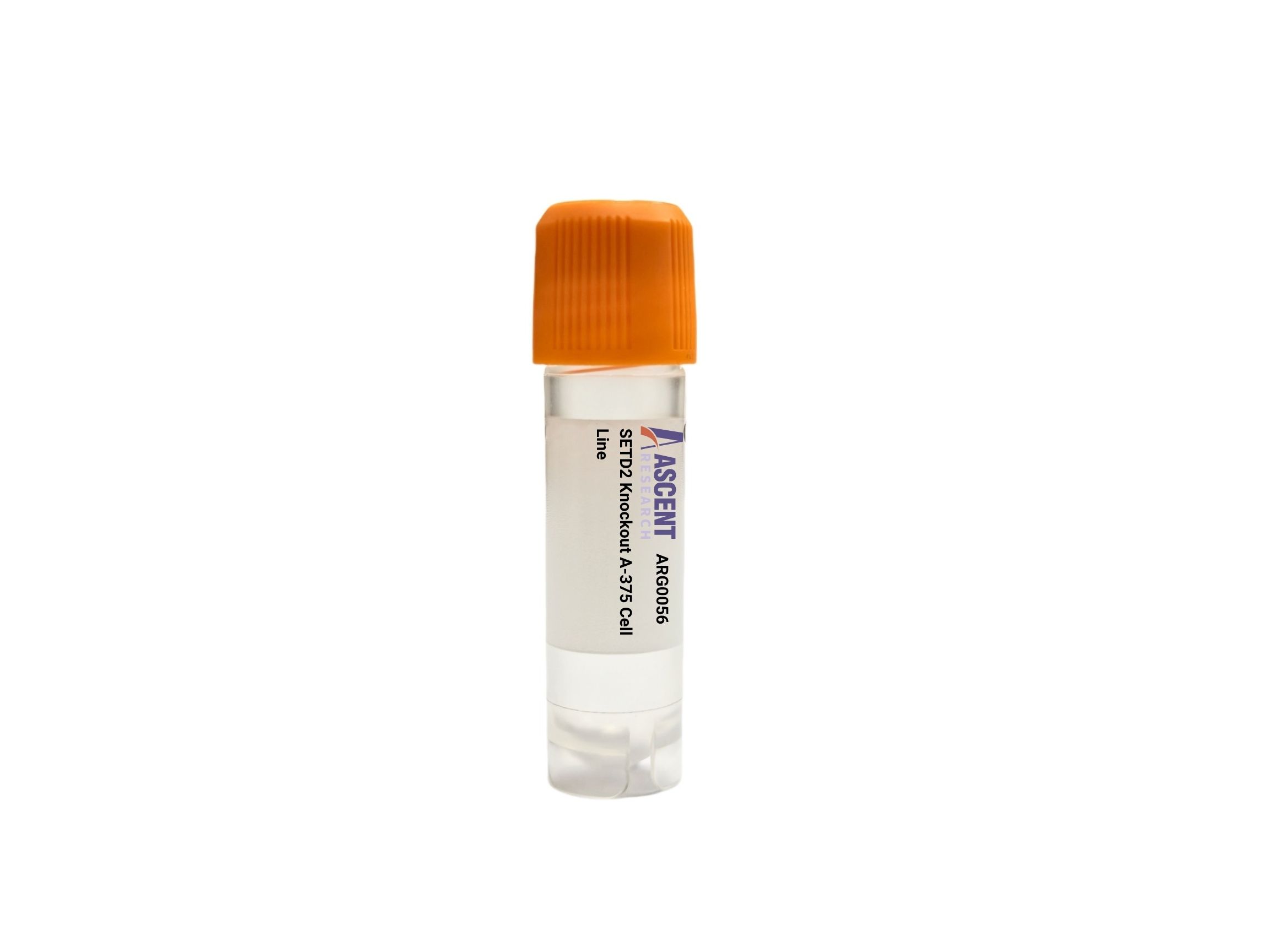
The SETD2 Knockout A-375 Cell Line is a human CRISPR/Cas9-engineered melanoma cell model in which the SETD2 gene has been disrupted to abolish functional SETD2 expression. This edited line is generated in A-375 cells, a human melanoma epithelial-like cell line, and provides a stable in vitro system for investigating the consequences of SETD2 loss in a tumor-derived skin melanocyte lineage background. The model is suited for studies of chromatin regulation, DNA damage responses, transcription-coupled genome maintenance, and cancer-associated therapeutic vulnerabilities.
A-375 is a widely used human malignant melanoma cell line with strong relevance for experimental studies of oncogenic signaling, cell-cycle regulation, apoptosis, invasion, and drug response. Because it represents a tumor-derived melanocyte lineage model, A-375 offers a practical platform for dissecting melanoma-associated signaling networks and stress responses under controlled culture conditions. Its broad use in cancer biology makes it particularly valuable for comparing epigenetic or DNA repair phenotypes with proliferation, survival, and treatment-response endpoints that are central to melanoma research.
SETD2 is the principal histone methyltransferase responsible for trimethylation of histone H3 lysine 36, generating H3K36me3 across actively transcribed gene bodies. Functionally linked to the RNA polymerase II elongation complex, SETD2 couples transcription elongation to chromatin organization, co-transcriptional RNA processing, and DNA repair pathway engagement. SETD2 interacts with histone H3 and RNA polymerase II and is connected to factors including RAD51, BRCA1, BRCA2, MSH2, MSH6, TP53BP1, SPT6, LEDGF/p75, DNMT3B, hnRNP family proteins, and alpha-tubulin. Through deposition of H3K36me3, SETD2 acts upstream of alternative splicing programs, homologous recombination and mismatch repair efficiency, replication fork stability, and regulation of downstream outputs such as RRM2 expression, CDKN1A/p21 control, genomic stability, and micronucleus formation. Loss of SETD2 therefore reduces H3K36me3 and can perturb replication stress responses involving ATR and CHK1 as well as p53-associated DNA damage signaling.
In the A-375 melanoma context, SETD2 knockout provides a relevant system for studying how epigenetic disruption reshapes tumor cell behavior. Because melanoma cells are frequently analyzed for proliferative control, stress adaptation, and treatment sensitivity, removal of SETD2 can help define how impaired H3K36me3-dependent chromatin states alter DNA repair capacity, RNA splicing patterns, and genome integrity in a melanoma setting. This is pertinent to research on melanoma progression, genomic instability, and cancer drug resistance, while also connecting to broader disease areas in which SETD2 dysfunction has been implicated, including renal cell carcinoma, leukemia, glioma, and pancreatic cancer.
This cell line is appropriate for mechanistic experiments assessing SETD2 protein loss and H3K36me3 depletion by western blotting, transcriptional consequences by RT-qPCR and RNA-seq, and chromatin changes by ChIP-qPCR or ChIP-seq for H3K36me3-marked loci. Researchers can examine DNA damage and repair phenotypes using immunofluorescence for gamma-H2AX or RAD51 foci, comet assays, micronucleus assays, and clonogenic survival following genotoxic stress. Additional applications include flow cytometry-based analysis of cell-cycle progression or apoptosis, co-immunoprecipitation studies of SETD2-associated regulatory complexes, and drug sensitivity or synthetic lethality screens targeting replication stress, homologous recombination deficiency, or chromatin-regulatory dependencies. Researchers may contact Ascent Research for additional technical information, product details, or related gene-edited cell models.