Quick Order Cart

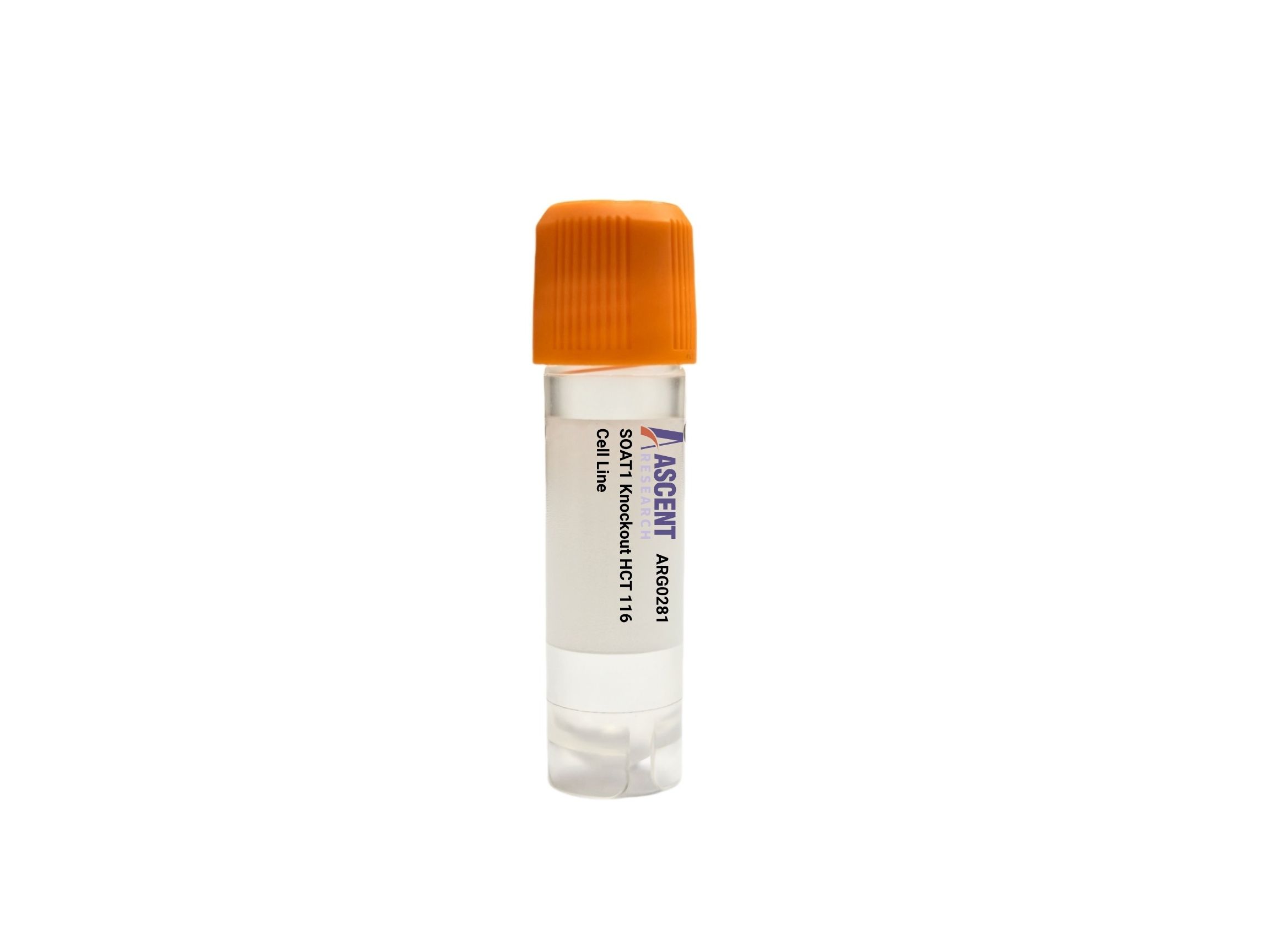
Cat. No. ARG0281

SOAT1 Knockout HCT 116 Cell Line

  • Product Type:

    Genome-edited Cells

  • Tissue Source:

    Large intestine (colon)

  • Disease:

    Carcinoma

  • Gene Species:

    Homo sapiens (Human)

The SOAT1 Knockout HCT 116 Cell Line is a CRISPR/Cas9-edited human colorectal carcinoma model with targeted disruption of SOAT1. SOAT1 encodes sterol O-acyltransferase 1, which esterifies free cholesterol to cholesteryl esters for lipid droplet storage, and is regulated by SREBP-2 and LXR. Knockout abolishes cholesterol esterification, reducing lipid droplets and altering cancer cell proliferation and apoptosis. This cell line suits cancer metabolism studies, drug target validation, and cholesterol pathway analysis. Standard assays include cholesterol esterification assays, Oil Red O staining, cell proliferation and apoptosis readouts, with Western blot and RT-qPCR for molecular confirmation.

Inquire Now

In stock

Ships next business day


Ask a Question

Shipping Info:

Cryopreserved in vials and shipped on dry ice


Disclaimer:

For Research Use Only

  • Characteristics

    Host Cell

    HCT 116

    Morphology

    Epithelial-like

    Age

    Adult

    Sex of Donor

    Male

    Gene Name

    SOAT1

    Gene Species

    Homo sapiens (Human)

    Gene Identifier

    NCBI Gene ID 6646

  • Culture Conditions

    Temperature

    37°C

    Atmosphere

    5% CO₂

  • Quality Control

    Sterility testing

    Daily monitoring confirms that the cells are free from bacterial, yeast, and fungal contamination.

    Mycoplasma testing

    Negative for mycoplasma through PCR analysis

    Pathogens

    Cells tested negative for HIV-1, HBV, and HCV.

  • Disclaimer

    Intended Use

    This product is intended for laboratory in vitro use only. lt is not intended for diagnostic, therapeutic, or clinical applications.

    Disclaimer

    Ascent Research endeavors to provide accurate and up-to-date product information. However, no warranties or representations are made regarding its completeness or reliability. References to scientific literature and patents are for informational purposes only, and the customer assumes sole responsibility for verifying their accuracy.

    By accepting this product, the customer acknowledges and agrees to assume all risks associated with its receipt, handling, storage, disposal, and use, including compliance with all applicable safety and environmental regulations and precautions. Relevant laws, regulations, and ethical guidelines must be followed in conducting any research, modifications, or derivatives derived from this product.

    This product is provided "AS IS", and except as expressly stated herein, Ascent Research disclaims all other warranties, express or implied. Under no circumstances shall Ascent Research, its affiliates, or representatives be liable for indirect, incidental, consequential, or punitive damages arising from the use of this material. While Ascent Research employs rigorous quality control measures, we shall not be held responsible for damages resulting from misidentification or misinterpretation of the provided materials.

Description

The SOAT1 Knockout HCT 116 Cell Line is a CRISPR/Cas9-edited loss-of-function model derived from human HCT 116 colorectal carcinoma cells. By disrupting the SOAT1 gene, this cell line eliminates sterol O-acyltransferase 1 activity, providing a stable platform for studying cholesterol metabolism and colorectal cancer biology without endogenous background interference.

HCT 116 is a human colorectal adenocarcinoma line with microsatellite instability (MSI-H), KRAS G13D and PIK3CA mutations, and wild-type p53. These features make it a key model for colorectal cancer research, including drug screening and signal transduction. Its robust growth and well-characterized genome enable reproducible gene editing and downstream functional assays, establishing it as an optimal host for knockout experiments.

SOAT1 catalyzes the esterification of free cholesterol to cholesteryl esters for storage in lipid droplets, a process critical for cholesterol homeostasis and VLDL secretion. Its expression is transcriptionally regulated by SREBP-2 and LXR in response to sterol levels, and can be modulated by NF-??B and TNF-?? in inflammatory contexts. SOAT1 interacts with ApoB and PLIN2 and works in concert with ACAT2 to promote cholesteryl ester accumulation. These molecular connections position SOAT1 as a central node in lipid droplet biogenesis and cholesterol trafficking.

In the HCT 116 background, SOAT1 knockout blocks cholesterol esterification, leading to diminished lipid droplets and potential cytotoxicity from excess free cholesterol. This metabolic disruption impairs cell proliferation and sensitizes cells to apoptosis, highlighting the enzyme’s relevance to colorectal adenocarcinoma. The model thus permits investigation of how cholesterol storage and lipid droplet dynamics support tumor cell survival and metabolic adaptation.

Researchers can employ this knockout cell line for cancer metabolism studies, drug target validation, and cholesterol pathway analysis. Standard assays include Western blot and RT-qPCR for knockout confirmation, cholesterol esterification activity assays, Oil Red O or fluorescent lipid droplet staining, and cell proliferation or apoptosis assays. These can be integrated with pharmacological perturbation of SREBP-2 or LXR signaling. For technical inquiries, please contact Ascent Research.


Reset Password

    Reach Us Questions? Click Me Here!

    Fill out the form below and a member of our team will contact you shortly!

    *Required field


      Reach Us

      Fill out the form below and a member of our team will contact you shortly!

      *Required field

      Product Inquiry (Optional)