Quick Order Cart

Cat. No. ARG0559

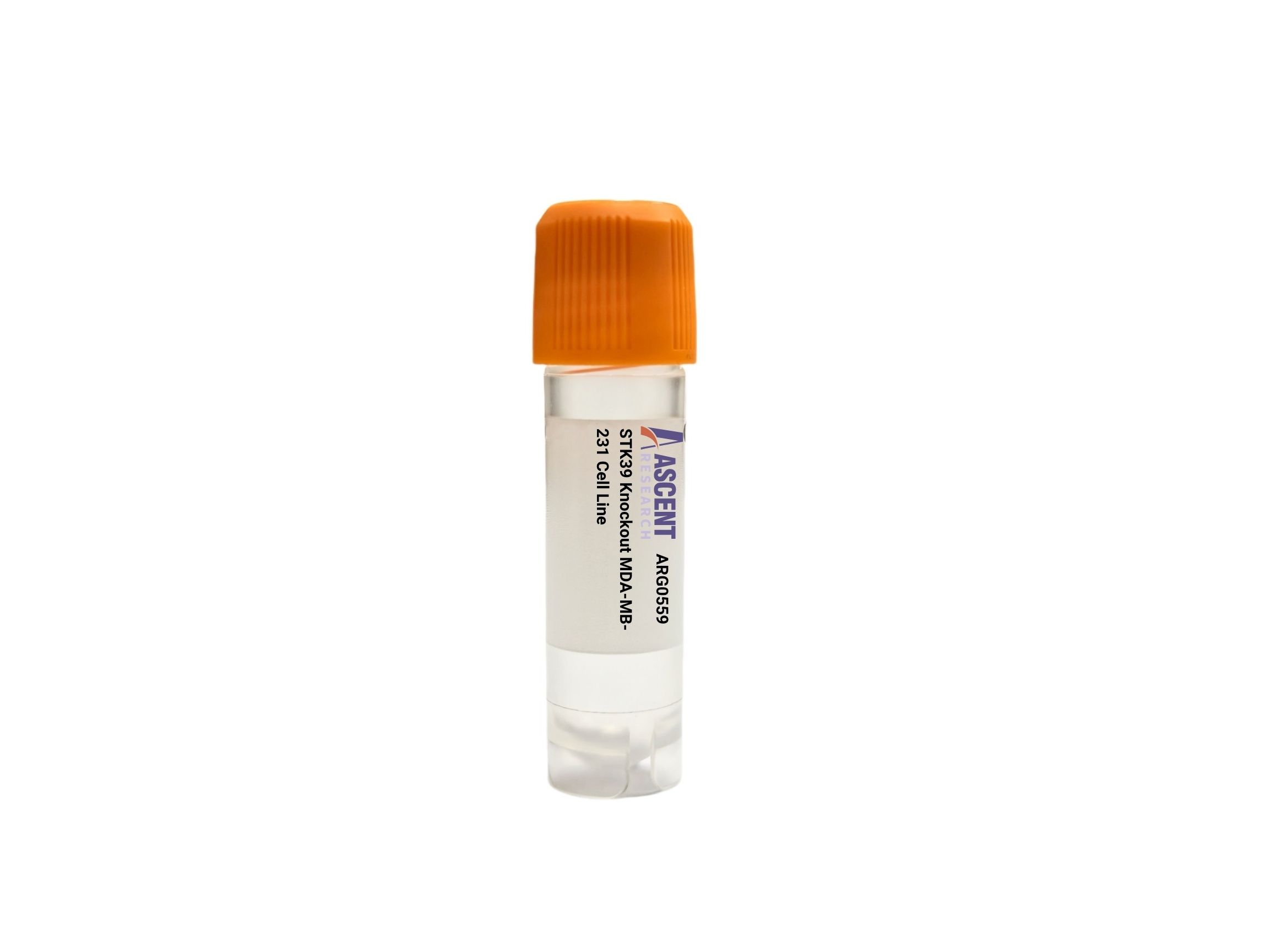
STK39 Knockout MDA-MB-231 Cell Line

  • Product Type:

    Genome-edited Cells

  • Tissue Source:

    Breast (mammary gland)

  • Disease:

    Adenocarcinoma

  • Gene Species:

    Homo sapiens (Human)

The STK39 Knockout MDA-MB-231 Cell Line is a CRISPR/Cas9-edited knockout cell line targeting STK39 (SPAK) in the triple-negative breast cancer cell line MDA-MB-231. STK39 encodes a serine/threonine kinase activated by WNK1/WNK4 that phosphorylates NKCC1 and NCC to regulate ion transport and cell volume. This model provides a genetically defined system to investigate SPAK-dependent signaling in cancer cell migration, invasion, and osmoregulation. It is suitable for mechanistic studies of the WNK/SPAK/OSR1 pathway, target validation for hypertension and related disorders, and functional assays such as Western blotting, immunofluorescence, ion flux measurements, and Transwell migration/invasion assays. The knockout cell line is an essential tool for researchers exploring ion homeostasis in aggressive cancers.

Inquire Now

In stock

Ships next business day


Ask a Question

Shipping Info:

Cryopreserved in vials and shipped on dry ice


Disclaimer:

For Research Use Only

  • Characteristics

    Host Cell

    MDA-MB-231

    Morphology

    Epithelial-like

    Age

    51 years

    Sex of Donor

    Female

    Gene Name

    STK39

    Gene Species

    Homo sapiens (Human)

    Gene Identifier

    NCBI Gene ID 27347

  • Culture Conditions

    Temperature

    37°C

    Atmosphere

    5% CO₂

  • Quality Control

    Sterility testing

    Daily monitoring confirms that the cells are free from bacterial, yeast, and fungal contamination.

    Mycoplasma testing

    Negative for mycoplasma through PCR analysis

    Pathogens

    Cells tested negative for HIV-1, HBV, and HCV.

  • Disclaimer

    Intended Use

    This product is intended for laboratory in vitro use only. lt is not intended for diagnostic, therapeutic, or clinical applications.

    Disclaimer

    Ascent Research endeavors to provide accurate and up-to-date product information. However, no warranties or representations are made regarding its completeness or reliability. References to scientific literature and patents are for informational purposes only, and the customer assumes sole responsibility for verifying their accuracy.

    By accepting this product, the customer acknowledges and agrees to assume all risks associated with its receipt, handling, storage, disposal, and use, including compliance with all applicable safety and environmental regulations and precautions. Relevant laws, regulations, and ethical guidelines must be followed in conducting any research, modifications, or derivatives derived from this product.

    This product is provided "AS IS", and except as expressly stated herein, Ascent Research disclaims all other warranties, express or implied. Under no circumstances shall Ascent Research, its affiliates, or representatives be liable for indirect, incidental, consequential, or punitive damages arising from the use of this material. While Ascent Research employs rigorous quality control measures, we shall not be held responsible for damages resulting from misidentification or misinterpretation of the provided materials.

Description

The STK39 Knockout MDA-MB-231 Cell Line is a CRISPR/Cas9-edited knockout cell line designed for loss-of-function studies of the STK39 gene, which encodes the STE20/SPS1-related proline-alanine-rich protein kinase (SPAK). Generated through targeted disruption of STK39 in the MDA-MB-231 breast adenocarcinoma background, this cell-based model provides a genetically defined system to investigate SPAK-dependent signaling and its role in ion transport, cell volume regulation, and cancer cell behavior. It is supplied as a ready-to-use knockout cell line, enabling researchers to bypass the laborious gene-editing steps and directly perform functional assays, comparative analyses, or rescue experiments.

The host cell line MDA-MB-231 is a widely used model of triple-negative breast cancer (TNBC), originally derived from the pleural effusion of a 51-year-old female with metastatic mammary adenocarcinoma. These cells lack estrogen receptor (ER), progesterone receptor (PR), and human epidermal growth factor receptor 2 (HER2) expression, recapitulating the aggressive and therapy-resistant nature of TNBC. MDA-MB-231 is characterized by high invasiveness and metastatic potential in vitro and in vivo, making it an ideal platform to study mechanisms governing cell migration, invasion, and metastasis. The epithelial-like morphology and robust growth properties also facilitate a broad range of cellular and molecular assays.

STK39 (SPAK) is a serine/threonine kinase that functions as a critical node in the WNK/SPAK/OSR1 signaling cascade. It is activated downstream of WNK1 and WNK4 kinases, which respond to osmotic stress, oxidative stress, and changes in intracellular chloride concentration. Upon activation, SPAK phosphorylates and stimulates the cation-chloride cotransporters NKCC1 and NCC, promoting ion influx and cell volume regulation. SPAK also phosphorylates the related kinase OSR1, and it interacts with the regulatory proteins MO25 and STRAD. Thus, STK39 integrates upstream osmotic and ionic signals to control downstream ion transport and cellular homeostasis, with implications for blood pressure regulation and neurological function.

In the context of TNBC, STK39-mediated ion homeostasis and volume regulation are particularly relevant, as cancer cells experience dynamic osmotic and mechanical challenges during migration and invasion. Disruption of STK39 in MDA-MB-231 cells is expected to impair NKCC1/NCC activity and alter intracellular ion gradients, potentially reducing cell volume changes and migratory capacity. This knockout line serves as a powerful tool to dissect the contribution of SPAK to the aggressive phenotype of TNBC and to evaluate its potential as a therapeutic target. Furthermore, it can be employed to study STK39-related disorders such as Gordon syndrome and hypertension, linking cancer biology with ion transport physiology.

Researchers can utilize this cell line in a variety of experimental workflows, including Western blotting for STK39 and phospho-NKCC1, immunofluorescence to assess protein localization, ion flux measurements to quantify transporter activity, and Transwell assays to evaluate migration and invasion. Cell volume monitoring techniques and transcriptomic profiling via RNA-seq further enable comprehensive characterization of STK39-dependent phenotypes. Applications span from basic mechanistic studies of the WNK/SPAK/OSR1 pathway to target validation and drug screening. For detailed technical specifications, validation data, or ordering inquiries, please contact Ascent Research.


Reset Password

    Reach Us Questions? Click Me Here!

    Fill out the form below and a member of our team will contact you shortly!

    *Required field


      Reach Us

      Fill out the form below and a member of our team will contact you shortly!

      *Required field

      Product Inquiry (Optional)