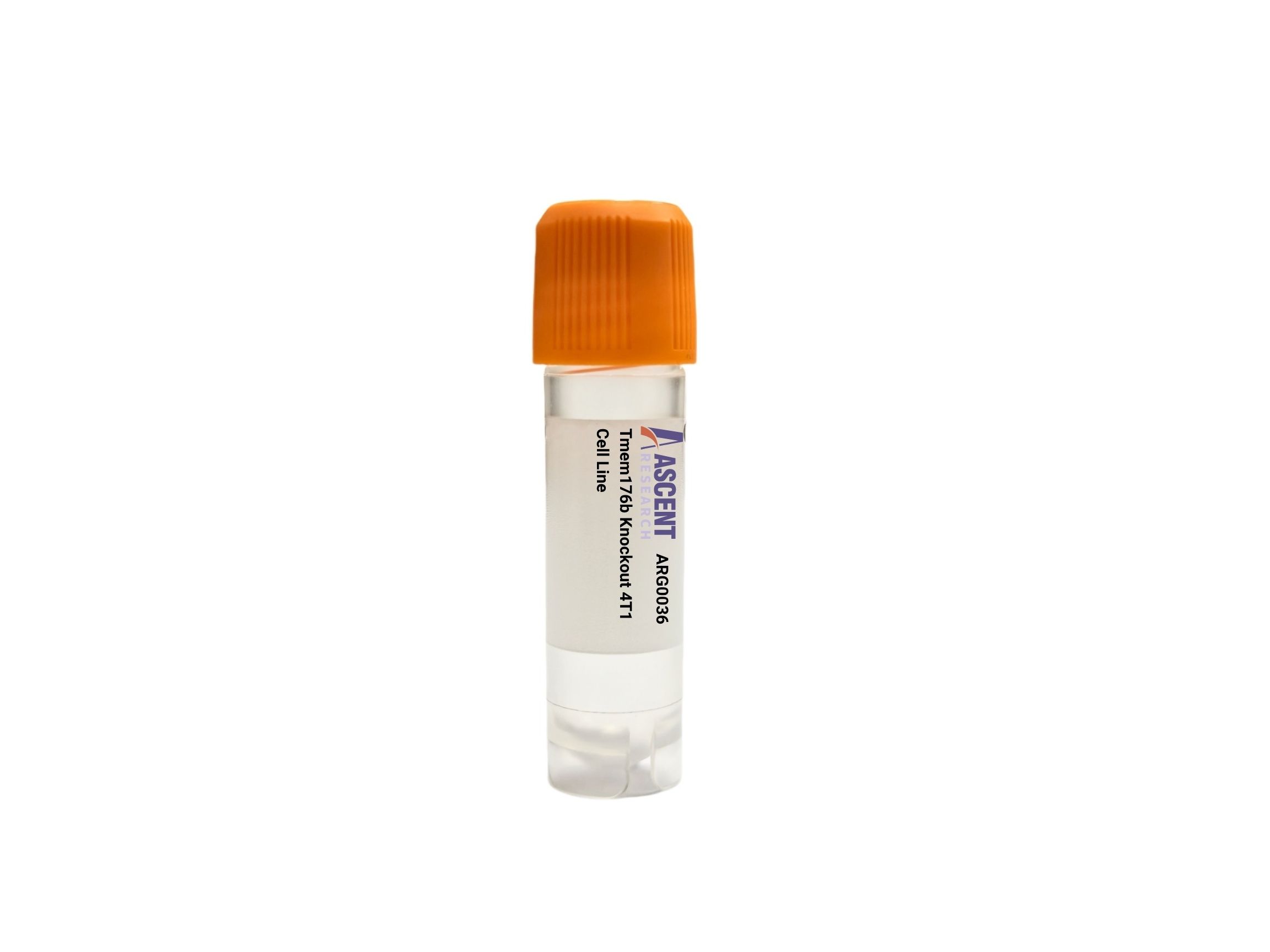
The Tmem176b Knockout 4T1 Cell Line is a CRISPR/Cas9-engineered mouse mammary carcinoma model in which the Tmem176b gene has been disrupted to eliminate functional gene expression. This stable edited cell line provides an in vitro system for investigating TMEM176B-dependent mechanisms in tumor cells with aggressive biological behavior. Derived in the 4T1 background, the model is particularly relevant for studies of breast cancer, innate immune signaling, vesicular homeostasis, and tumor?Cimmune crosstalk in a syngeneic murine setting.
4T1 is a well-established BALB/c-derived mammary tumor cell line widely used as a model of triple-negative breast cancer with high tumorigenic and metastatic potential. The line is valued for its ability to recapitulate key features of aggressive breast cancer, including rapid primary tumor growth, dissemination, and complex interactions with the immune microenvironment. Because 4T1 cells are frequently used in metastasis, immune-oncology, and host-tumor interaction studies, they provide a biologically relevant context in which to assess how loss of a vesicular membrane regulator alters tumor-intrinsic and immune-modulatory phenotypes.
TMEM176B is an intracellular transmembrane protein associated with endolysosomal and Golgi-related membranes, where it contributes to vesicular ion balance and endolysosomal function. It is regulated by pro-inflammatory stimuli, interferon signaling, TLR agonists, tumor microenvironment stress, and differentiation state, and it has been linked to pathways controlling NLRP3 inflammasome output and antigen presentation. Mechanistically, TMEM176B interacts functionally with TMEM176A, endolysosomal membrane components, and vesicular trafficking regulators, and acts in a pathway connected to NLRP3, PYCARD/ASC, CASP1, IL1B, IL18, ATP6V1 proton pump components, and MHC class I antigen presentation machinery. Through these relationships, TMEM176B can influence caspase-1 activation state, IL1B and IL18 maturation and secretion, inflammasome-dependent cytokine output, and antigen presentation efficiency.
In the 4T1 setting, Tmem176b loss offers a useful model for dissecting how endolysosomal ion regulation intersects with inflammatory signaling and tumor progression. Because 4T1 cells are commonly used to study metastasis and tumor-immune interactions, disruption of Tmem176b can support investigation of how altered vesicular trafficking, inflammasome regulation, and antigen processing contribute to changes in immune cell activation status, tumor-associated inflammatory responses, and metastatic behavior.
This knockout cell line is suitable for pathway-focused studies using western blotting, RT-qPCR, and RNA-seq to profile gene-expression and signaling changes associated with inflammasome and antigen-presentation pathways. Functional characterization may include ELISA-based measurement of IL-1?? and IL-18 secretion, caspase-1 activation assays, flow cytometry analysis of antigen-presentation markers, immunofluorescence or confocal colocalization with endosome-lysosome markers, and co-immunoprecipitation studies of inflammasome-associated machinery. In cancer biology workflows, the model can be applied to migration and invasion assays, apoptosis analyses, immune cell co-culture experiments, and in vivo tumor growth or metastasis studies in syngeneic mice to evaluate TMEM176B-dependent contributions to tumor immunology and therapeutic target assessment. Researchers may contact Ascent Research for additional technical information, product details, or related gene-edited cell models.