Quick Order Cart

Cat. No. ARG0828

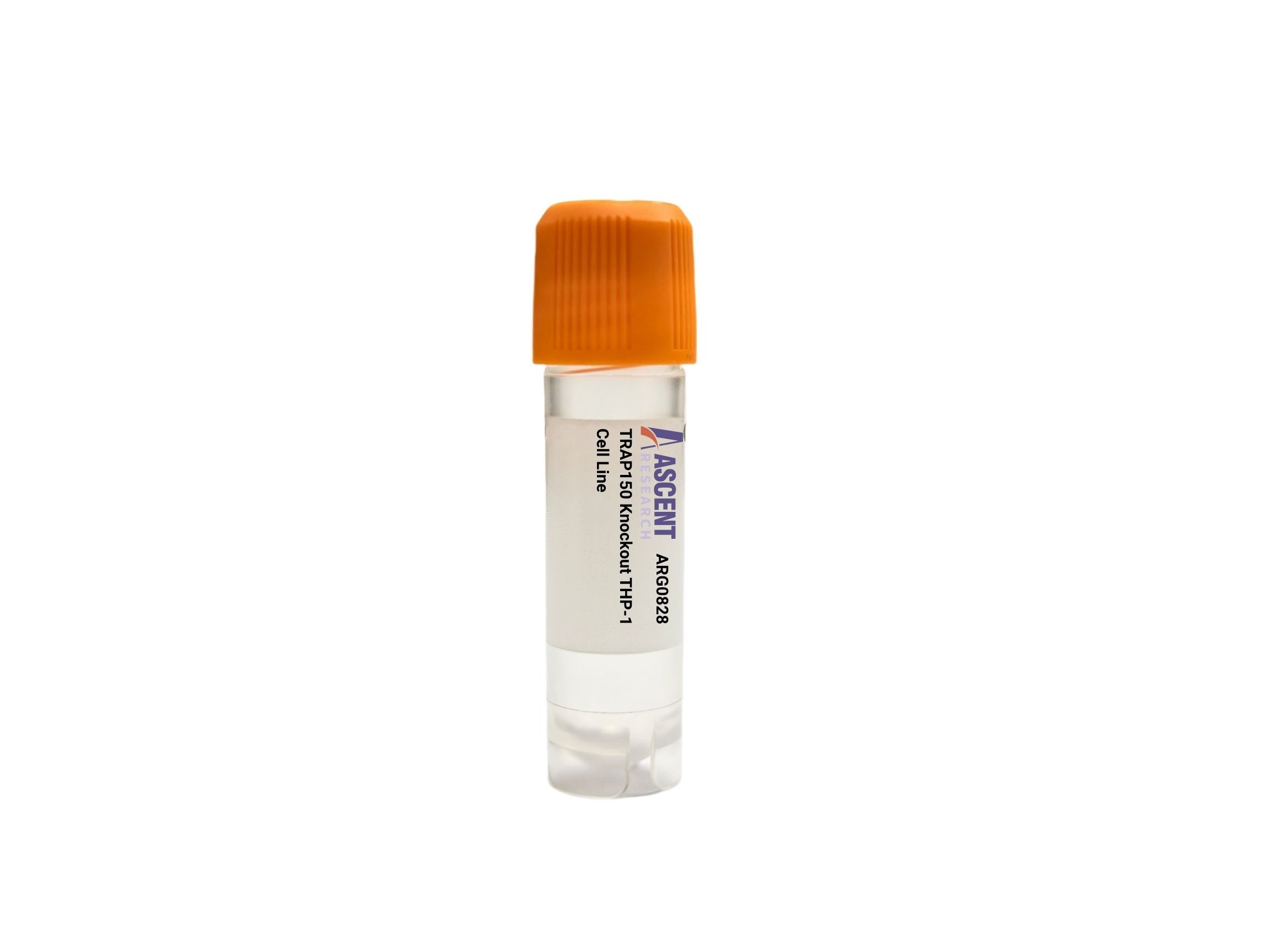
TRAP150 Knockout THP-1 Cell Line

  • Product Type:

    Genome-edited Cells

  • Tissue Source:

    Blood (peripheral blood)

  • Disease:

    Acute monoblastic leukemia

  • Gene Species:

    Homo sapiens (Human)

The TRAP150 Knockout THP-1 Cell Line is a CRISPR/Cas9-edited knockout cell line derived from the human monocytic leukemia THP-1 cell line. It provides a loss-of-function model for TRAP150 (THRAP3), a transcriptional coactivator and mRNA splicing regulator that bridges nuclear receptors such as THRB to the mediator complex and splicing factors. This knockout model is ideal for studying thyroid hormone signaling, nuclear receptor-mediated transcription, and alternative splicing in a monocyte/macrophage context. Researchers can employ this cell line in assays including RNA-seq splicing analysis, co-immunoprecipitation, dual-luciferase reporter tests, and immune function studies like phagocytosis and cytokine ELISA. It is applicable to research on thyroid disorders, acute monocytic leukemia, cancer endocrinology, and splicing regulation.

Inquire Now

In stock

Ships next business day


Ask a Question

Shipping Info:

Cryopreserved in vials and shipped on dry ice


Disclaimer:

For Research Use Only

  • Characteristics

    Host Cell

    THP-1

    Age

    1 year

    Sex of Donor

    Male

    Gene Name

    TRAP150

    Gene Species

    Homo sapiens (Human)

    Gene Identifier

    NCBI Gene ID 9967

  • Culture Conditions

    Temperature

    37°C

    Atmosphere

    5% CO₂

  • Quality Control

    Sterility testing

    Daily monitoring confirms that the cells are free from bacterial, yeast, and fungal contamination.

    Mycoplasma testing

    Negative for mycoplasma through PCR analysis

    Pathogens

    Cells tested negative for HIV-1, HBV, and HCV.

  • Disclaimer

    Intended Use

    This product is intended for laboratory in vitro use only. lt is not intended for diagnostic, therapeutic, or clinical applications.

    Disclaimer

    Ascent Research endeavors to provide accurate and up-to-date product information. However, no warranties or representations are made regarding its completeness or reliability. References to scientific literature and patents are for informational purposes only, and the customer assumes sole responsibility for verifying their accuracy.

    By accepting this product, the customer acknowledges and agrees to assume all risks associated with its receipt, handling, storage, disposal, and use, including compliance with all applicable safety and environmental regulations and precautions. Relevant laws, regulations, and ethical guidelines must be followed in conducting any research, modifications, or derivatives derived from this product.

    This product is provided "AS IS", and except as expressly stated herein, Ascent Research disclaims all other warranties, express or implied. Under no circumstances shall Ascent Research, its affiliates, or representatives be liable for indirect, incidental, consequential, or punitive damages arising from the use of this material. While Ascent Research employs rigorous quality control measures, we shall not be held responsible for damages resulting from misidentification or misinterpretation of the provided materials.

Description

The TRAP150 Knockout THP-1 Cell Line is a CRISPR/Cas9-edited knockout cell line derived from the THP-1 human monocytic leukemia cell line. This loss-of-function model targets TRAP150 (THRAP3), a transcriptional coactivator and splicing regulator. Generated through CRISPR/Cas9-mediated gene disruption, it provides a stable knockout context for investigating nuclear receptor signaling and mRNA processing, allowing researchers to dissect how TRAP150 integrates transcriptional and post-transcriptional regulation free of residual protein interference.

The THP-1 cell line, derived from peripheral blood of an acute monocytic leukemia patient, serves as a well-established model for monocyte and macrophage biology, engaging in immune activation, cytokine secretion, and phagocytosis. Retaining features of primary monocytes, THP-1 cells are widely used to study inflammation, innate immunity, and leukemia pathogenesis. This leukemic background offers a physiologically relevant system for examining how oncogenic signaling converges with monocyte function and endocrine pathways mediated by nuclear hormone receptors.

TRAP150 functions as a thyroid hormone receptor-associated coactivator, bridging nuclear receptors such as THRB and retinoic acid receptors to the transcriptional machinery via mediator complex subunits MED1 and MED17. It also modulates alternative splicing through interactions with splicing factors like SF3B1 and U2AF2. Upstream signals from thyroid hormones (T3/T4) via THRA/THRB and retinoic acid regulate TRAP150 activity, positioning it at a nexus where transcriptional activation by nuclear receptors integrates with splice site selection to coordinate gene expression programs.

In the THP-1 monocyte/macrophage context, TRAP150 disruption likely impairs hormone-dependent transcription and alters splicing patterns, affecting cytokine production and phagocytosis. This model is particularly relevant for studying thyroid disorders and acute monocytic leukemia, where nuclear receptor signaling and splicing are dysregulated. By eliminating TRAP150, researchers can investigate how this coactivator influences the inflammatory phenotype and endocrine responsiveness of leukemic monocytes, providing a platform to explore the intersection of oncogenic transformation and endocrine signaling in immune cells.

Applications include western blotting and RT-qPCR for confirmation and target analysis, RNA-seq for splicing profiling, co-immunoprecipitation to detect altered interactions, dual-luciferase reporter assays for nuclear receptor activity, and functional assays like phagocytosis and cytokine ELISA. This makes the cell line applicable to nuclear receptor signaling, monocyte/macrophage biology, cancer endocrinology, and splicing regulation studies. For further details, please contact Ascent Research.


Reset Password

    Reach Us Questions? Click Me Here!

    Fill out the form below and a member of our team will contact you shortly!

    *Required field


      Reach Us

      Fill out the form below and a member of our team will contact you shortly!

      *Required field

      Product Inquiry (Optional)