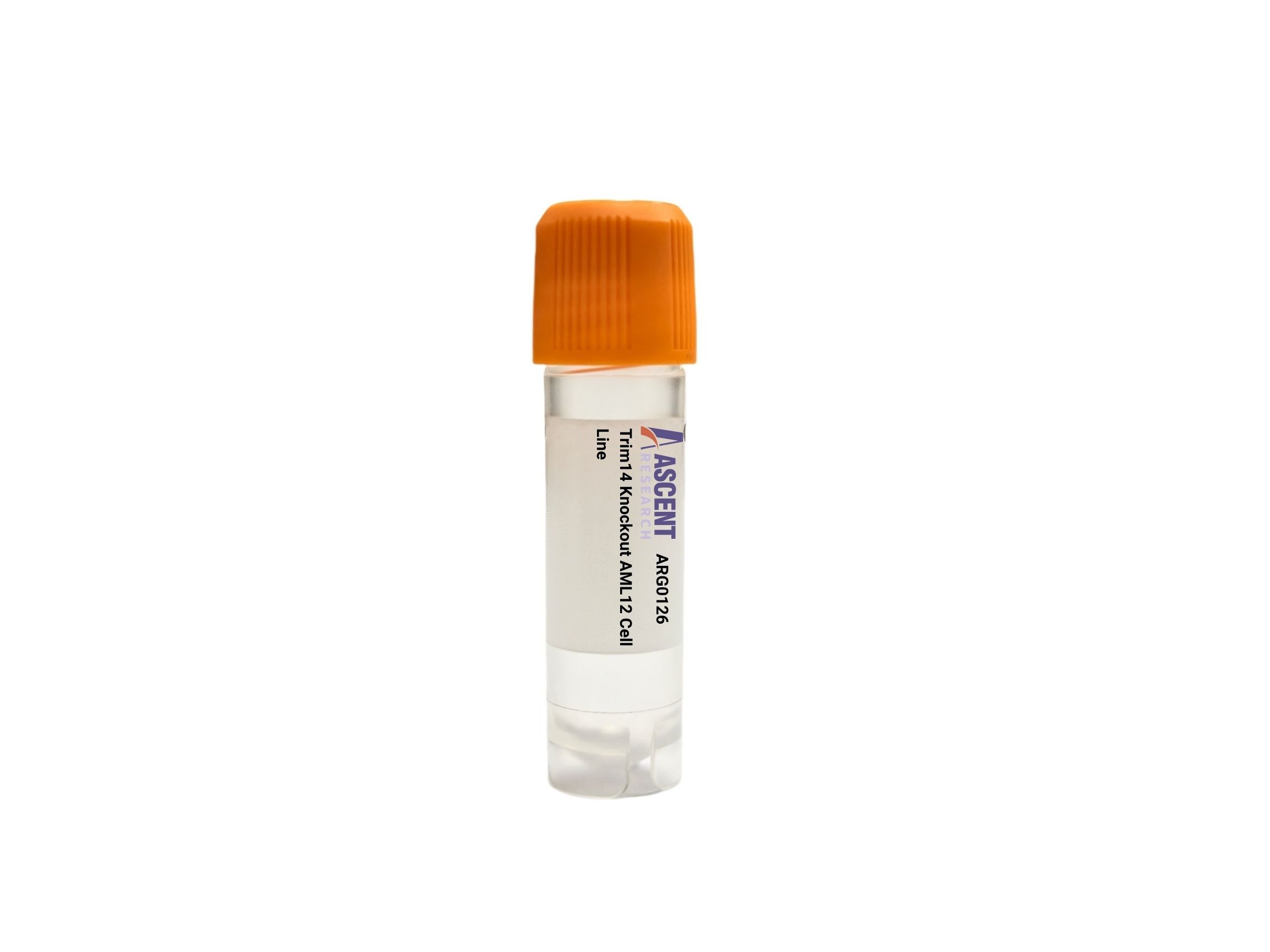
The Trim14 Knockout AML12 Cell Line is a CRISPR/Cas9-engineered mouse hepatocyte model in which the Trim14 gene has been disrupted to abolish functional TRIM14 expression. This stable knockout line is generated in AML12 cells, a nontransformed hepatocyte cell line, and provides an in vitro system for investigating TRIM14-dependent signaling in hepatic parenchymal cells. Because TRIM14 is linked to cytosolic nucleic acid sensing, type I interferon responses, NF-kB activation, and selective autophagy-associated host defense, this model is well suited for mechanistic studies of innate immunity in liver-derived cells.
AML12 is an immortalized mouse hepatocyte line derived from normal liver and is widely used as a differentiated hepatic model. The line is experimentally valuable for studies of liver metabolism, glucose and lipid regulation, inflammatory signaling, and antiviral responses while retaining key features relevant to hepatocyte biology. As a hepatic parenchymal cell model, AML12 supports investigation of liver stress responses and immune-metabolic coupling in contexts relevant to viral hepatitis, liver inflammation, innate immune dysregulation, and hepatocellular carcinoma research. Its nontransformed background is advantageous for studying pathway regulation without many of the confounding alterations present in transformed tumor cell lines.
TRIM14 is a noncanonical tripartite motif family protein that functions as a mitochondria- and innate immunity-associated scaffold. It is regulated by viral infection, cytosolic viral RNA, cytosolic DNA, type I interferons, and pattern-recognition receptor activation, with transcriptional control linked to IRF3, IRF7, and NF-kB. Mechanistically, TRIM14 interacts with cGAS, STING, MAVS, TBK1, IRF3, STAT3, p62/SQSTM1, and NEMO/IKBKG, thereby mediating signaling downstream of RIG-I/DDX58, MDA5/IFIH1, MAVS, and cGAS/MB21D1-STING/TMEM173 pathways. Through these complexes, TRIM14 acts upstream of TBK1-IRF3, NF-kB, and JAK-STAT signaling to promote expression of IFNB1 and interferon-stimulated genes such as ISG15, IFIT1, MX1, OAS1, CXCL10, and CCL5, while also contributing to selective autophagy-related antimicrobial responses.
Loss of Trim14 in AML12 cells provides a useful platform for defining how hepatocyte-intrinsic innate immune signaling is organized and how antiviral transcriptional programs are coupled to liver cell physiology. In this host-cell context, researchers can examine the consequences of TRIM14 deficiency on interferon competence, inflammatory cytokine production, pathogen sensing, mitochondrial-associated signaling, and autophagy-linked defense mechanisms. The model is particularly relevant for dissecting hepatocyte responses to viral or bacterial stimuli and for evaluating pathway dependence in liver inflammation and host-pathogen interaction studies.
This knockout cell line can be applied in western blot, phospho-signaling, and co-immunoprecipitation experiments to assess altered TBK1, IRF3, NF-kB, STAT1, or STAT2 pathway regulation after nucleic acid stimulation or infection. RT-qPCR, RNA-seq, and ELISA can be used to quantify changes in IFNB1, ISG15, IFIT1, CXCL10, CCL5, and related cytokine or antiviral gene programs. Reporter assays for IFN-beta, ISRE, or NF-kB activity support pathway-level functional interrogation, while immunofluorescence and mitochondrial localization studies can be used to analyze TRIM14-linked signaling organization. Additional applications include viral infection assays, flow cytometry-based phenotyping, and autophagy flux assays for studying selective antimicrobial responses in hepatocytes. Researchers may contact Ascent Research for additional technical information, product details, or related gene-edited cell models.