Quick Order Cart

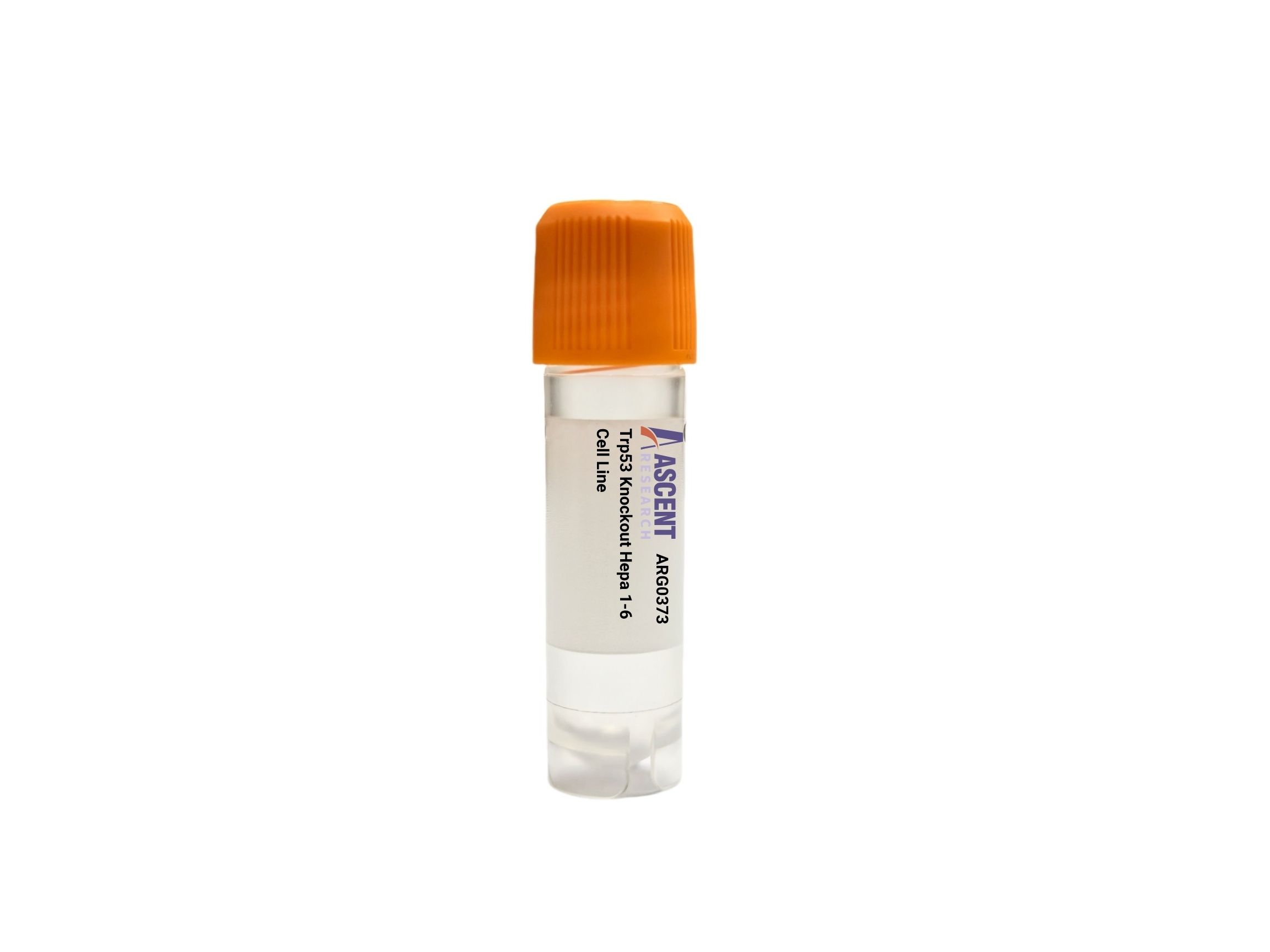
Cat. No. ARG0373

Trp53 Knockout Hepa 1-6 Cell Line

  • Product Type:

    Genome-edited Cells

  • Tissue Source:

    Liver

  • Disease:

    Hepatocellular carcinoma

  • Gene Species:

    Mus musculus (Mouse)

The Trp53 Knockout Hepa 1-6 Cell Line is a CRISPR/Cas9-edited knockout cell line derived from mouse Hepa 1-6 hepatoma cells, lacking functional p53. This model abolishes p53-mediated tumor suppression, including cell cycle arrest and apoptosis, in a liver cancer context. Hepa 1-6 cells, from C57L/J mouse hepatocellular carcinoma, retain hepatic metabolic features ideal for liver cancer research. Trp53 encodes p53, which transcriptionally regulates CDKN1A (p21) and BAX downstream of ATM/ATR, interacting with MDM2. This knockout disrupts the network, enabling unchecked proliferation. Applications include liver cancer modeling, drug screening, apoptosis studies, and tumor suppressor research, facilitating investigation of p53 pathways in hepatocellular carcinoma.

Inquire Now

In stock

Ships next business day


Ask a Question

Shipping Info:

Cryopreserved in vials and shipped on dry ice


Disclaimer:

For Research Use Only

  • Characteristics

    Host Cell

    Hepa 1-6

    Morphology

    Epithelial-like

    Gene Name

    Trp53

    Gene Species

    Mus musculus (Mouse)

    Gene Identifier

    NCBI Gene ID 22059

  • Culture Conditions

    Temperature

    37°C

    Atmosphere

    5% CO₂

  • Quality Control

    Sterility testing

    Daily monitoring confirms that the cells are free from bacterial, yeast, and fungal contamination.

    Mycoplasma testing

    Negative for mycoplasma through PCR analysis

    Pathogens

    Cells tested negative for HIV-1, HBV, and HCV.

  • Disclaimer

    Intended Use

    This product is intended for laboratory in vitro use only. lt is not intended for diagnostic, therapeutic, or clinical applications.

    Disclaimer

    Ascent Research endeavors to provide accurate and up-to-date product information. However, no warranties or representations are made regarding its completeness or reliability. References to scientific literature and patents are for informational purposes only, and the customer assumes sole responsibility for verifying their accuracy.

    By accepting this product, the customer acknowledges and agrees to assume all risks associated with its receipt, handling, storage, disposal, and use, including compliance with all applicable safety and environmental regulations and precautions. Relevant laws, regulations, and ethical guidelines must be followed in conducting any research, modifications, or derivatives derived from this product.

    This product is provided "AS IS", and except as expressly stated herein, Ascent Research disclaims all other warranties, express or implied. Under no circumstances shall Ascent Research, its affiliates, or representatives be liable for indirect, incidental, consequential, or punitive damages arising from the use of this material. While Ascent Research employs rigorous quality control measures, we shall not be held responsible for damages resulting from misidentification or misinterpretation of the provided materials.

Description

The Trp53 Knockout Hepa 1-6 Cell Line is a CRISPR/Cas9-edited knockout cell line derived from the mouse Hepa 1-6 hepatoma cell line, designed to disrupt the endogenous Trp53 gene. This loss-of-function model abolishes p53 tumor suppressor activity, providing a defined genetic background for studying p53-dependent processes. The knockout was generated via CRISPR/Cas9-mediated gene disruption, yielding a stable cell line lacking functional p53. Researchers can investigate p53-mediated signaling in liver-derived cells without pharmacological inhibitors or RNAi.

The parental Hepa 1-6 line originates from a spontaneous hepatocellular carcinoma in C57L/J mice, retaining liver parenchymal features with metabolic and detoxification functions. Widely used in HCC research, these cells grow rapidly, are tumorigenic, and susceptible to immune clearance in syngeneic models, enabling in vitro and in vivo studies in immunocompetent hosts for liver cancer biology and preclinical evaluation.

Trp53 encodes p53, a transcription factor that functions as a central tumor suppressor. Under normal conditions, p53 is maintained at low levels through MDM2-mediated ubiquitination and proteasomal degradation. In response to DNA damage or oncogenic stress, upstream kinases such as ATM and ATR phosphorylate p53, disrupting its interaction with MDM2 and stabilizing the protein. Activated p53 then transcriptionally regulates downstream target genes, including CDKN1A (p21) for cell cycle arrest, and BAX, PUMA, and NOXA for apoptosis. Additionally, p53 interacts with cofactors such as p300/CBP and HSP90, modulating its activity and stability. Knockout of Trp53 eliminates these regulatory nodes, resulting in unchecked proliferation and compromised DNA repair, as exemplified by pathway components ATM, CHK2, p53, p21, and BAX.

In hepatocellular carcinoma, p53 is frequently mutated; its loss drives tumor progression, genomic instability, and therapy resistance. The Trp53 Knockout Hepa 1-6 Cell Line enables dissection of p53-dependent tumor suppression in liver cancer cells. Comparison with parental Hepa 1-6 (wild-type Trp53) allows assessment of p53 loss on cell cycle regulation, apoptosis, and sensitivity to genotoxic agents. This isogenic pair is valuable for identifying p53-dependent metabolic changes and evaluating therapies targeting p53-deficient hepatocellular carcinoma.

This knockout cell line supports liver cancer modeling, drug screening, apoptosis studies, and tumor suppressor research. Assays include western blotting and RT-qPCR for p53 target expression, flow cytometric cell cycle analysis, annexin V apoptosis assays, and syngeneic tumorigenicity studies. The defined deletion enables functional genomics and drug response profiling in liver cancer. For technical inquiries, ordering, or custom editing, contact Ascent Research.


Reset Password

    Reach Us Questions? Click Me Here!

    Fill out the form below and a member of our team will contact you shortly!

    *Required field


      Reach Us

      Fill out the form below and a member of our team will contact you shortly!

      *Required field

      Product Inquiry (Optional)