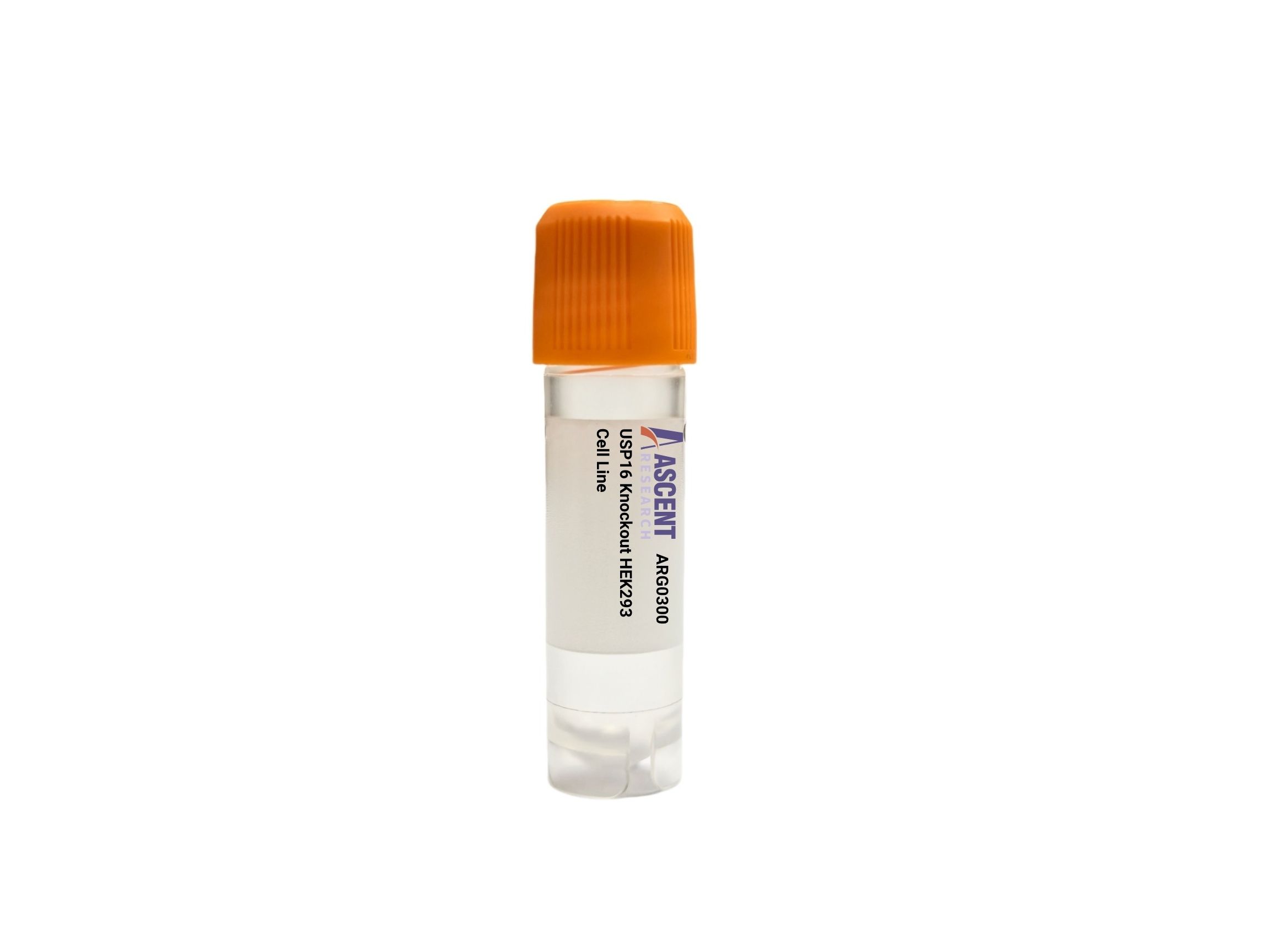
The USP16 Knockout HEK293 Cell Line is a CRISPR/Cas9-edited knockout cell line in which the USP16 gene has been disrupted by CRISPR/Cas9-mediated gene editing, resulting in loss of functional USP16 deubiquitinase activity. This engineered cell line provides a robust in vitro model for investigating the roles of USP16-mediated histone H2A deubiquitination in chromatin regulation, gene expression, and signal transduction. By eliminating USP16 expression, researchers can dissect its specific contributions to Polycomb-mediated gene silencing, Wnt/??-catenin signaling, and NF-??B pathway modulation within a well-characterized cellular background.
HEK293 cells, originally derived from human embryonic kidney cells transformed with sheared adenovirus 5 DNA, are among the most widely used cell lines in biomedical research. Their ease of culture, high transfection efficiency, and utility for protein expression and viral production make them an ideal host for gene knockout studies. The USP16 knockout in this background enables straightforward interrogation of USP16-dependent processes without the confounding variables associated with other cell types, while benefiting from the extensive body of literature and standardized protocols available for HEK293 cells.
USP16 encodes a deubiquitinase that specifically removes ubiquitin from histone H2A at lysine 119 (H2AK119ub), a modification deposited by the Polycomb repressive complex 1 (PRC1). Deubiquitination of H2A by USP16 relieves PRC1-mediated gene silencing, facilitating transcriptional activation of target loci, including HOX genes and Wnt-responsive genes such as MYC and CCND1. Beyond histones, USP16 acts on key signaling proteins: it stabilizes ??-catenin through deubiquitination, thereby potentiating Wnt/??-catenin signaling downstream of the Frizzled/DVL axis, and it deubiquitinates RIP1 to modulate NF-??B activation. USP16 expression is regulated transcriptionally by MYC and is influenced by chromosome 21 copy number due to its genomic location, linking it to pathologies like Down syndrome. Thus, USP16 integrates signals from multiple pathways to coordinate gene expression and cellular responses.
In the HEK293 context, USP16 knockout provides a clean loss-of-function system to study the immediate effects of H2AK119ub accumulation and altered Wnt/NF-??B dynamics. This model is particularly suited for examining how USP16-dependent regulation of chromatin structure impacts the expression of Polycomb target genes and Wnt-activated programs, as HEK293 cells exhibit robust responses to Wnt ligands and have well-documented chromatin landscapes. The knockout cell line also facilitates investigation of the crosstalk between PRC1-mediated repression and ??-catenin-dependent transcription, as USP16 removal simultaneously stabilizes ??-catenin and reinforces H2A ubiquitination, offering a unique tool to disentangle these intertwined mechanisms.
This USP16 knockout cell line supports a broad range of research applications. It is valuable for studying chromatin biology and epigenetic regulation through techniques such as Western blotting for H2AK119ub, ChIP-qPCR to map histone modifications at specific promoters, and RNA-seq to assess global transcriptomic changes. It serves as a platform for dissecting Wnt/??-catenin signaling using TOPFlash/FOPFlash reporter assays and co-immunoprecipitation to analyze ??-catenin/TCF complexes. Cancer researchers can employ this model to screen for USP16 inhibitors or evaluate the therapeutic potential of targeting USP16 in colorectal carcinoma and leukemia, using proliferation, colony formation, and apoptosis assays. Additionally, the knockout line enables exploration of USP16??s role in stem cell maintenance and neurodegeneration. For further information or to discuss custom applications, contact Ascent Research.