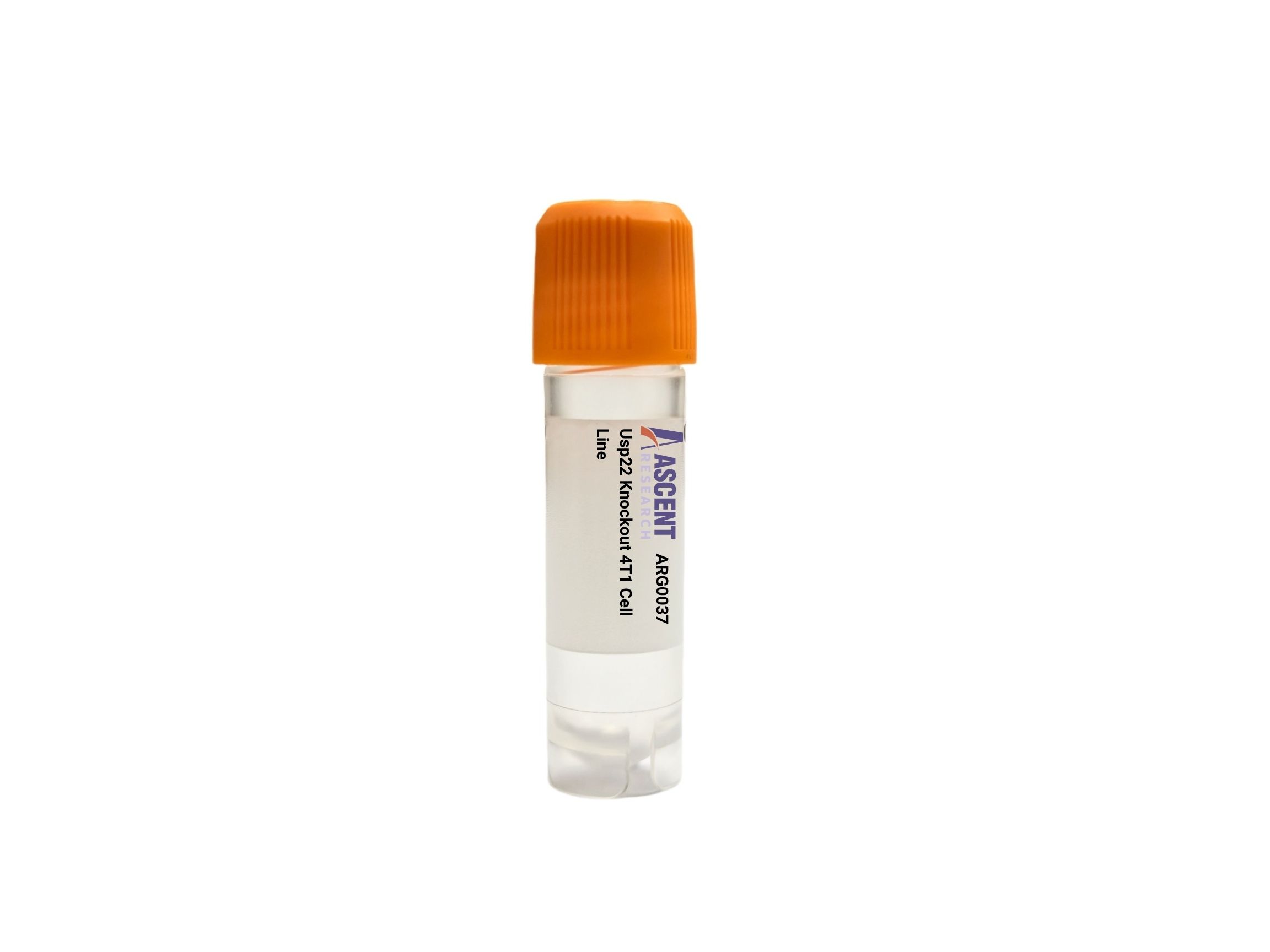
The Usp22 Knockout 4T1 Cell Line is a CRISPR/Cas9-engineered mouse mammary carcinoma model in which the endogenous Usp22 gene has been disrupted to eliminate functional USP22 expression. This stable in vitro knockout system is generated in 4T1 cells, an epithelial-like tumor cell line commonly used to study aggressive breast cancer biology. The model is intended for mechanistic analysis of USP22-dependent chromatin regulation, transcriptional control, and cancer-associated phenotypes in a syngeneic murine tumor background.
4T1 is a BALB/c-derived mammary carcinoma cell line that is highly tumorigenic and metastatic, and it is widely used as an experimental model of late-stage triple-negative breast cancer. The line recapitulates key features relevant to solid tumor progression, including rapid growth, invasive behavior, and metastatic dissemination. Because 4T1 cells are well established in studies of tumor progression and metastasis, they provide a relevant host context for evaluating how epigenetic and transcriptional regulators influence proliferation, migration, invasion, and therapy response in aggressive mammary tumor cells.
USP22 is a zinc-dependent deubiquitinase that functions within the deubiquitinase module of the SAGA transcriptional coactivator complex. In association with ATXN7L3 and ENY2, and within the broader SAGA assembly containing GCN5/KAT2A, PCAF/KAT2B, TRRAP, SUPT3H, and TAF5L, USP22 removes monoubiquitin from histone H2B, thereby regulating H2BK120ub1/H2Bub1 status and chromatin-dependent transcription. USP22 is regulated by MYC-associated transcriptional programs, cellular stress, DNA damage signals, and transcriptional coactivator recruitment within SAGA, and it acts upstream of MYC-responsive genes and cell-cycle regulators such as CCND1 and CDKN1A. Through these functions, USP22 influences transcriptional elongation, chromatin remodeling, DNA damage responses, and metastatic gene expression programs, including SNAI1 and epithelial-mesenchymal transition-associated transcriptional networks. Functional interactions with MYC and SIRT1 further link USP22 to oncogenic signaling and tumor cell state regulation.
In the 4T1 background, disruption of Usp22 provides a useful system for defining how loss of a SAGA-associated deubiquitinase reshapes transcriptional output in a metastatic triple-negative breast cancer model. This context is especially relevant for studying dependencies between chromatin regulation and aggressive tumor phenotypes, including alterations in proliferation, cell-cycle progression, invasive capacity, and stress responses. The model also supports investigation of how altered H2B deubiquitination affects gene-expression programs associated with metastasis and therapy resistance.
This cell line is suitable for western blotting-based assessment of USP22 loss and H2Bub1 changes, RT-qPCR or RNA-seq analysis of MYC-responsive and epithelial-mesenchymal transition-associated transcripts, and ChIP-qPCR or ChIP-seq studies examining chromatin occupancy and histone ubiquitination states. Researchers can apply co-immunoprecipitation to evaluate SAGA complex interactions, immunofluorescence and flow cytometry to measure cell-state and cell-cycle effects, and proliferation, colony formation, apoptosis, migration, invasion, and tumorsphere assays to quantify phenotypic consequences of Usp22 disruption. The model is also applicable to DNA damage response studies and drug sensitivity experiments aimed at epigenetic target validation or defining pathway-dependent vulnerabilities in breast cancer cells. Researchers may contact Ascent Research for additional technical information, product details, or related gene-edited cell models.