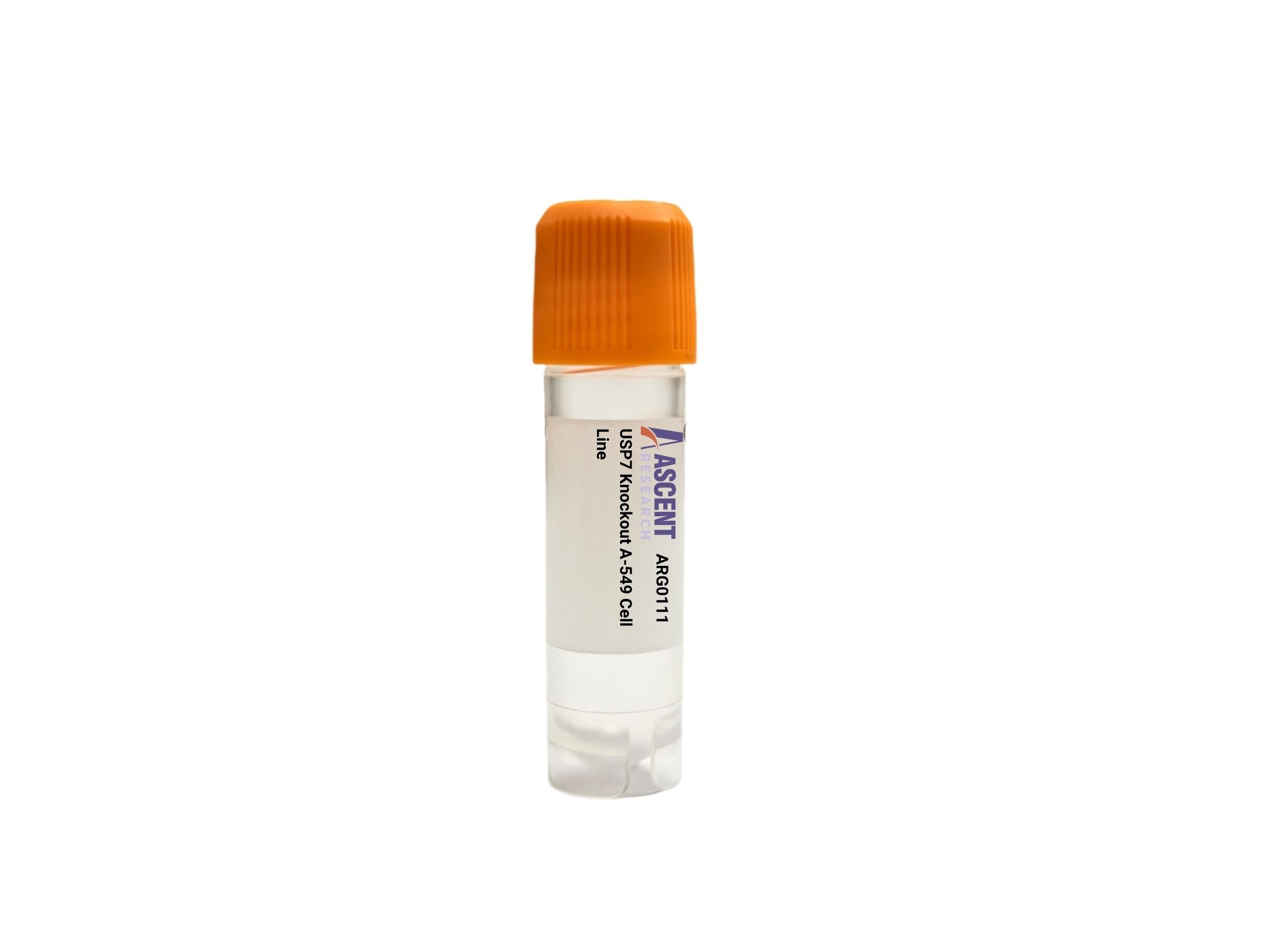
The USP7 Knockout A-549 Cell Line is a human CRISPR/Cas9-engineered cell model in which the USP7 gene has been disrupted to eliminate functional USP7 expression. This stable knockout line is generated in A-549 cells, a human alveolar epithelial carcinoma cell line, and provides an in vitro system for investigating the consequences of USP7 loss in a lung adenocarcinoma-derived epithelial background. The model is intended for mechanistic studies of deubiquitination, stress-responsive signaling, and pathway dependency in cancer-relevant cellular contexts.
A-549 is widely used as an in vitro model of non-small cell lung cancer and alveolar type II-like epithelial biology. As a human lung adenocarcinoma epithelial cell line, it is experimentally valuable for studies of epithelial signaling, cellular stress responses, DNA damage effects, and therapeutic response profiling. Its broad use in cancer biology and drug discovery makes it a practical host background for functional genomics, especially where epithelial tumor-cell phenotypes, cell-cycle control, apoptosis, and signaling adaptation are under investigation.
USP7 encodes a ubiquitin-specific protease that removes ubiquitin from selected protein substrates, thereby regulating substrate stability, localization, and signaling output. It is a central component of the ubiquitin-proteasome system and is closely linked to the TP53-MDM2 axis, where USP7 interacts with both TP53 and MDM2 to influence p53 signaling. USP7 is regulated by DNA damage and genotoxic stress and functions in signaling contexts involving ATM, ATR, CHK1, and CHK2. Beyond p53 pathway control, USP7 interacts with UHRF1, DNMT1, PTEN, FOXO4, DAXX, GMPS, and EZH2, connecting deubiquitination to chromatin regulation, epigenetic maintenance, PTEN-AKT signaling, NF-kB signaling, and innate immune regulation. Downstream consequences of USP7 perturbation can include altered abundance or activity of TP53, CDKN1A/p21, BAX, PUMA/BBC3, PTEN, FOXO proteins, DNMT1, EZH2, and histone H2B ubiquitination status.
In the A-549 background, USP7 knockout is a useful model for examining how loss of deubiquitinase activity reshapes epithelial tumor-cell signaling networks under basal conditions and in response to oxidative stress, DNA damage, or pharmacologic perturbation. Because A-549 cells are broadly used to study lung cancer cell signaling and drug response, disruption of USP7 enables direct analysis of how deubiquitinase-dependent substrate turnover contributes to cell-cycle progression, apoptotic priming, chromatin-associated regulation, and pathway compensation in a non-small cell lung cancer-relevant setting.
This cell line is suitable for western blotting and phospho-signaling analysis of TP53, MDM2, PTEN, AKT, CHK1, CHK2, and CDKN1A; RT-qPCR or RNA-seq profiling of stress-response and apoptotic transcriptional programs; and ubiquitination assays or co-immunoprecipitation studies to evaluate USP7-dependent substrate interactions. Researchers may also use the model in immunofluorescence and DNA damage marker analysis, flow cytometry-based cell-cycle analysis, apoptosis assays, clonogenic survival assays, and drug sensitivity studies to investigate treatment response, synthetic lethality, and pathway-specific vulnerabilities in NSCLC or broader solid tumor research. Researchers may contact Ascent Research for additional technical information, product details, or related gene-edited cell models.