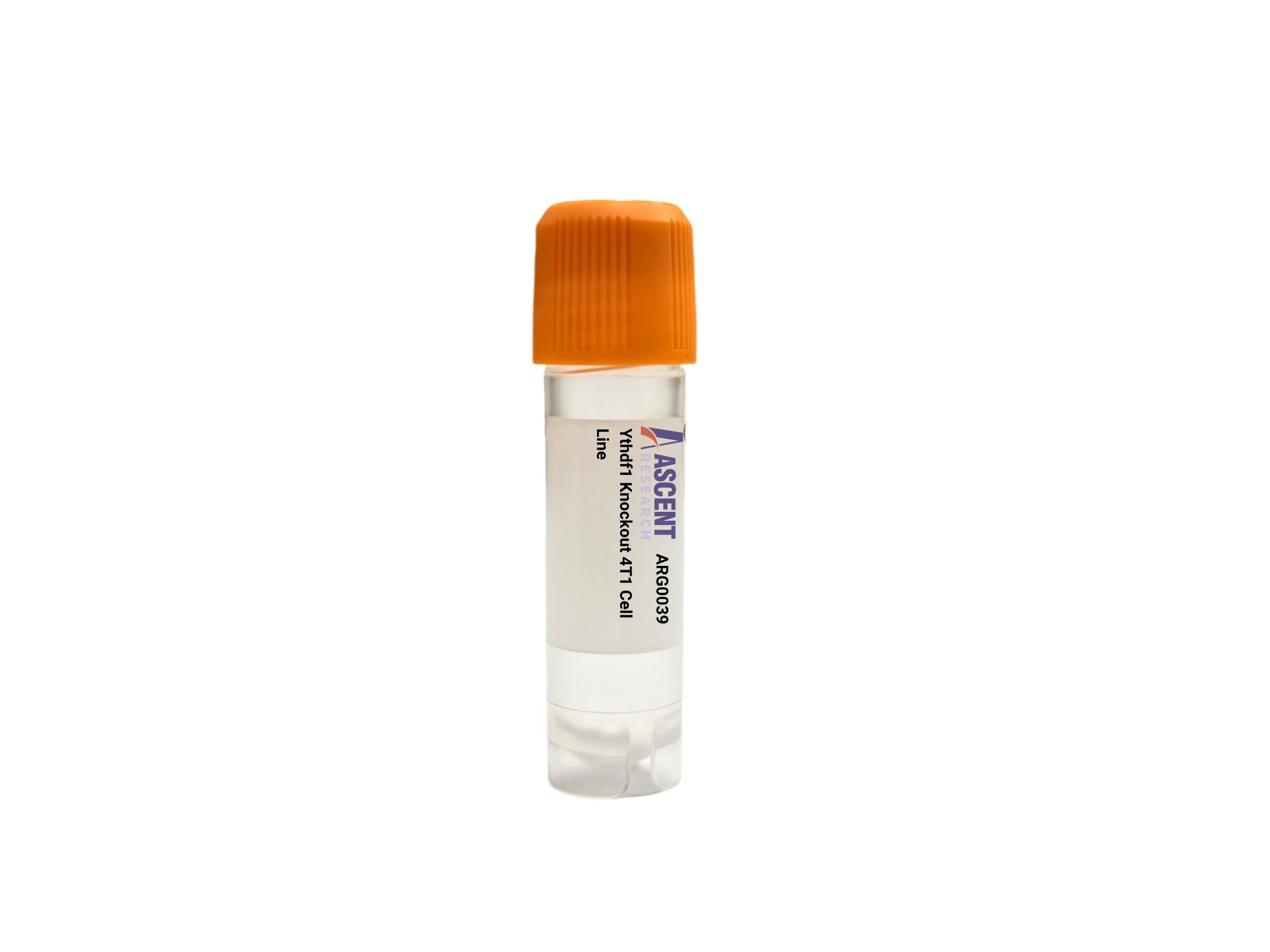
The Ythdf1 Knockout 4T1 Cell Line is a CRISPR/Cas9-engineered mouse mammary carcinoma model in which the Ythdf1 gene has been disrupted to abolish functional YTHDF1 expression. This stable knockout line is generated in the 4T1 background, providing an in vitro system for studying loss of an m6A reader protein in a highly aggressive breast cancer setting. As YTHDF1 is a cytoplasmic effector of methylated mRNA translation, this model is suited for experiments examining how epitranscriptomic regulation influences tumor cell behavior, stress adaptation, and immune-relevant gene expression programs.
4T1 is a murine triple-negative breast cancer cell line derived from a BALB/c mammary tumor and is widely used as a syngeneic model of metastatic breast cancer. The line is well established for investigation of tumor epithelial cell proliferation, invasion, migration, and dissemination to distant organs, making it highly relevant to studies of solid tumor progression and metastasis. Because 4T1 cells retain compatibility with immunocompetent mouse systems, they are also frequently used to interrogate tumor-immune interactions, inflammatory mediators, and therapeutic response in the context of breast cancer biology.
YTHDF1 functions in the m6A RNA methylation pathway as a reader of N6-methyladenosine-modified transcripts. It acts downstream of the METTL3-METTL14-WTAP methyltransferase complex and associated regulatory components including VIRMA, RBM15, and ZC3H13, while the methylation state of target RNAs is counter-regulated by the demethylases FTO and ALKBH5. At the mechanistic level, YTHDF1 binds m6A-marked mRNA in the cytoplasm and promotes translation efficiency through interaction with the EIF3 complex, translation initiation machinery, and ribosome-associated processes. It functions in parallel with other YTH domain proteins such as YTHDF2, YTHDF3, YTHDC1, and YTHDC2 within broader mRNA metabolism networks. Loss of Ythdf1 is therefore expected to reduce efficient translation of selected m6A-containing transcripts, including EIF3-recruited mRNAs and protein outputs linked to proliferation, survival, cytokine production, and immune regulation.
In the 4T1 host-cell context, Ythdf1 disruption provides a targeted approach to dissect how translational control contributes to aggressive tumor phenotypes. This model is useful for examining whether altered interpretation of m6A marks changes tumor cell fitness, stress response programs, migratory or invasive behavior, and molecular features relevant to breast cancer progression and metastatic competence. It also supports analysis of how post-transcriptional regulation shapes immune-associated signaling in a tumor epithelial background.
Researchers can apply this cell line in western blotting and RT-qPCR workflows to confirm loss of YTHDF1-dependent protein output relative to transcript abundance, and in RNA-seq, m6A-RIP-qPCR, ribosome profiling, or polysome profiling studies to map translational consequences of Ythdf1 deficiency. The model is also compatible with co-immunoprecipitation and immunofluorescence experiments to examine interactions with EIF3 and related translation machinery, as well as functional assays including proliferation, colony formation, apoptosis, migration, invasion, flow cytometry, drug sensitivity testing, and in vivo tumor growth or metastasis studies. These applications make the line relevant for m6A epitranscriptomics, functional genomics, target validation, and mechanistic studies in triple-negative breast cancer and cancer immunology. Researchers may contact Ascent Research for additional technical information, product details, or related gene-edited cell models.