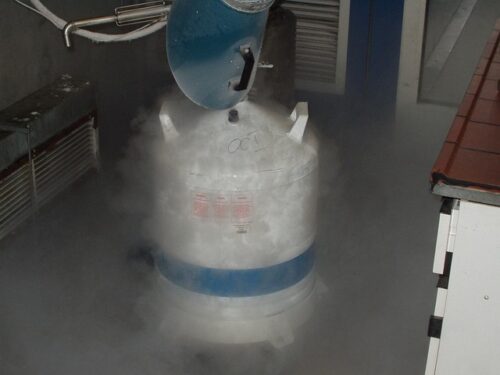
Cryopreservation is one of the foundations of modern cell culture. It allows researchers to preserve low-passage cells, establish master and working cell banks, maintain engineered clones, transport cell stocks, and return to a defined biological starting point instead of continuously passaging cultures. The practical procedure is familiar: cells + freezing medium → controlled cooling → approximately -80°C → liquid nitrogen storage.
That familiar sequence can make it seem as though cells somehow “need” -80°C first and -196°C later. In reality, these temperature ranges solve different physical problems. Controlled cooling determines how safely cells become frozen; approximately -80°C provides a practical deeply frozen state for temporary holding or transport; and cryogenic temperatures provide the stability required for long-term preservation.
Cell cryopreservation is best understood as two related problems: first, how to freeze a living cell without excessive injury; and second, how to keep the resulting frozen system stable for months or years.
What Happens When Cells Freeze?
A mammalian cell contains a large amount of water, so freezing is much more complicated than simply lowering the temperature. As a cell suspension cools below its freezing point, extracellular ice begins to form. Water molecules enter the growing ice lattice while salts, proteins, sugars, DMSO, and other dissolved materials are excluded, making the remaining unfrozen solution progressively more concentrated.
This increase in extracellular solute concentration draws water out of the cells by osmosis. That dehydration is an important part of successful cryopreservation because intracellular water can become dangerous if it remains inside the cell as the temperature falls: it may form intracellular ice, which can damage membranes and intracellular structures. However, excessive dehydration is also harmful, because cells can be exposed for too long to highly concentrated solutes and severe osmotic stress.
Cryopreservation therefore requires a balance. If cells cool too quickly, they may retain too much intracellular water and develop intracellular ice. If they cool too slowly, they may undergo excessive dehydration and prolonged solution-effect injury. For many conventional mammalian-cell preparations, an approximately 1°C/min cooling rate is a common starting point, although the optimal rate depends on the cell type and cryopreservation formulation.
Why Do We Add DMSO?
Cryoprotective agents such as DMSO help cells tolerate this transition. DMSO penetrates cell membranes and changes the physical behavior of water during freezing, reducing damaging ice formation and helping cells withstand controlled dehydration. Many routine mammalian-cell protocols use approximately 5–10% DMSO, but this is not a universal formula; primary cells, stem cells, immune cells, established cell lines, and organoid systems can have different requirements.
Successful cryopreservation is therefore not determined by temperature alone. It depends on the interaction between cryoprotectant formulation, cooling rate, and the temperature history of the sample.
The Most Important Freezing Events Happen Before -80°C
One of the most useful insights in understanding cryopreservation is that cells do not need to be slowly cooled all the way to -80°C for the critical dehydration process to occur. Experimental work with several DMSO-protected mammalian-cell systems, including CHO, HepG2, and MG63 cells, found optimal transfer temperatures around approximately -40 to -42°C. These results indicate that much of the controlled cellular dehydration required to limit intracellular ice formation can be substantially completed before the sample reaches -80°C.
This does not mean that every cell is “finished freezing” at exactly -40°C, nor that -40°C is an appropriate storage temperature. Rather, it shows that the biologically difficult part of the process (ice formation, extracellular solute concentration, and water movement out of the cell) occurs earlier in the cooling journey. That naturally raises the next question: if the critical freezing events have already occurred, why do laboratories continue to approximately -80°C?
Why Do We Use Approximately -80°C?
There is no biological switch at exactly -80°C. A cryopreserved cell does not suddenly become safe at -80°C while remaining unsafe at -70°C. In conventional cryopreservation workflows, temperatures roughly within the -70 to -90°C range can serve as a deeply frozen intermediate state.
By this stage, the major dehydration and ice-formation events have already occurred, the cryovial is far below its melting region, and normal cellular metabolism has effectively stopped. Cooling farther than the critical freezing region also provides a larger thermal margin for handling and transfer. For this reason, approximately -80°C is best understood as a practical endpoint of the freezing procedure and a temporary frozen-holding temperature, rather than a unique biological requirement.
Why not simply stop at -40°C?
The temperature at which controlled cellular dehydration is largely complete is not necessarily the most convenient temperature for handling the sample. Around -40°C, the sample is frozen but is still much closer to temperature ranges where warming or fluctuations can produce substantial physical changes. Cooling farther to the -70 to -90°C range makes the vial deeply frozen, slows physical processes further, and creates a much larger margin during temporary handling.
Dry ice helps explain the role of -80°C
Dry ice sublimates at approximately -78.5°C, almost exactly the same temperature regime as a -80°C freezer, and it is widely used to transport frozen cells. The cells being shipped have already passed through the controlled-freezing process; dry ice is not being used to establish the original freezing rate. Its job is simply to keep an already-frozen cell stock deeply frozen during a limited period of transportation.
This makes the functional distinction clearer: controlled cooling creates the frozen state, approximately -80°C or dry ice maintains that state temporarily, and cryogenic storage preserves it for the long term.
If Cells Are Frozen at -80°C, Why Do We Still Need Liquid Nitrogen?
Because frozen does not mean completely stable. A cryovial at -80°C is a complex frozen system containing ice crystals, cells, cryoprotectant, salts, proteins, and a highly concentrated residual non-ice phase. Molecular mobility is dramatically reduced, but it has not disappeared completely, so slow physical changes can continue within the frozen matrix.
Ice crystals, for example, can gradually reorganize through processes such as ice recrystallization, and the freeze-concentrated non-ice fraction can still undergo slow molecular rearrangement. These processes are slow enough that -80°C can be useful for overnight freezing, temporary holding, or several days of transportation, but the timescale becomes important when storage changes from days to months or years.
At substantially lower cryogenic temperatures, molecular mobility, diffusion, and structural rearrangement become extremely limited. For mammalian cell banking, temperatures below approximately -130°C are therefore commonly used as a practical long-term cryogenic regime. The exact transition is formulation dependent, so -130°C should not be viewed as another universal “magic temperature”; the important goal is to maintain the frozen system in a sufficiently immobile state for the required storage period.
Why Liquid Nitrogen?
Liquid nitrogen provides a practical way to maintain these cryogenic temperatures because its boiling point at atmospheric pressure is approximately -196°C. It allows laboratories to keep cell banks far below the temperature range required for long-term preservation without relying on conventional mechanical refrigeration to continuously operate at such extreme temperatures.
When we say that cells are “stored in liquid nitrogen,” however, the cryovials are not necessarily submerged in the liquid itself. LN₂ storage systems are commonly used in either liquid phase or vapor phase, and the distinction is important for cell-bank design.
Liquid Phase vs Vapor Phase Liquid Nitrogen Storage
Liquid-phase storage
In liquid-phase storage, cryovials are immersed directly in liquid nitrogen and remain close to -196°C. This provides an extremely cold and relatively uniform environment while the samples remain submerged. The tradeoff is direct LN₂ contact: liquid nitrogen can enter an inadequately sealed or incompatible vial, expand rapidly during warming, and provide a potential route for cross-contamination through the shared liquid environment.
Vial compatibility therefore matters. A vial described as suitable for “cryogenic storage” is not automatically validated for direct liquid-nitrogen immersion, so the manufacturer's storage specification should always be checked.
Vapor-phase storage
In vapor-phase storage, samples are positioned above the liquid nitrogen reservoir and are cooled by very cold nitrogen vapor. This avoids direct immersion, greatly reduces the possibility of LN₂ entering the vial, and reduces direct liquid-mediated contamination concerns while still maintaining cryogenic conditions suitable for long-term storage.
The main consideration is the temperature gradient within the tank. Samples near the bottom may be considerably colder than samples near the top, so tank design, liquid-nitrogen level, rack position, and temperature monitoring all matter. The important criterion is not whether the vial is physically touching liquid nitrogen, but whether it is continuously maintained below the validated temperature required for long-term cryogenic storage.
| Feature |
Liquid Phase |
Vapor Phase |
| Sample position |
Directly submerged |
Above LN₂ |
| Temperature |
Near -196°C |
Cryogenic; position dependent |
| Direct LN₂ contact |
Yes |
No |
| LN₂ entering vial |
Possible |
Greatly reduced |
| Direct-contact contamination concern |
Higher |
Reduced |
| Temperature gradient |
Relatively small while submerged |
Greater vertical gradient |
| Long-term cell storage |
Yes, with compatible vessels |
Yes, when temperature is validated |
For many routine mammalian cell banks, vapor-phase storage provides a useful combination of long-term cryogenic temperature and reduced direct-contact risk.
How Do We Control the Freezing Rate?
A -80°C freezer alone does not automatically cool a cell suspension at 1°C/min. If a cryovial is placed directly on a freezer shelf, its actual cooling profile depends on sample volume, vial geometry, airflow, freezer position, neighboring materials, and other factors. A freezing device is therefore used to regulate heat transfer between the sample and the cold environment.
Passive isopropanol freezing containers
The traditional laboratory approach uses an isopropanol-filled freezing container. Cryovials are placed into the device and then transferred to a -80°C freezer; the thermal properties of the container and alcohol slow heat transfer so that the sample cools gradually rather than immediately approaching freezer temperature. The method is simple and inexpensive, although the isopropanol must be maintained and periodically replaced.
Alcohol-free passive freezing containers
Modern passive systems achieve a similar function with engineered insulation and thermally conductive materials instead of isopropanol. The underlying principle is unchanged: the -80°C freezer provides the cold environment, while the freezing device controls how quickly the cell suspension experiences that environment.
Programmable controlled-rate freezers
Programmable controlled-rate freezers actively manage the temperature history of the sample. They can define cooling rates, hold stages, transition temperatures, and endpoint conditions, providing greater reproducibility than passive systems. This level of process control is particularly useful for sensitive primary cells, stem cells, large-volume preparations, master cell banks, and cell-therapy or GMP workflows.
The Cryopreservation Journey
- Healthy cultured cells: begin with a well-characterized, viable culture.
- Add an appropriate cryoprotective formulation: commonly a DMSO-containing freezing medium for conventional mammalian cells.
- Controlled cooling: manage extracellular ice formation, osmotic concentration, and cellular dehydration.
- Deeply frozen intermediate state: commonly around -70 to -90°C in routine passive-freezing workflows.
- Temporary holding or dry-ice transport: maintain the already-frozen state for a limited period.
- Cryogenic storage: transfer valuable stocks to a validated environment below the required long-term storage temperature.
- LN₂ vapor or liquid phase: maintain the bank until the cells are required.
- Rapid thawing and recovery: return cells to appropriate culture conditions using a cell-specific procedure.
Common Cryopreservation Mistakes
- Placing cryovials directly into a -80°C freezer. The freezer setpoint does not guarantee an appropriate cooling rate; use a validated passive freezing device or controlled-rate freezer.
- Treating -80°C as a magic temperature. It is better understood as part of a practical deeply frozen range rather than an exact biological threshold.
- Keeping valuable cell stocks at -80°C for long periods. The cells remain frozen, but slow physical changes can continue; use validated cryogenic storage for long-term banking.
- Leaving cells in DMSO for too long. DMSO is protective during freezing but can be detrimental during prolonged exposure, particularly at warmer temperatures.
- Freezing unhealthy cultures. Cryopreservation does not restore stressed, contaminated, overgrown, or poor-quality cells.
- Assuming every cryovial can be immersed in LN₂. Check the manufacturer's liquid-phase compatibility specification.
- Repeatedly warming samples during inventory handling. Maintain an accurate box and rack inventory so vials can be retrieved quickly.
- Thawing too slowly. Controlled slow freezing does not imply slow thawing; many conventional mammalian-cell protocols use relatively rapid warming.
Cryopreservation Is About Controlling Change
The most useful way to understand cell cryopreservation is not to memorize -80°C and -196°C as two required temperatures. During controlled freezing, cells must safely pass through the region where ice forms, extracellular solutes concentrate, and intracellular water leaves the cell. Once that critical transition has occurred, temperatures around -70 to -90°C provide a convenient deeply frozen state, explaining both the widespread use of -80°C freezers and why dry ice at -78.5°C is useful for short-term transportation.
For long-term preservation, simply remaining frozen is not enough. The temperature must be lowered much further so that molecular mobility, diffusion, and structural rearrangement become extremely limited. Liquid nitrogen provides a practical way to maintain this cryogenic environment, either through liquid-phase storage or, for many routine cell-banking applications, through vapor-phase storage.
Controlled cooling determines how safely cells become frozen. Approximately -80°C provides a practical temporary frozen state. Cryogenic storage determines how long that state can be preserved.
References
- ATCC. Cryogenic Storage of Animal Cells.
- Whaley D, et al. Cryopreservation: An Overview of Principles and Cell-Specific Considerations. Cell Transplantation. 2021.
- Kilbride P, et al. The transfer temperature from slow cooling to cryogenic storage is critical for optimal recovery of cryopreserved mammalian cells. PLOS ONE. 2021.
- Yuan Y, et al. Efficient long-term cryopreservation of pluripotent stem cells at -80°C. Scientific Reports. 2016.
- ATCC. Animal Cell Culture Guide.
- Corning Life Sciences. Cryogenic Vials and Storage Guidance.