Home / Resources / Articles / Host Immunity May Shape CAR T-Cell Responses in Recurrent Glioblastoma
Host Immunity May Shape CAR T-Cell Responses in Recurrent Glioblastoma
POSTED ON Sep 07, 2026
CAR T-cell therapy has transformed the treatment of several hematologic malignancies, but its application in solid tumors remains challenging. Glioblastoma (GBM) is a particularly difficult setting because of tumor heterogeneity, antigen loss, limited immune-cell trafficking, and a strongly immunosuppressive tumor microenvironment.
A 2026 study published in Cell examined an important question beyond the CAR T cells themselves: how does the patient’s endogenous immune system respond to CAR T-cell therapy, and does this response influence clinical outcome?
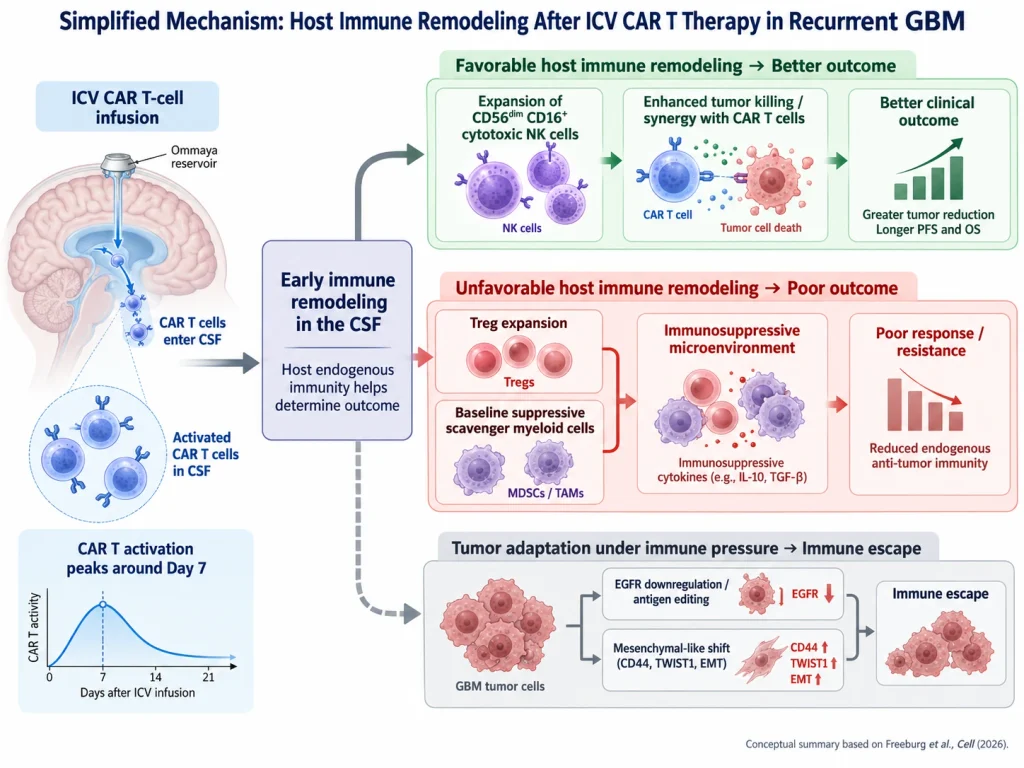
The study found that clinical outcomes were associated not only with CAR T-cell activity, but also with remodeling of endogenous NK cells, regulatory T cells, and myeloid populations.
Figure 1. Host immune remodeling following ICV CAR T-cell therapy in recurrent GBM. Conceptual illustration summarizing the major findings reported by Freeburg et al. Cytotoxic NK-cell expansion was associated with favorable outcomes, whereas Treg expansion and suppressive myeloid states were associated with poorer responses. Tumor cells may also adapt to immune pressure through antigen editing and mesenchymal-like remodeling. Illustration by Ascent Research, based on Freeburg et al., Cell (2026).
Study Design
The analysis included 18 patients from a phase 1 trial. Patients received intracerebroventricular EGFR/IL13Rα2-targeted CAR T cells and were divided into high- and low-dose cohorts.
The researchers performed longitudinal profiling of cerebrospinal fluid (CSF), CAR T-cell infusion products, and, where available, paired pre- and post-treatment tumor tissues. Single-cell RNA sequencing was used to characterize CAR T cells as well as endogenous T cells, NK cells, myeloid cells, and other immune populations.
Key Findings
CAR T Cells Were Activated in the CNS
CAR T cells in the CSF showed strong activation following infusion. CD8 CAR T cells displayed increased expression of cytotoxicity-associated genes such as GZMB, GNLY, and PRF1, together with activation and interferon-response markers.
Cytotoxic activity peaked around day 7, while exhaustion-associated features became progressively more evident by day 21, suggesting continued antigen engagement followed by gradual functional adaptation or exhaustion.
Importantly, however, characteristics of the infusion products themselves did not clearly distinguish responders from non-responders.
Cytotoxic NK-Cell Expansion Was Associated with Better Outcomes
One of the strongest observations involved endogenous NK cells.
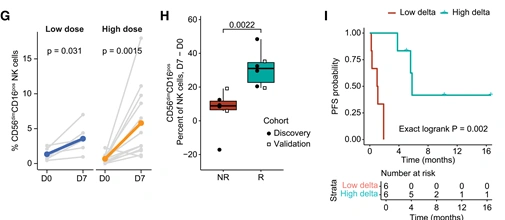
After CAR T-cell infusion, the CD56dimCD16-positive cytotoxic NK-cell population expanded in the CSF. This expansion was substantially greater in responders than in non-responders.
Patients with greater NK-cell expansion also showed longer progression-free and overall survival. The authors therefore proposed early cytotoxic NK-cell expansion as a potential biomarker of clinical benefit.
Figure 2A. Expansion of cytotoxic NK cells is associated with improved clinical outcomes following ICV CAR T-cell therapy. Panels G–I adapted from Figure 4 of Freeburg et al., Cell (2026), under CC BY 4.0.
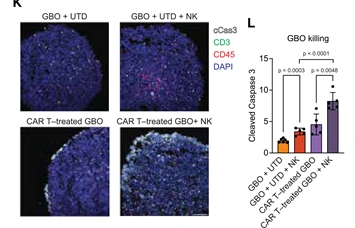
The biological relevance of this observation was further supported by patient-derived GBM organoid experiments. Combining CAR T cells with NK cells produced greater tumor-cell killing than either immune-cell population alone, suggesting potential functional synergy between CAR T cells and endogenous NK cells.
Figure 2B. NK cells enhance CAR T-cell-mediated killing in patient-derived GBM organoids. Panels K–L adapted from Figure 4 of Freeburg et al., Cell (2026), under CC BY 4.0.
Together, these findings suggest that NK-cell expansion may represent more than a biomarker of response. Endogenous NK cells may actively contribute to the anti-tumor effect initiated by CAR T-cell therapy.
Treg Expansion Was Associated with Reduced Tumor Control
CAR T-cell treatment also induced expansion of regulatory T cells (Tregs).
Greater Treg expansion correlated negatively with tumor-size reduction, and increased Treg clonality was similarly associated with poorer tumor responses. Expanded Tregs acquired a more proliferative and immunosuppressive phenotype, including increased expression of CTLA4 and other regulatory molecules.
The study also identified potential Treg-mediated suppressive interactions involving the CTLA-4/CD80-CD86 axis and galectin-9/TIM-3 signaling, suggesting mechanisms through which Tregs may inhibit endogenous anti-tumor immune responses.
Baseline Immunosuppressive Myeloid Cells Were Linked to Poor Outcomes
Another important finding concerned a population of myeloid cells characterized by a scavenger-like immunosuppressive transcriptional program, including markers such as CD163, CD204, and CD206.
Higher levels of this program in the CSF before CAR T-cell treatment were associated with non-response and shorter overall survival.
This finding raises the possibility that the pre-existing immune microenvironment could influence whether CAR T-cell therapy successfully initiates a broader anti-tumor immune response.
GBM Cells Also Adapted to Immune Pressure
The study further showed that tumor cells themselves changed following treatment.
In some paired tumor samples, EGFR expression decreased after therapy, consistent with possible antigen editing under CAR T-cell selection pressure. Persisting malignant cells also showed transcriptional changes associated with extracellular-matrix remodeling and a mesenchymal-like state, including increased CD44 and TWIST1 expression.
Importantly, the authors reproduced this mesenchymal enrichment in patient-derived GBM organoids exposed to CAR T cells, supporting the idea that tumor-state plasticity may contribute to immune escape.
Conclusions
The study suggests that the outcome of CAR T-cell therapy in recurrent GBM cannot be explained by CAR T-cell activity alone.
Instead, treatment appears to trigger a broader remodeling of the endogenous immune system. Expansion of cytotoxic NK cells was associated with favorable outcomes, while Treg expansion and pre-existing suppressive myeloid states were associated with poorer responses.
These findings support a broader therapeutic concept: future CAR T-cell strategies for solid tumors may need to combine engineered T cells with approaches that actively reshape the host immune microenvironment.
Study Limitations
The findings should be interpreted cautiously.
The study included only 18 patients, as expected for an early-phase clinical trial, and paired tumor tissue was available from only a subset of patients. In addition, post-treatment tumor resections occurred at substantially different time points, which may not represent the period of maximum CAR T-cell activity.
Many of the associations between immune-cell populations and clinical outcome therefore remain exploratory and will require validation in larger prospective cohorts.
Editor’s Perspective: Beyond the CAR T Cell Itself
This study is particularly interesting because it shifts attention from the engineered CAR T cell as an isolated therapeutic product toward the broader biological system in which that cell operates.
For solid tumors such as GBM, therapeutic efficacy may depend on several interconnected components:
The expansion of cytotoxic NK cells illustrates how an engineered immune-cell therapy may recruit additional endogenous effector mechanisms. Conversely, the expansion of Tregs and suppressive myeloid populations demonstrates how the same treatment can trigger regulatory responses that limit its effectiveness.
From a research-model perspective, this also highlights why increasingly complex experimental systems are becoming important in immuno-oncology.
Traditional tumor-cell monocultures remain useful for studying target expression and direct CAR-mediated cytotoxicity, but they cannot fully reproduce interactions among CAR T cells, NK cells, regulatory immune populations, and heterogeneous tumor cells.
The use of patient-derived GBM organoids combined with CAR T cells and NK cells in this study is therefore particularly noteworthy. Such models allow researchers to investigate not only whether an engineered immune cell can kill a tumor cell, but also how different immune populations interact and how tumor cells adapt under sustained immune pressure.
For researchers developing the next generation of cellular immunotherapies, the question may increasingly shift from:
“How can we make the CAR T cell more potent?�
to:
“How can we create an immune environment in which CAR T cells, and the patient’s own immune cells, can work together effectively?�
That broader perspective may be especially important for overcoming the barriers that continue to limit CAR T-cell therapy in solid tumors.
Reference
Freeburg NF, Chafamo D, Gopikrishna GK, et al. The critical role of the endogenous immune compartment after CAR T cell therapy in recurrent GBM. Cell. 2026;189:5340–5358. doi:10.1016/j.cell.2026.05.026.